The short version: it depends entirely on what you're comparing, and at what point in the project lifecycle you're doing the math.
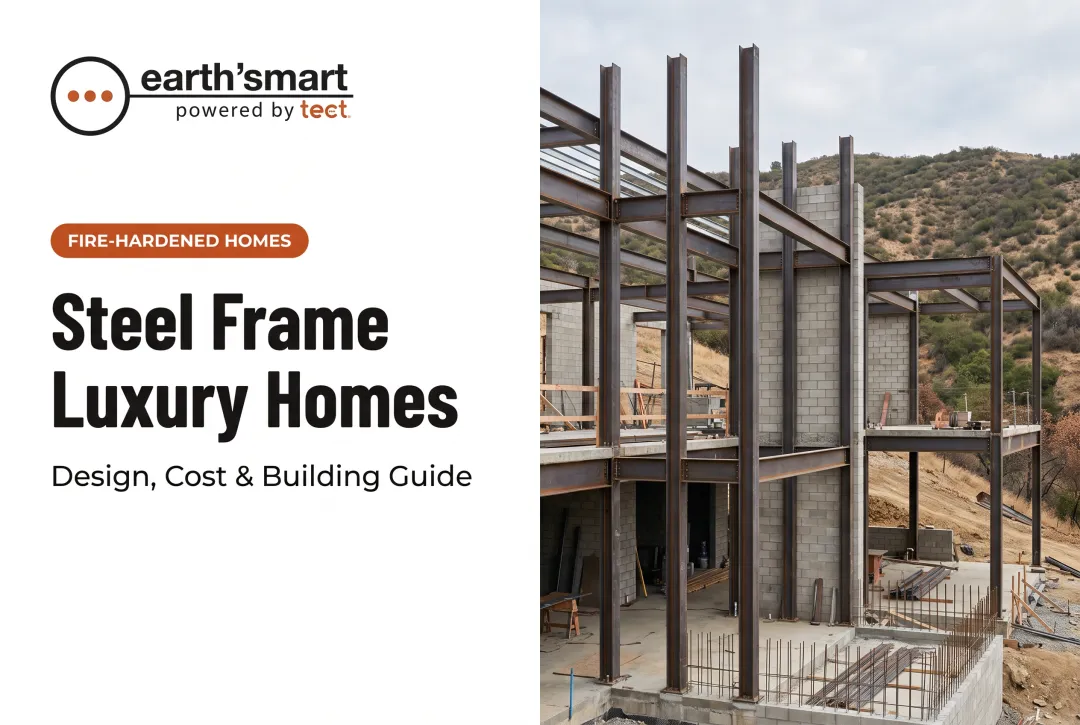
This guide breaks down what steel frame homes actually cost, what drives those costs up or down, and where the real financial case either holds up or falls apart.
Key Takeaways
- Steel frame homes typically cost $50–$120 per sq ft for a finished build (HomeAdvisor 2024/2025), matching or slightly exceeding standard wood framing
- Kit prices ($20,000–$90,000) exclude foundation, interior finishes, insulation, and erection: the expensive parts most buyers overlook
- Long-term savings — lower maintenance, termite resistance, and better insurance positioning in WUI zones — are where steel earns its cost
- Thermal bridging, misspecified systems, and WUI code requirements drive the real cost risks, not the frame price
- Budget the full stack upfront, or expect mid-project surprises that cost far more to fix
How Much Does a Steel Frame Home Cost?
The kit price is the number most people see first — and the one most likely to blow a budget.
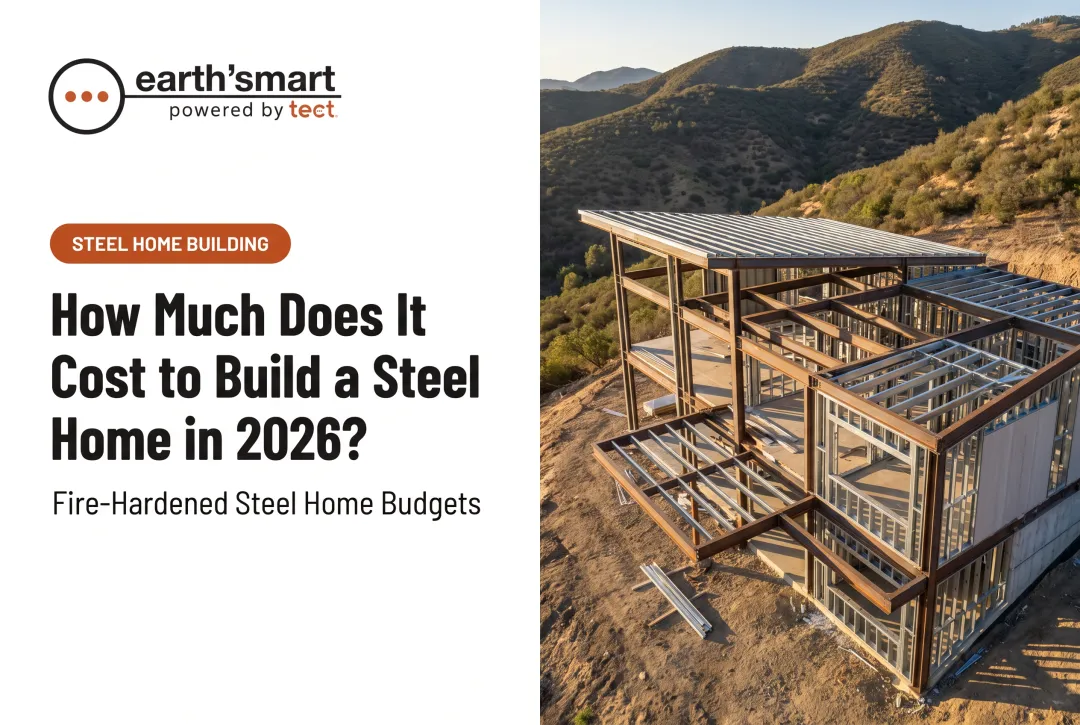
HomeAdvisor's metal home cost guide puts steel or metal home kits at $20,000–$90,000 and fully finished metal home builds at $74,000–$240,000, averaging around $157,000, or roughly $50–$120 per sq ft. For a 1,500–2,500 sq ft home, those ranges reflect a wide spread in what you actually get.
What the Three Tiers Actually Include
| Tier | Typical Cost Range | What's Usually Included | What's Usually Excluded |
|---|---|---|---|
| Steel frame shell / kit only | $20,000–$90,000 | Structural frame, roof panels, exterior wall components | Foundation, insulation, windows, interiors, plumbing, electrical, erection |
| Mid-range finished home | $74,000–$157,000 | Shell + standard interior finishes, basic systems | Premium upgrades, WUI-specific assemblies, high-end mechanical |
| High-end custom build | $157,000–$240,000+ | Full interior, premium systems, engineered site work | No reliable national benchmark — site and finish level drive this |
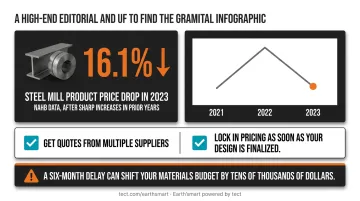
One critical caveat: steel prices move. NAHB data shows steel mill product prices fell 16.1% in 2023 after rising sharply in prior years. Get quotes from multiple suppliers, and lock in pricing as soon as your design is finalized — a six-month delay can shift your materials budget by tens of thousands of dollars.
Key Factors That Affect the Cost of a Steel Frame Home
No cost guide can substitute for actual bids. But the variables below explain why two seemingly similar projects can land at very different numbers.
Frame Type and Configuration
Most residential steel framing is cold-formed (light-gauge) steel — the system governed by AISI standards S230 and S240 for one- and two-family dwellings. This is what contractors mean when they quote "metal stud framing," and HomeAdvisor's metal stud guide puts framing materials for a 2,000 sq ft home at roughly $19,000–$25,000.
Structural I-beam steel is a different system — typically project-engineered for large spans, heavy loads, or custom configurations. It involves specialized fabrication and erection crews, and costs considerably more per square foot. Make sure any quote you receive specifies which system you're pricing.
Home Size, Span, and Complexity
Larger homes, taller ceiling heights, and open-span floor plans require heavier gauge members and more precise fabrication. Steel's structural strength allows wide column-free spans that would require multiple load-bearing walls in wood. That design flexibility is real, but it carries a cost premium per square foot compared to simpler rectangular layouts.
Site Conditions and Location
In California WUI zones, site factors compound quickly:
- Soil type and slope determine foundation engineering requirements
- Seismic zone drives structural design specifications
- Wildfire exposure triggers Chapter 7A compliance — Class A roofing, ember-resistant vents, noncombustible wall bases, and ignition-resistant cladding
- Anchor bolt precision is more critical for steel frames than wood, since prefabricated panels have no tolerance for off-center placement
In markets like Pacific Palisades, where homes must be engineered for fire, seismic activity, and slope exposure simultaneously, getting structural specifications right at the design stage is where homeowners either control costs or lose them. Retrofitting a misspecified assembly after the fact costs far more than designing it correctly upfront. Earth'smart powered by tect's work in these zones focuses on coordinating all three hazard requirements through a single aligned team from the start.
Labor and Contractor Availability
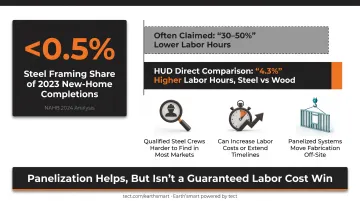
Steel framing is less common than wood. NAHB's 2024 analysis found that steel accounted for less than 0.5% of 2023 new-home completions — meaning qualified residential steel crews are harder to find in most markets. That scarcity can increase labor costs or extend project timelines.
Prefabricated and panelized steel systems reduce some of this variability by moving fabrication off-site. However, a direct HUD comparison of steel vs. wood demonstration homes found steel framer labor hours were only 4.3% higher than the wood equivalent — not the 30–50% reduction sometimes claimed. Panelization helps, but isn't a guaranteed labor cost win.
Full Cost Breakdown of a Steel Frame Home
Buyers who scope only the frame are typically 40–60% of the way through their total budget. Here's where the rest of the money goes:
Steel frame kit or materials Covers the structural frame, roofing system, and exterior wall panels. For a 1,500–2,500 sq ft home, budget $20,000–$90,000 depending on kit scope. Always require a line-item inclusions sheet — what's excluded matters more than what's listed.
Foundation and site preparation Steel frame homes require an engineered concrete foundation with precise anchor bolt placement. This typically costs more than a standard wood-frame foundation due to load-point requirements and tighter tolerances. Highly site-dependent; get a geotechnical assessment early.
Labor and installation Covers erection of the steel frame and exterior shell. Prefabricated systems can reduce on-site labor compared to stick-built wood, but the public evidence doesn't support broad claims of 30–50% savings. Budget based on actual bids from crews with steel erection experience.
Interior buildout Typically the largest share of total budget. Plumbing, electrical, HVAC, insulation, drywall, flooring, cabinetry, and fixtures are not included in any steel frame kit. NAHB's 2024 construction cost study found interior finishes represented 24.1% of total construction costs for new homes.
Insulation and thermal bridging mitigation Long-term impact starts here. Steel conducts heat far more efficiently than wood, and metal Z-bar attachments through continuous insulation can reduce insulation effectiveness by 30% or more, per Building Science Corporation.
Properly addressing thermal bridging requires one of the following:
- Continuous rigid foam board over the steel frame
- Spray foam in cavities combined with exterior insulated sheathing
- Specialized pre-insulated panel systems
Budget $1–$4 per sq ft for wall insulation as a baseline. Thermal-break detailing is a required budget line, not a value-engineering candidate.
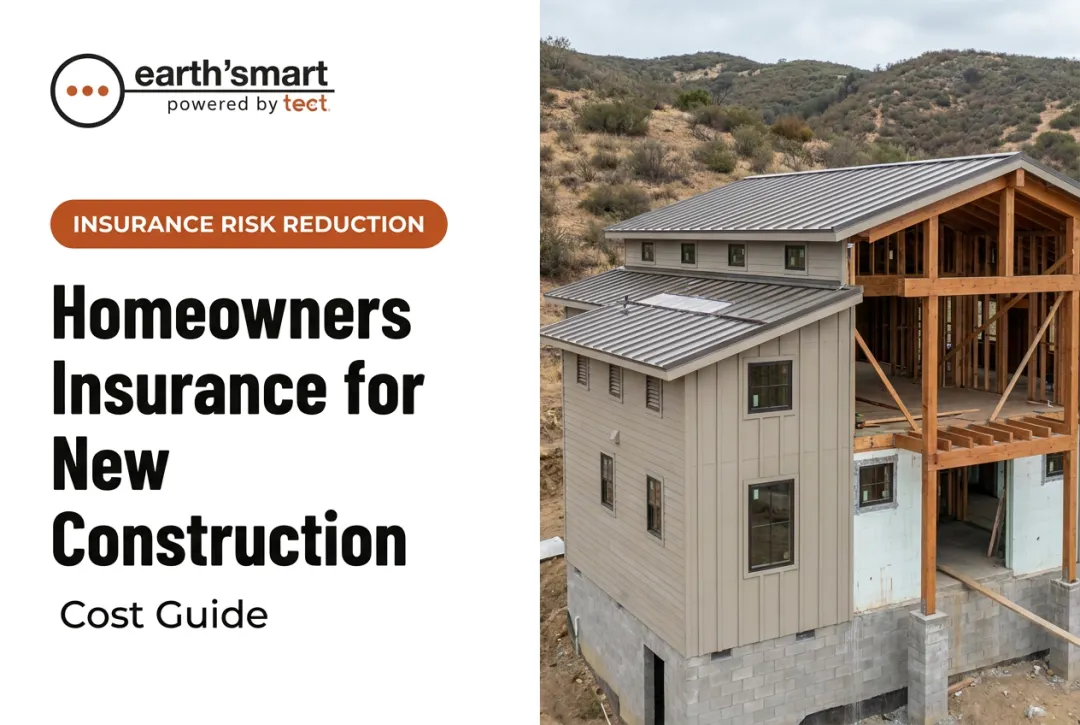
Ongoing maintenance and insurance This is where steel's long-term case is strongest. Cold-formed steel resists termites, rot, and moisture because it's inorganic. In fire-prone areas, the California DOI notes that every Safer from Wildfires action qualifies for insurance discounts — though no steel-frame-specific premium reduction percentage is published.
Earth'smart powered by tect works directly with insurance brokers and underwriters to produce documentation packages covering fire-resistive assemblies, non-combustible material specs, and suppression system engineering. These packages support coverage and pricing decisions for WUI rebuilds.
Steel Frame vs. Wood Frame: Where Each Wins on Cost
| Dimension | Steel Frame | Wood Frame |
|---|---|---|
| Upfront material cost | Higher per unit; precision-fabricated with less waste | Lower entry point; widely available |
| Labor market | Less than 0.5% of new homes; crews harder to find | 93% of new homes; crews everywhere |
| Build speed | Panelized systems can reduce site cycle time | Standard stick-build is well understood by all trades |
| Commodity volatility | Steel prices can swing significantly year to year | Lumber prices also volatile; gap narrows during spikes |
| Maintenance | Resists termites, rot, and moisture inherently | Vulnerable without ongoing treatment and monitoring |
| Fire-prone zones | Non-combustible; supports full WUI assembly compliance | Combustible; higher insurance risk; may face coverage limits |
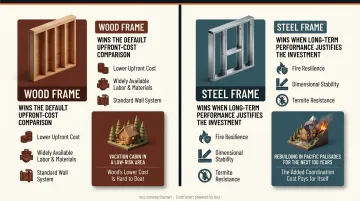
Wood wins the default upfront-cost comparison. Steel's case is stronger where fire resilience, dimensional stability, termite resistance, or long-term performance justify the added coordination cost and wall system investment. For a homeowner rebuilding in Pacific Palisades for the next 100 years, that tradeoff looks very different than for someone building a vacation cabin in a low-risk area.
What Most Homeowners Miss When Budgeting for a Steel Frame Home
These aren't edge cases — they're the predictable mistakes that show up repeatedly in steel frame projects.
Kit price vs. finished home cost. The kit is often less than half the total budget. Foundation, electrical, plumbing, HVAC, insulation, and interior finishes together typically cost more than the steel structure itself. Compare complete scopes — not kit prices against finished wood-home prices.
Underestimating insulation costs. Thermal bridging creates measurable heat loss in steel frame construction — it's not a footnote. Cutting corners here saves little upfront and drives higher energy bills every month, plus moisture problems that compound over time. The insulation strategy needs to be designed in from the start.
Specifying systems before confirming they integrate. Mechanical, electrical, or envelope systems that require redesign mid-build are among the most expensive problems in steel frame projects. Early manufacturer coordination prevents this. Earth'smart powered by tect's earth'smart powered by tectApp™ platform connects projects with 70+ vetted building product manufacturers — across structure, envelope, roofing, fire suppression, MEP, and smart-home systems — with that input happening at the design stage, before decisions are locked in.
Systems understood and integrated from the start versus corrected mid-build: the cost difference is often tens of thousands of dollars.
Treating WUI code compliance as a late-stage checklist. Chapter 7A in California drives structural specifications, roofing selection, fenestration details, and vent design — it's not an add-on. Specifying these incorrectly can mean failed inspections, demolished work, or costly retrofits.
Getting the regulatory framework established early, with the right engineering team, is where real budget protection happens.
Conclusion
Steel frame homes are not automatically cheaper to build. Upfront, they often cost more in materials, engineering, and envelope requirements. Over the full project lifecycle, though, the numbers tend to work in their favor — especially when you account for:
- Reduced long-term maintenance costs
- Termite and rot resistance
- Insurance alignment in high-risk zones
- Structural longevity over a 50–100 year horizon
For homeowners building to last, the financial case holds.
The right budget accounts for every layer from foundation to finish, treats insulation and systems integration as non-negotiables, and is built on specifications that are correct from day one. The decisions that are hardest to reverse — structural system, envelope design, mechanical integration — happen early. Getting the right expertise in place before those calls are made is what separates a well-built project from a costly one to fix.
Frequently Asked Questions
Are steel frame homes cheaper to build?
Not typically at the outset. Steel frame materials generally cost more than comparable wood framing, and qualified crews are harder to find. Over time, however, lower maintenance costs, termite resistance, and insurance advantages in WUI zones can make steel the more cost-effective choice when you calculate across the full project lifecycle.
Is it hard to sell a steel-framed house?
Steel frame homes are gaining broader market acceptance, and durability, fire resistance, and energy performance are increasingly valued by buyers. Having proper documentation of construction quality, insulation specifications, and code compliance helps with buyer confidence and appraisal accuracy.
How does living in a fire-prone area affect the cost of a steel frame home?
WUI zones like Pacific Palisades require Chapter 7A-compliant assemblies: Class A roofing, ember-resistant vents, and noncombustible wall details. These measures add upfront cost but are typically offset by lower insurance premiums and reduced rebuild risk compared to wood-frame construction in the same location.
What insulation is required for a steel frame home and what does it cost?
Thermal bridging is the core challenge: steel conducts heat far more efficiently than wood, undermining standard cavity insulation. Continuous rigid foam, spray foam, or insulated sheathing systems are required to compensate. Wall insulation runs $1–$4 per sq ft as a baseline; budget thermal-break detailing into the original design, not as an afterthought.
Does building with steel affect homeowner's insurance premiums?
Steel's non-combustibility and resistance to pests, rot, and weather can support better coverage availability and lower premiums, especially in fire-prone California markets where wood-frame homes increasingly face non-renewal. California DOI confirms Safer from Wildfires actions qualify for discounts; the specific benefit depends on your full assembly and carrier documentation.
How long does a steel frame home last compared to a wood frame home?
Properly designed and maintained steel frame homes are built for 50–100+ years of structural performance, with minimal intervention for rot, termites, or moisture damage. Wood frame homes require more active maintenance and are more vulnerable to the biological and environmental risks that compound in high-risk climates over time.