Introduction
In wildfire-prone areas like California's Wildland-Urban Interface, the roof is the most exposed surface on a home — and one of the primary ignition pathways during a wildfire. UC ANR research identifies the roof as the home's most vulnerable component in wildfire conditions, given its large horizontal surface area where embers accumulate and ignite.
For homeowners building or rebuilding in communities like Pacific Palisades, choosing the right fire rating is one of the highest-impact decisions you'll make. A Class A roof is tested to resist severe fire exposure. An unrated roof has no tested fire resistance. That gap determines how your home responds when embers land.
This guide breaks down what Class A fire-rated roofs are, how ratings are tested and issued, which materials qualify, and what installation details determine whether a rated roof actually performs when it matters.
Key Takeaways
- Class A is the highest fire resistance rating for roofing — the assembly withstands severe fire exposure without igniting or spreading
- The rating applies to the complete roof assembly, not just the surface material, and is only valid when installed exactly as tested
- Common Class A materials include fiberglass asphalt shingles, metal roofing, clay/concrete tile, slate, and some synthetic composites
- California's High Fire Hazard Severity Zones require Class A roofing for new construction and major re-roofing
- Class A roofing improves insurance eligibility and can reduce premiums under California's Safer from Wildfires framework
What Is a Class A Fire Rating for Roofs?
Class A is the highest tier in a three-class system (A, B, C) used to evaluate roof coverings against exterior fire exposure. Per ASTM E108, Class A roof coverings are expected to be effective against severe fire exposure and afford a high degree of fire protection to the roof deck. Class B covers moderate exposure; Class C covers light exposure.
To qualify as Class A, a roof covering must demonstrate three things during standardized testing:
- Minimal flame spread across its surface
- No fire penetration through to the underlying deck structure
- Resistance to burning brand (ember) ignition without producing a flying-brand hazard
Inherent vs. By-Assembly Ratings
Class A applies to the complete roof assembly — not just the outermost surface material. This distinction matters more than most homeowners realize.
Some materials are inherently Class A: they're non-combustible on their own, regardless of what's beneath them. Concrete tile and slate fall into this category. Others are Class A by assembly: the covering only achieves the rating when installed with specific underlayment, deck type, and fasteners as documented in the manufacturer's tested specification. A roofing product being labelled "Class A" doesn't guarantee the assembly you're building will carry that rating — the full system must match.
By contrast, unrated roofing offers no meaningful protection against exterior fire exposure. Untreated wood shake shingles are the most common example — and the highest-risk one. The IBHS Wildfire Prepared Neighborhood Technical Standard prohibits wood shakes and wood shingles entirely in wildfire-prone areas and requires Class A roof covering ratings across the board.
How Class A Roofs Are Tested and Certified
The primary standard used in North America is ASTM E108, also published as UL 790. It's a laboratory procedure that exposes a complete roofing assembly — not just the surface product — to three types of fire exposure:
- Spread of flame test — a continuous gas flame applied directly to the surface (10 minutes for Class A and B)
- Burning brand test — simulates wind-blown embers landing on the roof, using dry Douglas fir brands for Class A testing
- Intermittent flame and radiant heat test — simulates heat radiating from nearby burning structures
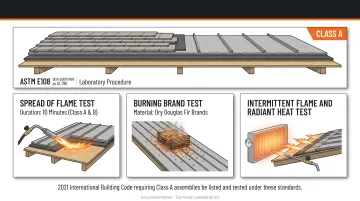
To achieve Class A, the assembly must pass all three conditions at the most demanding levels. The 2021 International Building Code requires that Class A roof assemblies and coverings be listed and tested under ASTM E108 or UL 790.
What the Rating Actually Covers
The Class A rating is tied to the specific assembly as tested — including the deck type, roof incline, underlayment, and barriers. Substituting any component invalidates the rating in the field. That's how assembly-rated systems work by design.
Homeowners can verify a product's rating through:
- The manufacturer's product documentation and ICC-ES evaluation reports
- UL Product iQ (productiq.ulprospector.com), UL's searchable certification database
- Product packaging, which model codes require to carry manufacturer identification and an approved testing agency label
Some metal roofing products may qualify as non-combustible without undergoing ASTM E108. Regardless of material category, always verify the specific product's listed assembly rather than assuming categorical compliance.
Class A Roofing Materials: What Qualifies
Fiberglass Asphalt Shingles
The most widely installed Class A material. The fiberglass mat within the shingle provides the fire resistance; the asphalt serves as the binder. Per NRCA guidance, most fiberglass asphalt shingles carry Class A ratings, while most organic-mat asphalt shingles rate only Class C. If you're specifying asphalt shingles for a fire zone, fiberglass composition is non-negotiable.
Metal Roofing
Steel, copper, and most metal panel systems are non-combustible and typically achieve Class A status. Aluminum requires product-specific verification ; confirm the assembly is listed and tested rather than assuming non-combustible status applies automatically. CAL FIRE lists metal panels as common Class A roof coverings alongside fiberglass shingles and tile.
Clay and Concrete Tile
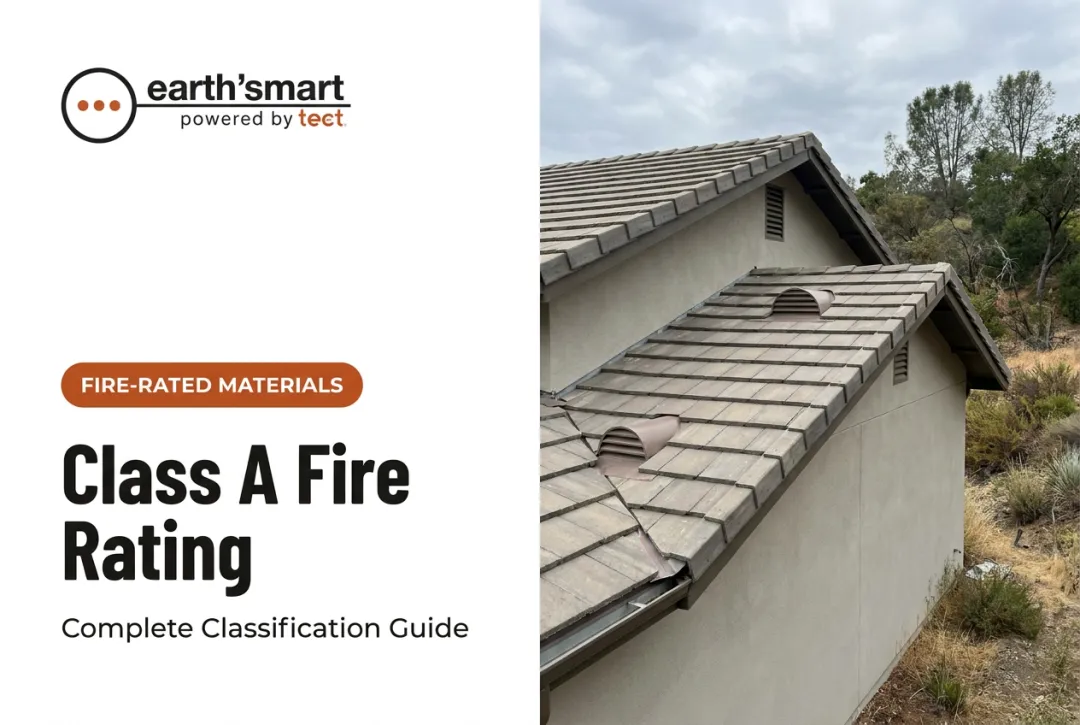
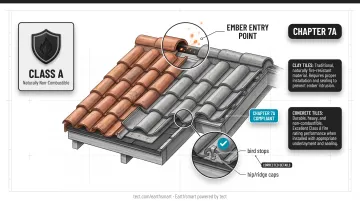
Both are naturally non-combustible and inherently Class A. However, barrel-shaped tiles create gaps at ridge lines and eave edges that can allow embers to enter the assembly. California's Chapter 7A requires these gaps to be sealed with "bird stops" and hip/ridge caps to be mudded or otherwise closed. This maintenance detail is frequently overlooked — and it's where tile roofs fail in real wildfire events.
Slate
Naturally non-combustible and inherently Class A. The durability tradeoff: slate can crack or break over time, and cracked tiles create penetration points that undermine fire performance. Regular inspection is the only way to maintain the rating's real-world effectiveness.
Synthetic Composite and Fire-Retardant Treated Wood
Recycled rubber/plastic composites and fire-retardant-treated wood shakes can achieve Class A by assembly, but require specific additional materials beneath them. In California, fire-retardant-treated wood shakes must be registered with the OSFM and pass weathering exposure testing. They are also banned outright in many communities, including any Fire Hazard Severity Zone per LA County rebuilding guidance.
Getting the Assembly Right from the Start
For homeowners rebuilding in WUI communities like Pacific Palisades, selecting a Class A product is only the beginning. The Class A rating must be engineered into the complete assembly. The right underlayment, deck specification, fasteners, and transitions all have to match what was tested — a mismatch at any layer can void the listing.
This is where earth'smart powered by tect's Earth'smart™ Path A Turnkey Delivery process eliminates the guesswork that causes assembly failures. Rather than leaving roofing decisions to late-stage contractor bids, earth'smart powered by tect engages roofing material manufacturers directly through the earth'smart powered by tectApp™ community of 70+ vetted manufacturers from concept design forward. The process brings together:
- The architect, engineer, and construction team on a single aligned plan
- Manufacturer representatives who verify assembly specifications before construction begins
- Permit strategy coordinated around Chapter 7A and OSFM requirements from the start
The result: a Class A rating confirmed in the drawings, with every layer of the assembly documented and intentional.
Class A vs. Class B and C: How the Ratings Compare
Understanding where Class B and C fall — and why they're inadequate for wildfire-prone areas — matters when evaluating older roofs or properties in lower-risk zones.
| Rating | Exposure Level | California WUI/HFHSZ Compliance |
|---|---|---|
| Class A | Severe | Required under CBC Chapter 7A |
| Class B | Moderate | Not compliant in wildfire-exposure areas |
| Class C | Light | Minimum standard in low-risk residential zones only |
| Unrated | None | Prohibited in most wildfire-prone jurisdictions |
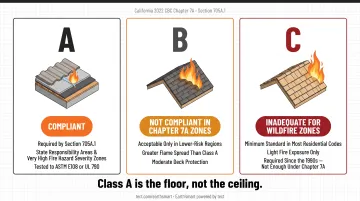
California's 2022 CBC Chapter 7A applies to new buildings in State Responsibility Areas and designated Very High Fire Hazard Severity Zones. Section 705A.1 requires roof assemblies within this scope to be Class A when tested to ASTM E108 or UL 790. Class B and C are not compliant baselines in these zones.
Class B may be acceptable in lower-risk regions, but it allows greater flame spread than Class A during standardized testing and provides only moderate protection to the underlying deck. Class C is the minimum standard in most residential codes — intended for light fire exposure only, and inadequate anywhere wildfires are a realistic threat.
California has required at least Class C roofing since the 1990s, but Chapter 7A raises the bar significantly: in any fire hazard severity zone, Class C compliance is not enough. Class A is the floor, not the ceiling.
Why Class A Roofing Matters Beyond Fire Resistance
Building Code and Regulatory Compliance
In California's High Fire Hazard Severity Zones and WUI areas, Class A isn't a recommendation — it's a legal requirement. CBC Chapter 7A governs new construction and major re-roofing in these zones. For homeowners rebuilding after a wildfire, the requirement applies to the rebuild permit, not the pre-fire condition. You cannot restore a pre-existing wood shake or Class C roof in a Fire Hazard Severity Zone when a new permit is required.
LA County's rebuilding guidance for design professionals confirms this directly: wood shingles and wood shakes are prohibited in any Fire Hazard Severity Zone regardless of fire classification.
Insurance Implications
The California insurance market has become one of the clearest financial arguments for Class A roofing. Harvard JCHS reported in 2025 that Pacific Palisades average annual premiums rose 33% between 2018 and 2022 (from $5,025 to $6,689), while FAIR Plan policies in Palisades and Altadena ZIP codes more than doubled between 2021 and 2024.
California's Department of Insurance Safer from Wildfires framework treats Class A roofing as a recognized home-hardening action. Three practical consequences follow:
- Insurers must offer discounts for documented wildfire safety measures, including a Class A roof
- Some carriers now require Class A roofing as a condition of coverage in high-risk zones — not just a pricing factor, but an eligibility threshold
- Documented system-level evidence (fire-assembly details, manufacturer specifications) is what brokers and underwriters need to support both coverage and pricing decisions
Earth'smart powered by tect's Earth'smart™ engagements produce that documentation package. Class A roofing is one component within the broader risk profile submitted to carriers.
Long-Term Performance and Lifecycle Cost
Class A materials typically offer substantially longer service lives than lower-rated alternatives. Earth'smart powered by tect specifies roof systems designed for 50–100+ year service life, compared to the 15–25 year norm for conventional asphalt shingles. That gap represents significant lifecycle cost reduction — eliminating one or more full re-roofing cycles over the life of a home, along with the disruption and exposure each re-roof creates.
A roof specified correctly at the outset avoids the compounding costs — and the repeated fire-exposure window — that each replacement cycle introduces.
Key Vulnerabilities and Maintenance Considerations
Class A doesn't mean invulnerable. Several real-world failure points can compromise even a properly rated roof.
The Assembly Failure Risk
The most common Class A failure isn't material combustion — it's installation deviation. Wrong underlayment, substituted components, gaps in flashing, or improper fastening can all void the assembly rating without any visible sign of non-compliance. Field performance can differ from lab performance if the complete system isn't installed as tested and specified.
Debris Accumulation and Valley Zones
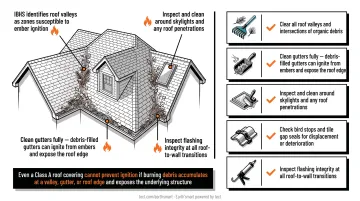
Roofs with multiple intersections, dormers, and valleys collect windblown debris — pine needles, leaves, and dry organic material. IBHS specifically identifies roof valleys as zones susceptible to ember ignition. Even a Class A roof covering cannot prevent ignition if burning debris accumulates at a valley, gutter, or roof edge and exposes the underlying structure.
Pre-fire season maintenance checklist:
- Clear all roof valleys and intersections of organic debris
- Clean gutters fully — debris-filled gutters can ignite from embers and expose the roof edge
- Inspect and clean around skylights and any roof penetrations
- Check bird stops and tile gap seals for displacement or deterioration
- Inspect flashing integrity at all roof-to-wall transitions
Edge, Gutter, and Skylight Vulnerabilities
The Class A rating protects the roof surface, not necessarily the edges, eaves, or adjacent components. NFPA notes that wind-blown embers are a primary home-ignition cause and can travel over a mile from an active fire front — making these perimeter zones a critical secondary vulnerability.
Operable skylights must be kept closed during wildfire events. CAL FIRE warns to fill gaps between roof covering and sheathing to block ember and flame intrusion — a detail that applies particularly to tile roofs where bird stops have displaced or were never installed.
Frequently Asked Questions
What is a Class A fire rating for a roof?
Class A is the highest fire resistance rating for roofing materials, indicating the roof covering can withstand severe fire exposure — including burning embers, direct flame, and radiant heat — without igniting or spreading flames across the surface. It is the required standard in California's High Fire Hazard Severity Zones and most other wildfire-prone jurisdictions.
What shingles are Class A?
Fiberglass-based asphalt composition shingles are the most common Class A shingle type. Synthetic composite shingles and certain fire-retardant-treated wood shakes (by assembly) can also qualify. Always verify Class A status on the manufacturer's documentation or ICC-ES evaluation report before purchasing or installing.
Does Class A roofing lower my homeowners insurance?
Often, yes. California's Safer from Wildfires framework requires insurers to offer discounts for documented home-hardening measures, including Class A roofing. In some high-risk zones, Class A has become an eligibility condition rather than just a pricing factor. Results vary by insurer and location.
Is Class A roofing required in California fire zones?
Yes. CBC Chapter 7A requires Class A roof assemblies for new construction and major re-roofing projects in High Fire Hazard Severity Zones and WUI areas. Homeowners rebuilding after wildfires must meet current code requirements, which means upgrading beyond what existed before the fire.
What is a "Class A by assembly" roof rating?
"By assembly" means the material only achieves Class A fire resistance when installed with specific additional components — such as a particular underlayment or deck type — as documented in the manufacturer's tested specification. The rating belongs to the complete system, not the surface product alone.
Can I upgrade my existing roof to Class A?
Yes, by replacing the roof covering with a Class A-rated material and ensuring the underlayment and deck configuration match the manufacturer's tested assembly. Consult a licensed architect or roofing professional before proceeding: product-level compliance alone doesn't guarantee the full assembly meets local code.