Introduction
CMU walls bring structural strength, fire resistance, and durability that wood framing simply cannot match. The tradeoff has always been thermal performance: a standard empty-core 8-inch CMU wall delivers only around R-2 of thermal resistance, according to CMHA TEK 06-02C — a fraction of what modern energy codes require.
Insulated CMU closes this gap by adding insulation through core fill, inserts, or continuous rigid boards — without giving up concrete's structural and fire-resistant properties.
This guide covers:
- The types of CMU insulation available and how each performs
- How to read thermal performance numbers and satisfy energy code requirements
- Honest advantages and limitations of insulated CMU construction
- How it compares to ICF systems for homeowners focused on long-term resilience
What Are Concrete Masonry Units (CMU)?
CMU blocks are modular units manufactured from Portland cement, water, and aggregate — sand, crushed stone, or lightweight materials like expanded clay or pumice. They're cast into standardized shapes, compacted, and oven-cured. Per CMHA CMU-TEC-001, the governing standard is ASTM C90, which requires a minimum net-area compressive strength of 2,000 psi.
"Cinder block" and "concrete block" get used interchangeably, but they're not the same thing. Modern units are concrete masonry — the cinder block name persisted from an era when coal cinders were the aggregate of choice.
Standard Dimensions and Wall Construction
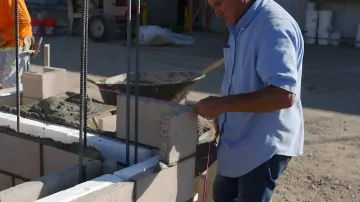
The most common structural CMU has nominal dimensions of 8 × 8 × 16 inches (specified dimensions are 7⅝ × 7⅝ × 15⅝ inches, allowing for ⅜-inch mortar joints). Walls are built by stacking units with mortar, then placing steel rebar in hollow cores and filling with grout to improve lateral and seismic resistance.
Density classifications matter for both structural and thermal calculations:
- Lightweight: less than 105 lb/ft³
- Medium weight: 105 to less than 125 lb/ft³
- Normal weight: 125 lb/ft³ or more
The Hollow-Core Advantage
Those hollow voids reduce block weight, provide pathways for rebar and grout, and — critically for this guide — create cavities that accept insulation to improve thermal performance. That last function is what separates standard CMU from insulated CMU assemblies.
Why Standard CMU Walls Need Insulation
An empty-core 8-inch CMU delivers roughly R-2.56 to R-1.99 of thermal resistance depending on concrete density, per CMHA TEK 06-02C. The 2021 IECC requires mass walls to reach anywhere from R-3 in Climate Zones 0–1 up to R-21 in Zones 7–8. In most occupied climates, that empty-core baseline falls short before interior finishes are even on the wall.
The Thermal Bridging Problem
Core insulation alone doesn't solve the full problem. Each CMU has solid concrete webs connecting the inner and outer block faces — typically three full-height webs per unit. Those webs conduct heat directly through the wall, bypassing whatever insulation sits in the cores.
CMHA's series-parallel calculation method specifically accounts for this web bridging. The result: whole-wall R-values are noticeably lower than the insulation material's rated R-value when you only fill the cores.
What Under-Insulation Actually Costs
Under-insulated CMU walls carry real costs:
- Higher heating and cooling loads year-round
- Cold or warm wall surfaces that create occupant discomfort
- Condensation risk at thermal bridge locations
- Difficulty passing energy code compliance checks
- Ongoing energy costs that compound over the building's lifetime
For homeowners building to last, energy code is the floor — not the target. Getting the thermal assembly right at the start prevents costly remediation later and keeps a 100+ year home performing the way it was designed to.
Types of CMU Insulation: From Core Fill to Continuous Boards
There's no single right answer for CMU insulation. The method you choose depends on the R-value target, code requirements, and how the wall will be finished.
Core Fill Options
Loose granular fills are poured directly into CMU cores during or after construction:
| Fill Type | 8-inch CMU Whole-Wall R-Value | Notes |
|---|---|---|
| Empty core | R-2.56 to R-1.99 | Baseline — below code in nearly all zones |
| Perlite | R-7.54 to R-3.88 | Varies by concrete density |
| Vermiculite | R-6.92 to R-3.75 | Similar performance to perlite |
| Polyurethane foam-in-place | R-8.58 to R-4.08 | Highest core-fill R-value; higher installation cost |
Source: CMHA TEK 06-02C
Foam-in-place polyurethane outperforms granular fills on R-value per inch, but the thermal bridging through webs remains unresolved with any core-only strategy.
EPS Insulation Inserts
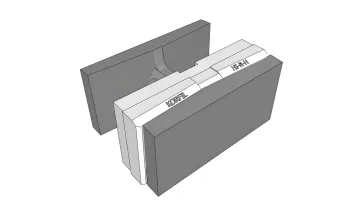
Pre-cut expanded polystyrene (EPS) inserts are manufactured to fit standard CMU core dimensions. They can be installed at the factory or on-site. Performance is comparable to granular fills for most standard insert designs. Some specialized reduced-web units address bridging more directly, but they're less common in residential applications.
Rigid Continuous Insulation Boards
Core fill and EPS inserts improve R-value, but neither resolves thermal bridging through the CMU webs. A continuous layer of rigid insulation — applied to the interior or exterior face of the wall — does, which is why it's the preferred strategy for meeting prescriptive energy code targets.
R-values per inch by product type:
- Polyiso: R-5.6 per inch (LTTR method)
- XPS: R-5.0 per inch
- Mineral wool board: R-4.2 per inch
- EPS board: minimum R-3.6 per inch
"Continuous insulation" means uninterrupted by furring strips or structural members — exactly what IECC prescriptive tables require for mass wall compliance.
Purpose-Built Insulated CMU Products
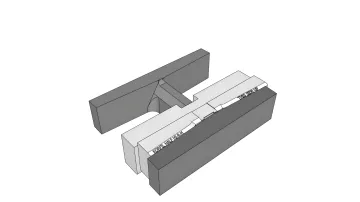
Products like Omni Block integrate EPS insulation layers within a multi-component masonry unit. According to manufacturer-published data, Omni Block's System 8 achieves R-19.3 and System 12 reaches R-26.5 — with a published fire rating of 2.7 hours for System 8 and 4 hours for System 12.
These units install with standard masonry tools and techniques, which simplifies trade coordination. One important caveat from the manufacturer: wherever rebar and grout are present, insulation cannot occupy the same core.
Thermal Performance: R-Values, Thermal Mass, and Energy Code Compliance
R-Value vs. Thermal Mass
R-value measures steady-state resistance to heat flow. Thermal mass describes a material's ability to absorb, store, and release heat over time. Concrete masonry is dense enough that its mass moderates indoor temperature swings — a wall that feels "slow" to heat up is also slow to release heat at night.
The 2021 IECC recognizes this distinction. Mass walls (including CMU) qualify under lower R-value requirements than light-frame walls in the same climate zone. For reference:
| Climate Zone | R-Value (ext. side dominant) | R-Value (int. side >50%) |
|---|---|---|
| 0–1 | 3 | 4 |
| 2 | 4 | 6 |
| 3–4 (except Marine) | 8 | 13 |
| 5 and Marine 4 | 13 | 15 |
| 6 | 15 | 20 |
| 7–8 | 19 | 21 |
The higher R-value applies when more than half the insulation is placed on the interior side of the wall.
Southern California's coastal and inland areas generally fall in Climate Zones 3–6 depending on elevation and location — meaning continuous insulation is required, but the thermal mass credit meaningfully reduces the total R-value needed compared to wood frame.
That said, more insulation isn't always the answer.
Diminishing Returns at Higher R-Values
CMHA TEK 06-02C notes that beyond approximately R-12 in residential wall assemblies, additional insulation delivers progressively smaller reductions in overall building energy use. Beyond that threshold, investments in air sealing, window performance, and roof insulation often deliver more value per dollar spent.
Energy Code Compliance Pathways
Builders have three main routes to IECC compliance:
- Prescriptive tables — match the R-value/U-factor minimums for your climate zone and wall type
- Overall assembly U-factor method — calculate the whole-wall U-factor including mass and all layers
- Energy modeling software — demonstrate equivalent or better whole-building performance
The pathway you choose directly affects which insulation strategy makes sense for your project. In Southern California WUI zones, a system like Omni Block may satisfy prescriptive requirements directly. A standard CMU wall with continuous exterior polyiso typically requires a full U-factor calculation to confirm compliance.
Advantages and Limitations of Insulated CMU Construction
Advantages
Structural strength and durability. CMU walls offer excellent compressive strength and resistance to impact, pests (including termites), and moisture. That combination contributes to a long service life with reduced maintenance — exactly what you want when building a home designed to last over a century.
Fire resistance for WUI zones. Standard 8-inch hollow CMU achieves 2-hour fire ratings with limestone aggregate, 2.5 hours with expanded clay, and 3 hours with expanded slag or pumice aggregate, per CMHA TEK 07-01D. In wildland-urban interface environments where ember cast and radiant heat are the primary ignition risks, a non-combustible exterior wall is a significant structural advantage.
Under California's 2022 CBC Chapter 7A, exterior wall coverings in WUI areas must be noncombustible, ignition-resistant, or carry a 1-hour fire-resistance rating from the exterior. CMU satisfies this requirement by design.
Meeting code is the floor, not the ceiling. Achieving reliable fire performance means treating the insulation layer, air barrier, and cladding as a unified assembly rather than independently specified add-ons. Earth'smart powered by tect's Earth'smart™ approach for Pacific Palisades rebuilds coordinates these decisions early, ensuring the full wall assembly performs as specified — not just on paper, but in the field.
Design versatility. CMUs come in split-face, smooth-face, and burnished textures, across a range of colors. In some applications, the CMU itself serves as the finish surface, eliminating an entire cladding layer and reducing overall wall assembly cost and complexity.
Limitations
Labor intensity. CMU construction requires experienced masons, careful mortar joint workmanship, and proper sequencing of reinforcement, grouting, and insulation installation. On residential projects in Southern California, masonry crews are less common than light-framing contractors, which affects both scheduling and cost.
Multi-step finishing. A raw CMU wall isn't finish-ready for interior occupation. Completing the interior requires coordinating several trades across distinct steps:
- Continuous insulation installation
- Vapor and air control layer application
- Furring and substrate work
- Drywall installation
That sequencing takes time and adds cost, particularly compared to systems that integrate these layers by design.
Insulated CMU vs. ICF: Choosing the Right System for Resilient Homes
The Core Difference
Insulated CMU is a traditional masonry system where insulation is added as a separate layer or fill. Insulated concrete forms (ICF) are a poured concrete system where EPS foam forms stay in place permanently as insulation on both faces.
The thermal performance gap is real. Fox Blocks ICF achieves a clear R-value of R-22; Nudura's standard ICF tests at R-23.59, with premium systems reaching R-48. ICF also delivers an integrated air/vapor barrier and built-in furring attachment in a single pour, which reduces trade coordination and accelerates enclosure.
Cost and Labor Comparison
A 1998 HUD/NAHB Research Center study found ICF homes averaged over $3,000 more than wood-frame baselines — roughly $2.73 per square foot, representing 6–7% of builder construction cost. One notable data point: an ICF foundation came in at $1,317.99 versus $1,334.85 for a comparable CMU baseline. At the foundation level, costs were nearly identical.
Current installed cost comparisons are more nuanced:
- CMU material costs are generally lower upfront
- Insulating, weatherproofing, and finishing a CMU wall assembly adds labor and trade coordination that narrows the gap
- Lifecycle comparisons — factoring in energy performance, maintenance, and longevity — often favor more highly insulated systems
Which System Is Right for Your Project?
For homeowners rebuilding in high-risk fire, flood, or seismic zones, both insulated CMU and ICF deliver non-combustible, reinforced-concrete wall systems that substantially outperform wood frame on durability and disaster resistance.
The right choice depends on several variables:
- Contractor availability: masonry crews are common in most markets; ICF requires concrete contractors with specific forming experience
- Finish preferences: CMU offers exposed texture; poured ICF produces a smooth surface ready for virtually any cladding
- Where your budget sits: CMU materials cost less, but full assembly (insulation, air barrier, finishing) can close the gap quickly
- Performance targets: core-fill CMU, continuous-insulation CMU, and ICF R-22+ represent meaningfully different thermal outcomes
What matters more than the material choice is getting the right expertise involved before decisions lock in. Reinforcement sequencing, grouting, insulation placement, air barrier continuity, and cladding all interact — and those interactions determine actual assembly performance, not the product spec sheet alone. That's the coordination that separates homes that perform from homes that just meet minimum code.
For rebuilding projects in Southern California's high-risk zones, earth'smart powered by tect's integrated approach — connecting homeowners with architects, engineers, and the manufacturers behind these systems early in design — is specifically built to navigate these decisions without the friction that typically derails custom residential construction.
Frequently Asked Questions
How do insulated concrete forms (ICF) compare with concrete masonry units (CMUs) in cost and performance?
ICF delivers higher integrated R-values (R-22 to R-24 for standard systems) and faster single-trade wall construction compared to CMU. CMU offers lower initial material cost and established masonry aesthetics. When all trades and finishing steps are factored in, fully loaded installed costs tend to favor ICF where high thermal performance is the primary target.
What R-value do insulated CMU walls typically achieve?
The range runs from approximately R-2 (empty core) to R-20+ with added continuous rigid board insulation. Core fill alone — perlite, vermiculite, or foam — typically reaches R-4 to R-8 for an 8-inch CMU, falling short of most IECC climate zone requirements without additional continuous insulation on the face.
What is the best insulation method for CMU walls?
Continuous rigid insulation board — polyiso, EPS, XPS, or mineral wool — applied to the interior or exterior face is the most effective method. It directly addresses thermal bridging through CMU webs, which core fill alone cannot resolve.
Are insulated CMU walls fire-resistant enough for WUI and wildfire zones?
Standard 8-inch CMU achieves 2- to 3-hour fire ratings depending on aggregate type, per CMHA TEK 07-01D. Purpose-built insulated units like Omni Block publish ratings up to 4 hours. The full wall assembly — including cladding, insulation type, and air barrier — must be specified together to meet California's 2022 CBC Chapter 7A requirements for WUI construction.
Do insulated CMU walls meet current energy code requirements?
In most climate zones, yes — with added continuous insulation. The 2021 IECC recognizes thermal mass benefits and allows reduced R-value requirements for mass walls compared to light-frame assemblies. Compliance can be demonstrated via prescriptive tables, U-factor method, or energy modeling.
Can insulated CMU be used for full above-grade residential construction?
Insulated CMU works for residential foundations, basement walls, and above-grade exterior walls. Its weight and skilled-mason requirement make it less common in standard builds, but it's well-suited to high-performance and resilient projects where long-term durability and fire resistance matter most.