Introduction
Many homeowners rebuilding in wildfire zones assume fire resistance is stamped on the block — that an "8-inch CMU" carries a fixed, reliable rating. It doesn't work that way.
A CMU fire resistance rating is a calculated assembly characteristic, not a material property. It tells you how long a wall can withstand standard fire exposure per ASTM E119: long enough for occupants to evacuate and firefighters to operate. But that duration depends entirely on design choices made upstream of construction.
For homeowners in California's WUI zones, where fire-resistive wall assemblies are the primary line of structural defense, understanding what drives that number matters. Getting it wrong during specification, or failing to verify it in the field, means the installed wall may not perform the way the construction documents say it should.
What follows breaks down the two variables that govern every CMU fire rating, what the code tables actually say, and — critically — where the gap between a specified rating and a verified one tends to open up in the field.
Key Takeaways
- CMU fire ratings are governed by equivalent thickness and aggregate type — not nominal block size
- Ratings range from under 1 hour to 4+ hours depending on unit size, grouting, and aggregate category
- Rating is established through one of three methods: calculated equivalent thickness, prescriptive tables, or UL listing
- Finish materials can supplement a CMU rating, but the masonry alone must provide at least half the required rating
- ASTM C140 testing is the standard for verifying that installed units match the rated specification
What Fire Resistance Ratings Represent in CMU Construction
Assembly Performance, Not a Block Label
A fire resistance rating measures duration — in hours — that a wall assembly can withstand standardized fire exposure under ASTM E119 without:
- Transmitting enough heat to ignite the unexposed face
- Allowing passage of hot gases
- Losing load-carrying capacity (for bearing walls)
- Failing under hose stream impact after fire exposure
The critical word is assembly. The rating belongs to the wall system as configured and built — not to any individual block pulled off a pallet.
How the Governing Code Framework Works
The calculation procedure for CMU fire ratings flows from two parallel references that say the same thing: IBC Section 722.3.2 and ACI 216.1/TMS 216. IBC Table 722.3.2 and ACI/TMS 216.1 Table 5.1a are identical and referenced interchangeably in practice. CMHA TEK 07-01D confirms this, documenting its calculated fire-resistance information based on both IBC and ACI 216.1/TMS 216.
Three standards underpin every CMU fire rating calculation:
- ASTM E119 — defines the fire test against which all calculations are calibrated
- IBC Section 722.3.2 / Table 722.3.2 — the code pathway for calculated ratings
- ACI 216.1/TMS 216 — the parallel engineering standard; tables are identical to IBC
The code tables translate physical inputs — aggregate type, equivalent thickness, finishes — directly into expected fire performance, based on decades of standardized testing. Fire resistance is a design output. The same block, configured differently, yields a different rating.
The Two Variables That Govern Every CMU Fire Rating
Equivalent Thickness
Equivalent thickness (ET) is the solid concrete thickness that would result if the hollow unit's volume of concrete were recast without core holes. It's the primary physical input to every CMU fire rating calculation.
ET is determined by ASTM C140 testing and reported on the C140 test report. The formula is straightforward: ET equals percent solid multiplied by actual unit thickness.
For solid or solid-grouted units, ET equals actual thickness. For hollow units with unfilled cells, ET uses the ungrouted value — regardless of partial grouting.
Grouting condition significantly affects this:
- Partially grouted (unfilled cells remain): Use ungrouted ET — lower value, lower rating
- All cells filled with approved loose-fill material: ET equals actual unit thickness — substantially higher rating achievable
- Solid grouted: ET equals actual thickness — maximum rating for that unit size
Approved fill materials include sand, pea gravel, pumice, expanded shale, perlite, and vermiculite per ASTM C33, C331, C549, and C516.
Aggregate Type
Aggregate type is the second governing variable. Different aggregates conduct and absorb heat at different rates, so two units with identical ET can carry different ratings depending on what they're made of.
IBC Table 722.3.2 recognizes four aggregate categories, ranked from best to lowest fire resistance per unit of ET:
| Aggregate Category | Performance |
|---|---|
| Pumice or expanded slag | Highest — least ET required for a given rating |
| Expanded shale, clay, or slate | Second |
| Limestone, cinders, or unexpanded slag | Third |
| Calcareous or siliceous gravel | Lowest — most ET required |
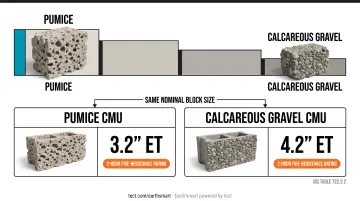
Lightweight aggregates outperform normal-weight gravel because they conduct heat more slowly. A pumice CMU needs 3.2 inches of ET for a 2-hour rating; a calcareous gravel CMU needs 4.2 inches for the same rating. Same nominal block size, notably different performance.
Blended Aggregates
When a CMU is manufactured with a combination of aggregate types, the minimum required ET is interpolated using the blended aggregate formula from ACI 216.1:
Tr = (T1 × V1) + (T2 × V2) + ... + (Tn × Vn)
Where T values are the table-required ETs for each aggregate category and V values are the fractional volumes. This allows a designer to calculate the exact ET threshold for a mixed-aggregate unit — but it requires confirmed aggregate composition data from the manufacturer.
Design Flexibility
That blended-aggregate formula points to a broader principle: ET and aggregate type work together, and adjusting either one changes the outcome. A higher fire rating can be achieved by increasing block size, shifting to a lighter-weight aggregate, or grouting all cells. Often a combination of two factors gets there — at lower cost than simply specifying the thickest unit available.
Fire Resistance Rating Ranges Across CMU Assembly Types
The IBC Table 722.3.2 Values
Minimum equivalent thickness (inches) required for bearing or nonbearing concrete masonry walls:
| Aggregate Type | 1 hr | 2 hr | 3 hr | 4 hr |
|---|---|---|---|---|
| Pumice or expanded slag | 2.1 | 3.2 | 4.0 | 4.7 |
| Expanded shale, clay or slate | 2.6 | 3.6 | 4.4 | 5.1 |
| Limestone, cinders or unexpanded slag | 2.7 | 4.0 | 5.0 | 5.9 |
| Calcareous or siliceous gravel | 2.8 | 4.2 | 5.3 | 6.2 |
Aggregate type determines the ET threshold. Grouting condition determines how far a given block can go.
Hollow vs. Grouted: The Practical Difference
According to Angelus Block's fire rating data, a standard 8-inch CMU wall shows this pattern:
- Partially grouted, normal weight: 1 hour
- Partially grouted, lightweight: 2 hours
- Solid grouted, all weight classes: 4 hours
The grouting decision alone drives a 1-to-4-hour swing from the same nominal block size.
Multi-Wythe Assemblies
When walls consist of multiple wythes separated by an air space, each layer compounds the total rating. IBC Equation 7-7 calculates the combined result:
RA = (R1^0.59 + R2^0.59 + ... + Rn^0.59 + A1 + A2 + ... + An)^1.7
Each air space factor (A) equals 0.30 for a continuous gap of at least ½ inch between wythes. Multi-wythe construction is an efficient path to higher ratings without increasing individual unit thickness.
Structural Elements
- Columns: Rated by least plan dimension per IBC Table 722.3.5 — 1 hr requires 8 in., 2 hr requires 10 in., 3 hr requires 12 in., 4 hr requires 14 in.
- Lintels: Rated by nominal thickness and minimum cover of longitudinal reinforcement per IBC Table 722.3.4. An 8-inch lintel requires 1.5 in. cover for 2 hours, 1.75 in. for 3 hours, and 3 in. for 4 hours.
Finish Material Contributions
Plaster, stucco, or gypsum wallboard can supplement the base CMU rating:
- Non-fire-exposed side: Finish thickness is multiplied by a correction factor from code tables and added to CMU equivalent thickness before looking up the rating
- Fire-exposed side: Finish is assigned a time contribution (in minutes) added to the base wall rating
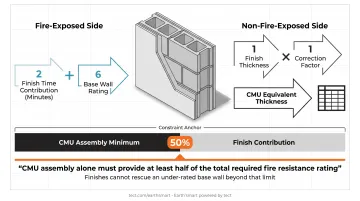
Critical constraint: The CMU assembly alone must provide at least half of the total required fire resistance rating. Finishes cannot rescue an under-rated base wall beyond that limit.
How CMU Fire Ratings Are Determined and Verified
Three Accepted Methods
1. Calculated fire resistance (ACI 216.1/TMS 216 and IBC Section 722) The most flexible and commonly used approach. The designer uses ET and aggregate data to calculate the rating for any compliant assembly. No pre-testing required for standard aggregate types.
2. Prescriptive designs (IBC Section 721) Direct table lookups without calculation. Less flexible but faster for straightforward assemblies.
3. Third-party listing services (UL) UL tests and classifies specific assemblies through its Product iQ database. The assembly must be constructed exactly as listed — changes to unit size, mix design, or plant of manufacture require a new listing. Less design flexibility, but a pre-validated tested result.
Who Is Responsible for the Rating
The registered design professional (RDP) — architect or engineer of record — establishes the required fire rating for each CMU element and documents it in the construction drawings and specifications. The CMU submittal demonstrating ASTM C90 compliance before construction sets the baseline. It does not guarantee that every block delivered over a multi-month construction schedule meets the same criteria.
Field Verification: ASTM C90 and C140
Field verification is the most frequently skipped step in CMU fire rating compliance — and the one with the most real-world consequences.
ASTM C90 governs the specification for loadbearing CMU. ASTM C140 governs sampling and testing during construction. The process:
- Take field samples (6 units per sample event) from units delivered during construction
- Submit to laboratory for testing
- Calculate fire resistance rating from actual measured ET and confirmed aggregate composition
- Compare to the rated specification in construction documents
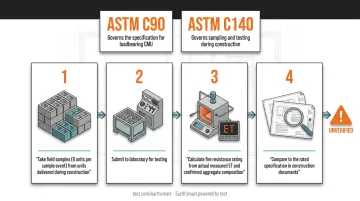
Without this step, the actual fire rating of the installed wall is unverified — regardless of what the submittal said.
The Special Inspection Gap
Per IBC Section 1705.4, masonry construction requires special inspections per TMS 402/TMS 602. CMU fire resistance ratings fall within that scope. The problem: without an explicit inspection protocol requiring ASTM C140 sampling during construction, field CMU fire ratings routinely go unconfirmed.
For load-bearing fire-rated walls — the kind specified across WUI residential rebuilds in Pacific Palisades and the North Bay — this gap between specified and verified performance is where real-world fire resistance diverges from design intent.
That gap is preventable — but only when the right decisions happen before construction documents are finalized. Earth'smart powered by tect's Earth'smart™ approach brings CMU manufacturers into the project during the design phase through the earth'smart powered by tectApp™ community of 70+ vetted building product manufacturers. Aggregate type, grouting strategy, and equivalent thickness get confirmed with real data, not carried forward as assumptions into the field.
Common Misinterpretations That Undermine Fire Performance
Nominal Block Size as a Fire Rating Proxy
"8-inch CMU" is a dimension, not a rating. As the Angelus Block data shows, an 8-inch wall can rate anywhere from 1 hour (partially grouted, normal weight) to 4 hours (solid grouted). Two 8-inch blocks from different manufacturers may have meaningfully different percent solid values, producing different equivalent thicknesses — and different ratings — for the same nominal size.
Without confirmed equivalent thickness (ET) data and aggregate type, nominal dimensions tell you nothing about actual fire performance — and nothing defensible for permit or insurance purposes.
Ignoring Aggregate Type in Non-Standard Units
When CMUs are manufactured with blended or non-standard aggregates — including recycled or proprietary materials not listed in ACI 216.1 — the standard calculation tables don't directly apply. CMHA's guidance (CMU-FAQ-013-23) establishes that industry practice requires at least two full-scale ASTM E119 tests on assemblies containing non-listed aggregate material before a calculation-based fire resistance expression can be derived.
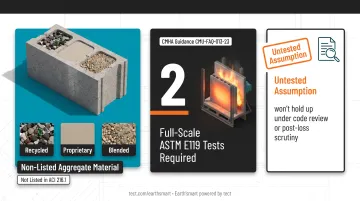
Specifying units without confirming aggregate type against the applicable table category means your fire resistance claim rests on an untested assumption — one that won't hold up under code review or post-loss scrutiny.
Assuming Submittal Compliance Equals Field Compliance
A pre-construction ASTM C90 submittal confirms the proposed unit meets the specification at time of submission. It does not verify:
- The ET of units delivered six months into construction
- Whether aggregate composition stayed consistent across production batches
- Grouting condition as actually installed
- Whether the as-built assembly matches the as-designed configuration
Without ASTM C140 progress sampling from delivered units, the fire rating on paper and the fire rating in the wall can quietly diverge — with no record to show either way.
Conclusion
CMU fire resistance is a calculated assembly parameter with two inputs: equivalent thickness and aggregate type. Neither is fixed by nominal block size alone, and both can vary between manufacturers, batches, and grouting conditions.
Getting the rating right requires deliberate specification — confirming aggregate category, calculating required ET for the target rating, and documenting the grouting strategy. Verification requires field sampling via ASTM C140 during construction — a pre-construction submittal alone is not enough.
The gap between a specified fire rating and a verified installed fire rating is where real-world fire performance diverges from design intent. In WUI residential construction, that gap can mean a wall assembly fails before it's rated to — giving occupants less time than the design assumed they'd have.
Frequently Asked Questions
What is the fire resistance rating of a standard 8-inch CMU?
There is no single fixed rating for an 8-inch CMU. A partially grouted 8-inch normal-weight unit with limestone aggregate typically rates around 1 hour, while solid grouting can push the same nominal block to 4 hours. ASTM C140 testing of the specific unit is required to determine the exact equivalent thickness needed for a precise calculation.
Does grouting CMU cells improve fire resistance?
Yes, significantly. Filling all cells with grout or approved loose-fill material (perlite, vermiculite, sand, or pea gravel) allows actual unit thickness to stand in as equivalent thickness, rather than the lower hollow-unit ET value. This can shift a 1-hour wall to 4 hours for the same nominal block size.
What is equivalent thickness and why does it matter for fire ratings?
Equivalent thickness is the solid concrete depth you would get if the hollow unit's volume were recast without core holes — determined by ASTM C140 testing. It is the primary input, alongside aggregate type, for calculating CMU fire resistance per IBC Table 722.3.2 and ACI 216.1.
Can gypsum wallboard or plaster increase a CMU wall's fire rating?
Yes, with limits. Finishes on the non-fire-exposed side contribute additional equivalent thickness via a correction factor from code tables, while finishes on the fire-exposed side add a set number of minutes to the base rating. The CMU assembly alone must still provide at least half of the total required fire resistance.
What is the difference between a calculated fire rating and a UL-listed rating?
The calculated method (ACI 216.1/IBC 722) derives the rating from ET and aggregate data, allowing flexibility across any compliant assembly. A UL listing covers a specific tested assembly and restricts changes to unit size, mix design, or plant of manufacture. It is less flexible, but the rating has already been verified through full-scale fire testing.
How do I verify that field-installed CMU meets the required fire resistance rating?
Take field samples (typically 6 units) during construction per ASTM C90 and test them per ASTM C140 to determine actual equivalent thickness and confirm aggregate composition. The fire resistance rating is then calculated from those lab results. A pre-construction submittal alone does not confirm what was actually installed.