Introduction
Choosing the right building material isn't a design decision — it's a safety decision. For homeowners rebuilding in wildfire-prone areas like Pacific Palisades, or in earthquake and flood exposure zones, that choice shapes how a home performs for decades. Make the wrong call, and you're rebuilding again in twenty years. Make the right one, and the home outlasts the hazard.
Concrete masonry construction stands out as one of the strongest choices in that decision. CMU walls are non-combustible, engineered for seismic loads, and rated to last 100+ years with proper design and maintenance.
This guide covers what CMU construction actually is, the materials involved, the benefits that matter most to resilient homebuilders, how the build sequence works, and what quality work looks like on site.
Key Takeaways
- CMU walls use precast concrete blocks bonded with mortar, governed by different standards than poured concrete
- Fully grouted 8-inch CMU walls can achieve fire-resistance ratings greater than 4 hours under specific conditions
- Reinforced CMU meets seismic code for high-risk zones when designed to TMS 402/IBC Chapter 21
- CMU resists rot, termites, and moisture, cutting long-term maintenance costs versus wood-frame construction
- System performance depends on early coordination between architect, engineer, and manufacturers — not just the blocks
What Is Concrete Masonry Construction?
Concrete masonry construction is the method of building structures using individual concrete masonry units (CMUs) — precast blocks of cementitious materials, aggregates, and water — bonded together in courses with mortar.
CMU construction is distinct from poured concrete, and the two are often confused because both involve concrete materials.
| Method | How It Works | Governed By |
|---|---|---|
| CMU Construction | Precast units laid in courses with mortar | ASTM C90, TMS 402/602, IBC Chapter 21 |
| Cast-in-Place Concrete | Semi-fluid mixture poured into formwork on site | ACI 318, project-specific mix design |
The construction method, tooling, inspection process, and structural behavior differ significantly between the two. CMU construction falls under unit masonry (even though the blocks themselves are made from concrete).
Why It Still Matters
Masonry has a documented durability track record that spans centuries. For modern residential construction, that translates to homes designed for a 100+ year service life — a direct priority for homeowners in wildfire-prone areas who are rebuilding with permanence in mind.
The Concrete Masonry and Hardscapes Association (CMHA) estimates a 100+ year service life for both CMUs and mortar, contingent on:
- Proper structural design and detailing
- Correct mortar selection and application
- Periodic inspection and targeted maintenance
Types of Concrete Masonry Units and Materials
CMU Block Types
The most common nominal size in residential construction is 8×8×16 inches — actual dimensions run 3/8 inch smaller on each face to allow for mortar joints. Several unit types serve different structural roles:
- Standard hollow-core CMU — the workhorse for exterior walls; cores can be left open or filled with grout and rebar for structural uplift
- Solid CMU blocks — higher equivalent thickness improves fire ratings; used where combustibility and lateral load resistance are priorities
- Bond beam blocks — depressed webs allow horizontal reinforcing bars and grout to run continuously through the wall
- Lintel blocks — solid bottoms confine grout over door and window openings
- Corner and jamb units — maintain module at openings and wall ends without field cutting
CMUs are also available in architectural finishes, split-face textures, and integral colors — options that matter in WUI zones where non-combustible cladding is required without sacrificing appearance.
The Four Core Material Components
Every reinforced CMU wall system depends on four materials working together. Skimping on any one of them weakens the whole assembly:
- CMU blocks (governed by ASTM C90) — provide structure, fire resistance, and thermal mass
- Mortar (governed by ASTM C270) — bonds units together and seals against moisture infiltration
- Grout (governed by ASTM C476) — fills designated cores to bond steel reinforcement to the masonry
- Steel reinforcement — provides ductility and resistance to lateral and seismic forces
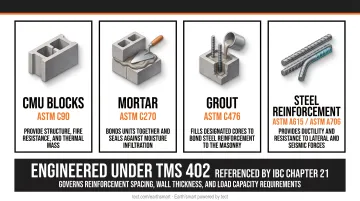
Each material carries its own ASTM standard — and together, the system is engineered under TMS 402, referenced by IBC Chapter 21. That standard governs reinforcement spacing, wall thickness, and load capacity requirements, defining how the assembly performs, not just how it's built.
Key Benefits of Concrete Masonry for Resilient Homes
Fire Resistance
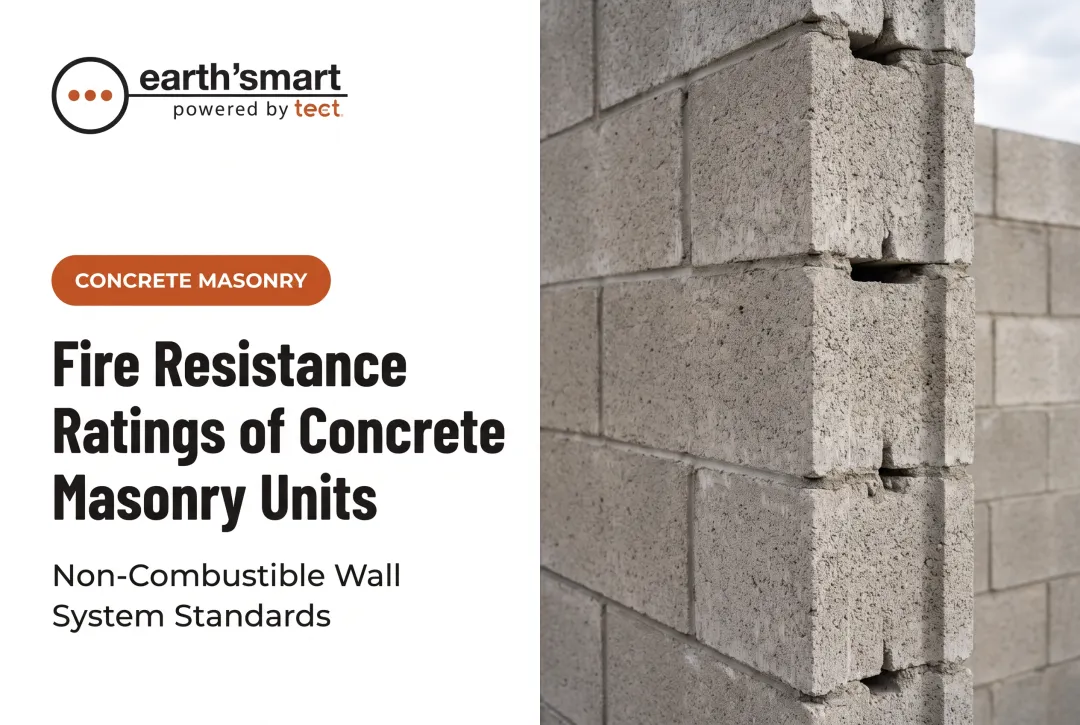
CMU walls are non-combustible. CMHA TEK 07-01D states that concrete masonry is widely specified for fire walls and barriers precisely because of this property.
Fire-resistance ratings aren't fixed by block size alone — they depend on equivalent thickness, aggregate type, grout fill, and surface finishes. Specific benchmarks from CMHA data:
- 8-inch ungrouted hollow CMU (approximately 4.0-inch equivalent thickness): 1.75 to 2.5 hours, depending on aggregate
- 8-inch fully grouted or solid CMU: greater than 4 hours
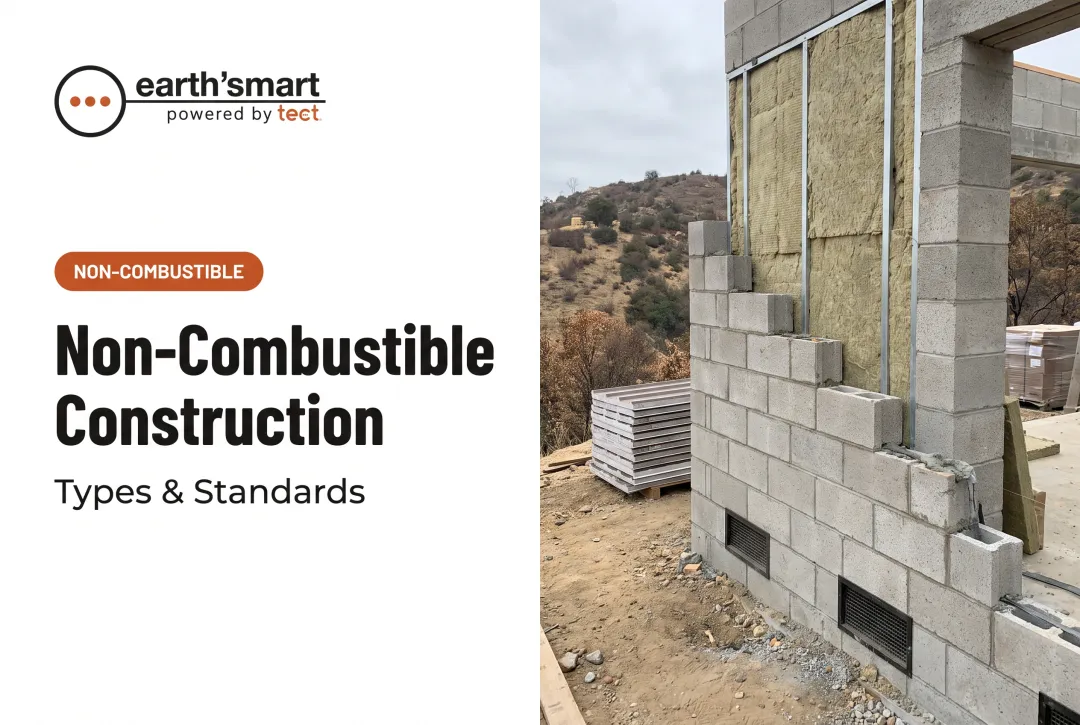
For WUI construction, this matters directly. California Building Code Chapter 7A governs exterior wildfire exposure requirements for new construction in fire hazard areas, and FEMA recommends non-combustible or fire-resistant exterior wall coverings that are not susceptible to melting. CMU satisfies both.
Important caveat: the wall is only one part of the fire equation. Openings, vents, roof-to-wall connections, and adjacent materials all require WUI-specific detailing to complete the defense.
Structural Strength and Seismic Performance
Unreinforced CMU walls and reinforced CMU walls perform very differently. The seismic performance that makes CMU a credible choice in Southern California comes from the reinforced system — grouted cores with vertical and horizontal rebar, designed and inspected under IBC Chapter 21 and TMS 402.
For Seismic Design Categories D and E (which include most of Southern California), CMHA TEK 14-18B requires special reinforced masonry shear wall detailing:
- Minimum total reinforcement area of 0.002 times gross wall area
- Neither direction falling below 0.0007
- Grouted cores with vertical and horizontal rebar throughout
- Design and inspection compliance under IBC Chapter 21 and TMS 402
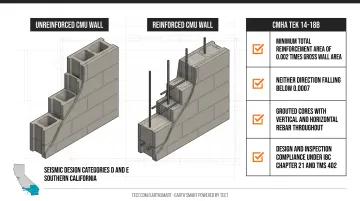
Seismic resilience in CMU is engineered and inspected — it doesn't come from the block alone.
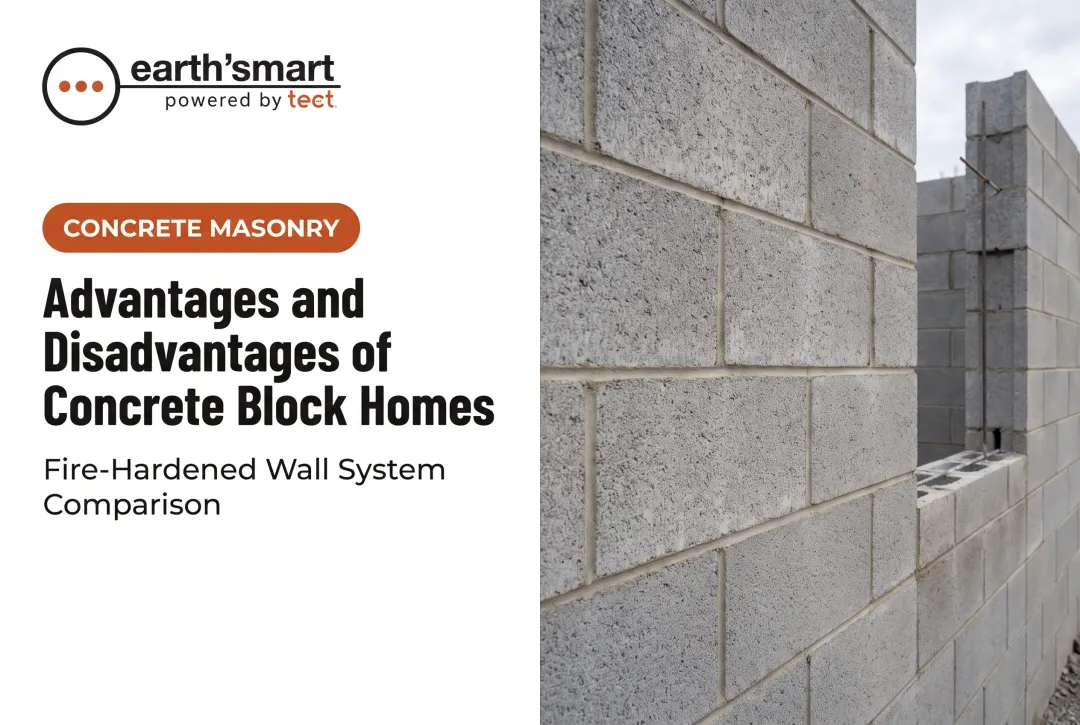
Durability and Lifecycle Cost
CMU walls resist the failure modes most common in wood-frame construction — rot, termite attack, mold, and moisture infiltration. HUD's Concrete Masonry Homes guide explicitly notes this resistance, and it holds up particularly well in areas with seasonal heat and humidity swings.
Combined with a 100+ year service life benchmark, the long-term cost comparison favors CMU for homeowners building to keep, not to sell in ten years.
One honest note: no authoritative data directly quantifies lower insurance premiums for CMU-built homes. The practical benefit is reduced maintenance exposure and a structurally more defensible rebuild argument — which matters in today's insurance market.
Thermal Mass and Energy Efficiency
CMU walls absorb heat during the day and release it slowly after temperatures drop — moderating interior temperature swings without the HVAC system carrying the full load. CMHA TEK 06-16A classifies wall thermal mass using heat capacity values, with ASHRAE 90.1 mass-wall thresholds including 7.0 Btu/ft²·°F for high-mass assemblies.
This is particularly relevant in Southern California's climate, where summer heat and wildfire smoke events put prolonged stress on mechanical systems. CMU's thermal mass supports energy performance strategies — though actual savings depend on climate zone, insulation placement, orientation, and HVAC design.
The Role of Early Coordination
CMU delivers its full benefit when materials and system interfaces are resolved during design, not discovered during construction. The wall alone doesn't determine performance — waterproofing details, flashing at openings, insulation placement, and reinforcement schedules all have to be right from the start.
Earth'smart powered by tect addresses this through the earth'smart powered by tectApp™ community — a network of 70+ building product manufacturers brought into the process alongside architects and structural engineers during design. Material selections and system interfaces get resolved before the first block is laid, not revisited once construction is underway.
How Concrete Masonry Construction Works: The Build Sequence
Foundation and Dry-Run Layout
The build starts with a clean, level foundation. Before any mortar is mixed, the mason performs a dry run: laying the entire first course without mortar to confirm dimensions, verify block spacing around openings, and identify where cuts will be needed.
Catching layout problems at this stage costs nothing. Catching them after three courses of mortar have set costs time, material, and money.
Mortar Mixing and Working Window
Variation in water-to-cement ratio between batches produces uneven bond strength across the wall — so consistent mixing matters throughout the pour. Key benchmarks from CMHA guidance:
- Machine-mix each batch for a minimum of 3–5 minutes
- Properly mixed mortar sticks to a trowel, slides off evenly, and holds moisture without slumping
- Use mortar within 2½ hours of initial mixing — discard after that window, regardless of appearance
Building Corners and Leads
Corners are built first and built accurately. They act as the control reference for every course that follows — if a corner is off-plumb or out of level, the error compounds across the entire wall.
A mason's line is stretched taut between completed corners to guide each intermediate course, keeping bed joints straight, level, and at the correct height. With corners set, course-by-course laying can proceed with a reliable reference at each end.
Laying Courses, Tooling Joints, and Grouting
- Mortar is applied to both bed joints (horizontal) and head joints (vertical ends) as each unit is set
- Hollow CMUs are laid with mortar fully covering the face shells; solid units require full mortar bedding
- When mortar reaches thumbprint-hard consistency, joints are tooled to a concave finish — this compresses the surface, improving water resistance and bond strength
- 3/8-inch joints are the module standard, matching the nominal dimension reduction built into CMU sizing
For reinforced walls, steel rebar is placed in designated cores before grouting. Grout fills those cores and bonds the steel to the masonry, so both materials carry load together as one structural system.
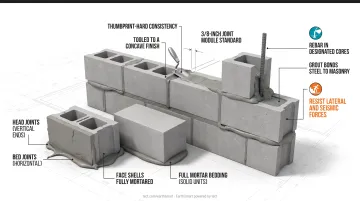
That integration is what gives a reinforced CMU wall its capacity to resist lateral and seismic forces — something a standard block wall simply cannot do.
What to Look for in Quality Concrete Masonry Work
Visual inspection alone won't reveal whether a CMU wall will perform. Homeowners reviewing work in progress should know what to look for — and what to ask for in writing.
Mortar Joint Quality
- Joints should be full and consistent at approximately 3/8 inch
- Voids, gaps, and thin spots compromise both moisture resistance and structural bond
- All joints should be tooled to a concave finish — not struck flat, not left rough
Dimensional Tolerances
CMHA TEK 03-08A sets measurable tolerances for acceptable work:
- Plumb: ¼ inch in 10 feet
- Level (top of bearing walls): ¼ inch in 10 feet, ½ inch maximum total variation
- Bearing wall plan location: ½ inch total variation from specified position
Walls outside these tolerances aren't just aesthetically off. Deviations affect how loads transfer through the structure.
Reinforcement as Specified
For any CMU wall intended to be structural or to meet seismic or fire code requirements, grouted cores with rebar are required without exception. Ask for documentation that:
- Rebar was placed per the structural drawings before grouting
- Core locations match the grouting schedule
- Special inspection was performed as required by the project's IBC/TMS requirements
Design-Construction Coordination
A well-built CMU wall can still underperform if system interfaces weren't resolved before construction started. Several details have to be designed in advance — not improvised in the field:
- Waterproofing terminations and flashing at lintels
- Insulation placement and thermal continuity
- Anchor bolt locations and embedment depths
- Lintel bearing and header coordination
Decisions left unresolved until construction is underway cost significantly more to correct. The earlier these interfaces are detailed, the fewer field surprises end up in the project budget.
Frequently Asked Questions
Is masonry construction the same as concrete?
No. Masonry uses individual precast units (including concrete blocks) bonded with mortar. Cast-in-place concrete is a fluid mixture poured into formwork. Both use concrete materials, but the construction methods, standards, and structural behavior differ significantly.
Why is the CMU wall widely used?
CMU walls combine non-combustibility, compressive strength, pest resistance, moisture resistance, and a 100+ year service life at a cost that competes with wood-frame construction. That combination makes them a standard choice across commercial and residential projects globally.
How much does a masonry contractor charge per hour?
BLS data for 2023 shows a national median wage of $28.67/hour for brickmasons and blockmasons, with Los Angeles-area wages running higher at around $35/hour. These are worker wages, not contractor billing rates. Contractor charges vary by project complexity and scope; for reinforced or seismic-detailed CMU work, coordination quality matters more than the lowest hourly rate.
What is the 4-2-1 rule for concrete?
The 4-2-1 ratio (4 parts aggregate, 2 parts sand, 1 part cement) is an informal rule of thumb sometimes used as a starting point for site-mixed concrete. CMU mortar and grout follow separate engineering standards entirely. Engineered mixes are specified based on structural requirements, not informal ratios.
What makes a CMU wall perform well in a wildfire zone?
CMU is non-combustible and doesn't contribute to fire spread. Fully grouted walls also maintain structural integrity under heat exposure. However, the wall alone isn't sufficient — complete wildfire resilience requires ember-resistant vents, protected openings, correct roof-to-wall detailing, and WUI-compliant adjacent materials throughout the assembly.