Concrete block (CMU) construction inspires genuinely strong opinions. Engineers point to its fire resistance and structural mass. Budget-conscious homeowners wince at the upfront cost. Architects note its constraints. All of them are right. This article cuts through the noise with a balanced look at what concrete block homes genuinely deliver — and where they fall short — so you can make an informed decision before committing.
Material choice is only part of the picture. How a home is designed, how its systems are coordinated, and how well the assembly is executed matters just as much as the block itself.
Key Takeaways
- Concrete block offers superior fire, wind, and seismic resistance — making it a strong choice in high-risk zones
- Bare CMU walls have low thermal resistance (~R-2.0 for an 8-inch hollow unit) and need added insulation to meet modern energy codes
- Higher upfront costs are offset by lower maintenance, better insurance outcomes, and a longer service life
- Moisture vulnerability is manageable with proper waterproofing — a solvable design challenge, not a structural weakness
- Full performance requires early coordination across structure, envelope, insulation, and MEP — getting this right starts at design, not during construction
What Is a Concrete Block Home?
Concrete masonry units (CMUs) are manufactured from Portland cement, water, and mineral aggregates such as sand or gravel, as defined by ASTM C90. The term "cinder block" is a colloquial name for the same product — though modern units no longer use coal ash as aggregate.
The standard unit on most residential projects is the 8 x 8 x 16 inch nominal block, with actual dimensions roughly 3/8 inch smaller to accommodate mortar joints.
Units come in two varieties: hollow (net cross-sectional area below 75% of gross area, meaning more than a quarter of the block face is open space) and solid (75% or greater).
How CMU Construction Works
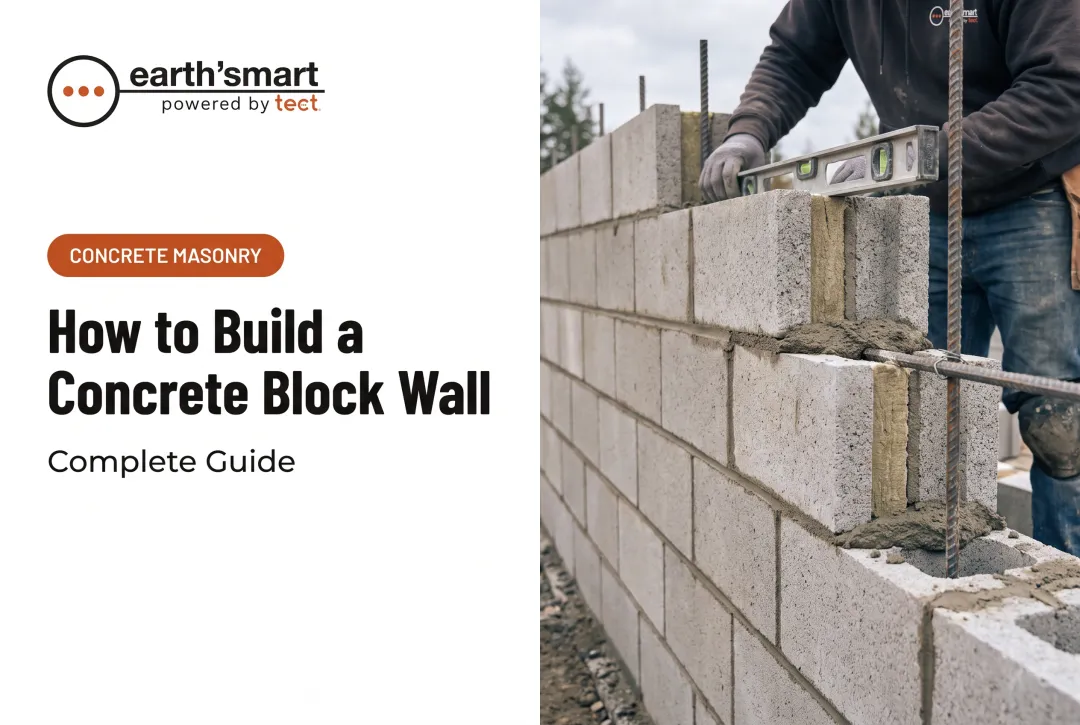
Blocks are stacked in courses using mortar, then cells are typically filled with concrete grout and reinforced with steel rebar. This grouting and reinforcement is what converts a stack of blocks into a structural wall capable of resisting lateral and vertical loads. CMU walls are used in several structural roles:
- Load-bearing walls
- Exterior building envelope
- Foundations
- Retaining walls
A note on ICF: Insulated Concrete Forms (ICF) are sometimes confused with CMU. Both use concrete, but ICF involves foam formwork filled with poured concrete — providing built-in continuous insulation. Standard CMU construction is the focus here. ICF performs significantly better thermally due to that continuous foam layer, so the distinction matters when evaluating energy efficiency and fire resilience.
Key Advantages of Concrete Block Homes
Fire Resistance
Concrete is non-combustible. It doesn't burn, contribute to flame spread, or release toxic gases when exposed to fire. That's the baseline.
The specifics matter more than the headline: according to fire-resistance data for concrete masonry assemblies, an 8-inch nominal CMU wall with a 60/40 gravel-pumice blend achieves:
- 2-hour fire-resistance rating with empty or partially filled cells
- 4-hour fire-resistance rating when solid-filled
These ratings are based on equivalent thickness and aggregate type, tested per ASTM E119. The fill condition and aggregate blend are what drive the number — not the block size alone.
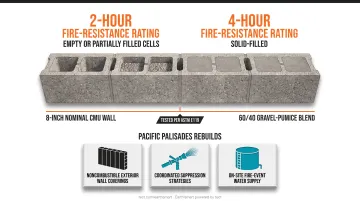
For homeowners rebuilding in Wildland-Urban Interface (WUI) zones, this matters directly. FEMA's wildfire construction guidance explicitly recommends noncombustible exterior wall coverings including concrete masonry units (CMU blocks) as a home-hardening strategy.
Earth'smart powered by tect's Earth'smart™ approach uses fire-resistive exterior wall systems with pre-insulated concrete masonry as a core strategy for Pacific Palisades rebuilds. Fire resistance is treated as a system outcome: non-combustible materials throughout, coordinated suppression strategies, and on-site water supply designed for fire-event response.
Disaster and Wind Resistance
Reinforced CMU walls provide structural mass and rigidity that resist both wind-driven lateral forces and seismic loads. FEMA P-361 designates reinforced masonry as a qualified system for safe rooms designed for wind speeds up to 250 mph for tornadoes and 235 mph for hurricanes — though these ratings apply to FEMA/ICC safe-room construction standards, not standard whole-house wall assemblies.
The structural case for CMU in seismic regions rests on the combination of wall mass, grouted cells, and continuous rebar reinforcement. When properly engineered, this assembly resists racking forces that can destabilize lighter framing systems.
Energy Efficiency and Sound
Thermal mass is CMU's real energy contribution. A single-wythe concrete masonry wall weighing 34 lb/ft² carries a heat capacity of approximately 7.14 Btu/ft²-F — exceeding ASHRAE Standard 90.1 thresholds for mass wall designation. In practical terms, this means the wall absorbs heat during the day and releases it at night, moderating indoor temperature swings without mechanical assistance.
The caveat: uninsulated 8-inch hollow CMU has a base R-value of approximately R-2.0. That's not enough for California energy code compliance on its own. California's 2025 energy code requires above-grade mass/masonry walls to achieve R-13 interior or R-8 exterior insulation in Climate Zones 1-15. Insulation must be added, which increases cost and construction steps, but is completely achievable within a well-sequenced build.
On sound, CMU performs well. NCMA TEK 13-01C documents STC ratings for 8-inch CMU:
| Assembly | STC Range |
|---|---|
| 8-inch hollow CMU | 44–52 |
| 8-inch fully grout-filled CMU | 54–61 |
| 8-inch solid CMU | 55–62 |
For comparison, standard wood-stud walls without additional treatment typically land in the STC 35–45 range. The density of concrete does the work here.
Insurance and Long-Term Financial Value
No verified insurer data exists to support a specific premium reduction percentage for CMU homes — and this article won't fabricate one. What is accurate: insurance in California's high-risk zones is harder to obtain, more expensive, and in some areas no longer available through standard carriers. Homes built with non-combustible materials and fire-resistive assemblies are better positioned in that environment.
Earth'smart powered by tect's Earth'smart™ projects are explicitly designed to "materially reduce risk" — for occupant safety and for insurability. Building to address the risks insurers are reacting to has become as much a financial strategy as a safety one.
Notable Disadvantages of Concrete Block Homes
Higher Upfront Cost
CMU construction costs more than wood framing per square foot. The premium comes from multiple directions:
- Material weight: Blocks require more labor and equipment to handle than dimensional lumber
- Skilled labor: Experienced masonry crews are less common than wood framing crews in many regions
- Added insulation: California energy code requires insulation that isn't built into standard CMU, adding both materials and steps
- Grouting and rebar: Achieving structural CMU performance requires filled cells and reinforcement, which adds cost beyond the blocks themselves
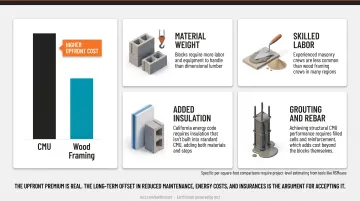
Specific per-square-foot comparisons require project-level estimating from tools like RSMeans. The range varies significantly by region, design complexity, and labor market. The upfront premium is real — and the long-term offset through reduced maintenance, energy costs, and insurance positioning is the argument for accepting it.
Thermal Performance Gap
Unlike ICF, standard CMU walls don't come with insulation built in. An 8-inch hollow block at approximately R-2.0 is a structural system, not a thermal envelope. Achieving code compliance in California requires adding continuous insulation (either interior or exterior) and coordinating that layer with the rest of the wall assembly.
It's an additional design step that requires early planning. Specifying insulation as an afterthought invites thermal bridging, moisture issues at transitions, and compliance gaps.
Utility Access and Future Modifications
Running plumbing and electrical through CMU walls is manageable during construction and far more difficult afterward. Unlike wood framing where a saw and some patching handles most modifications, changing embedded runs in a concrete block wall means cutting through grouted masonry.
The practical implication: every utility decision should be locked in during design. Earth'smart powered by tect coordinates mechanical, electrical, and plumbing routing before walls go up, resolving these decisions during design where changes are still low-cost.
Moisture Vulnerability
Concrete block is porous. CMHA guidance confirms that water penetration resistance depends on wall design, movement detailing, workmanship, maintenance, and water repellent treatments. In high water table conditions or moisture-heavy environments, water can penetrate through capillary action, leading to efflorescence, potential mold, and long-term degradation.
This is a solvable problem — but it must be solved during design, not after move-in. Proper waterproofing treatment, drainage detailing, and moisture management are essential for CMU walls in moisture-prone conditions.
Concrete Block vs. Wood-Frame Homes
| Attribute | Concrete Block (CMU) | Wood Frame |
|---|---|---|
| Upfront construction cost | Higher | Lower |
| Fire resistance | 2–4 hours (assembly-specific) | Depends on gypsum/tested assembly |
| Wildfire/WUI suitability | FEMA-recommended noncombustible | Requires compliant cladding/assemblies |
| Wind/disaster resistance | High mass and rigidity; qualified for reinforced masonry safe rooms | More vulnerable to lateral forces |
| Energy efficiency (uninsulated) | ~R-2.0 base; thermal mass benefit | Better base R-value; less thermal mass |
| Energy efficiency (with insulation) | Strong, code-compliant with added insulation | Strong with standard insulation |
| Sound isolation | STC 44–61 depending on fill | Typically STC 35–45 without enhancement |
| Design flexibility | Moderate; complex curves require more effort | High |
| Moisture management | Requires waterproofing treatment | Different vulnerabilities (rot, swelling) |
| Maintenance requirements | Low once properly built | Higher (rot, pest treatment, repainting) |
| Pest and rot resistance | Inorganic — unaffected by termites or rot | Vulnerable without treatment |
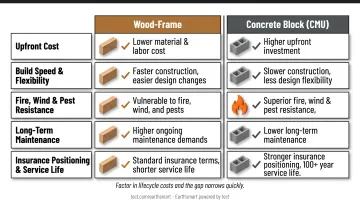
The core tradeoff is straightforward: wood framing is cheaper upfront, faster to build, easier to modify, and more flexible for unusual architectural forms. Concrete block delivers superior resilience — in fire, wind, and pest resistance — with lower long-term maintenance demands.
Factor in lifecycle costs and the gap narrows quickly. Reduced maintenance, better insurance positioning, and longer service life all move in CMU's favor — which is why it's the dominant choice for homeowners rebuilding in fire-prone areas where long-term performance matters more than first-cost savings.
Is a Concrete Block Home Right for You?
Strong Candidates for CMU
- Homeowners rebuilding after wildfire in WUI zones like Pacific Palisades, where non-combustible construction directly addresses the documented risk
- Those in hurricane or high-wind corridors where structural mass and rigidity provide genuine protection
- Coastal or high-humidity climates where pest resistance and rot resistance eliminate ongoing treatment costs
- Anyone building for the long term — CMU's service life, with proper maintenance, far exceeds typical wood framing
When Another System May Fit Better
- Tight initial budgets where the upfront premium is a genuine barrier
- Regions with scarce masonry labor, where finding experienced CMU crews drives costs and timelines higher
- Highly custom architectural designs requiring complex curves or unusual forms
- Projects where thermal performance is the top priority — in that case, ICF may deliver higher R-values out of the box with less added work
The System Integration Imperative
A concrete block wall is one component of a complete assembly. The fire resistance, thermal performance, moisture management, and structural integrity of a CMU home all depend on how that assembly is designed and executed — insulation placement, waterproofing details, utility routing, and envelope continuity.
Most CMU projects underperform not because the material fails, but because the systems around it are treated as afterthoughts — insulation added late, waterproofing details improvised, envelope continuity never fully resolved.
Earth'smart powered by tect's Earth'smart™ approach addresses this directly. By bringing together architecture, engineering, construction, and direct input from 70+ building product manufacturers through the earth'smart powered by tectApp™ community, decisions about insulation, waterproofing, and system integration get made early — when they're still straightforward to get right.
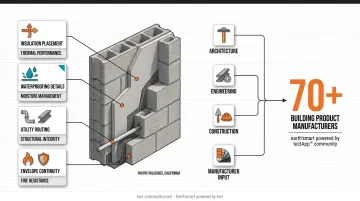
For Pacific Palisades homeowners rebuilding with CMU, that early coordination is what separates a home that performs under pressure from one that looks the part but falls short when it matters.
Frequently Asked Questions
What are the advantages of concrete blocks?
Concrete block offers fire resistance (2–4 hours depending on assembly), strong wind and seismic resistance from its structural mass, immunity to rot and termite damage, excellent sound isolation (STC 44–61), and low long-term maintenance demands. These advantages compound over the life of the home through reduced repair costs and better insurance positioning.
How long do concrete block homes last?
Properly built and maintained CMU structures have very long service lives. The CMHA notes that useful life is directly tied to maintenance quality, and because the material is inorganic, a well-maintained CMU home can outlast multiple generations of conventional construction.
Are concrete block homes more expensive to build than wood-frame homes?
Yes, upfront costs are generally higher due to labor, material weight, and the insulation required to meet energy codes. That gap narrows significantly over time through lower maintenance, energy costs, and insurance positioning — CMU becomes the more economical choice when evaluated across the full lifecycle.
Do concrete block homes have moisture problems?
CMU is porous and can allow water seepage if not properly waterproofed — particularly in high-moisture or high water table environments. This is a solvable design issue, not an inherent material flaw. Correct waterproofing treatment, drainage design, and movement detailing address it effectively when planned from the start.
Are concrete block homes better for fire-prone areas?
Yes. CMU is non-combustible and achieves 2–4 hour fire-resistance ratings depending on assembly conditions. FEMA's wildfire construction guidance explicitly recommends CMU blocks as a noncombustible exterior wall covering for WUI homes.
What is the difference between concrete block (CMU) and ICF construction?
CMU uses pre-formed hollow or solid blocks stacked with mortar and grouted; ICF uses foam formwork filled with poured concrete that provides continuous built-in insulation. ICF generally delivers higher thermal performance without added steps, while CMU requires insulation to be designed in separately but is widely understood, available, and carries well-documented fire-resistance data.