Introduction
Most homeowners approaching a custom build or wildfire rebuild start with the same assumption: hire an architect, get plans, then bid those plans to contractors. It seems logical. In practice, it creates a structure where the person who designed your home has no stake in how it gets built, and the person building it had no say in how it was designed.
That gap costs money, delays the schedule, and produces a home that underperforms what was promised on paper.
The design-build method eliminates that gap. Under a single contract, one entity is responsible for both design and construction from concept through completion.
For standard builds, this produces better schedules and fewer surprises. For high-performance homes — particularly those rebuilding in wildfire-exposed areas like Pacific Palisades, where the January 2025 Palisades Fire displaced thousands of households — it determines whether the home actually performs as intended once built.
This guide covers what design-build is, how it works, why it produces better outcomes for complex projects, and where it has real limitations.
Key Takeaways
- Design-build unifies design and construction under one contract and one accountable team
- Architects, engineers, and contractors collaborate from day one, reducing rework and cost overruns
- Performance-driven homes require deeply integrated systems — fragmented teams make those decisions out of sequence
- Early manufacturer input, enabled by an integrated team, produces better material decisions before systems are enclosed
- Design-build isn't ideal for every project; it works best when long-term outcomes matter more than the lowest initial bid
What Is the Design-Build Method of Project Delivery?
Design-build is a project delivery method where the owner signs a single contract with one entity — the design-builder — who is responsible for both the architectural design and physical construction of the project. As the AIA defines it, this creates a single point of responsibility between the owner and design-builder across the entire project lifecycle.
The design-builder may be a single firm, or an integrated team — architect and contractor working as one unit under a shared agreement. Either way, both design and construction decisions flow through the same accountable party.
How This Differs from Design-Bid-Build
In the traditional design-bid-build sequence:
- Owner hires an architect separately
- Architect produces completed drawings
- Owner bids those drawings to contractors
- A contractor is selected — often one who had no input into the design
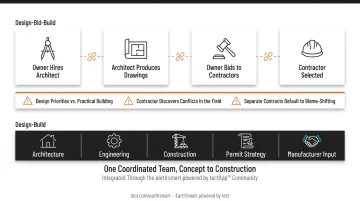
The result is natural friction. The architect's priorities don't always match what's practical to build. The contractor discovers conflicts in the field. Both parties have separate contracts with the owner, which means disputes default to blame-shifting rather than problem-solving.
Design-build removes that structure entirely. The same entity that designs the project builds it, so there's no handoff gap and no competing interests between the people who drew the plans and the people executing them.
For homeowners — particularly those rebuilding after wildfire or navigating complex WUI construction — that alignment matters from the first design conversation. Earth'smart powered by tect's Earth'smart™ Path A Turnkey Delivery applies this model to resilient residential construction: one coordinated team handling architecture, engineering, construction, and permit strategy, with direct manufacturer input through the earth'smart powered by tectApp™ community integrated from concept forward.
Why Design-Build Is Especially Valuable for High-Performance and Resilient Homes
Standard construction tolerates ambiguity. When the architect and contractor are separate entities, system decisions — structural, mechanical, envelope — often get resolved during construction rather than during design. The result: substitutions, compromises, and performance gaps that are expensive to fix and impossible to ignore.
For fire-resistive homes in wildfire-exposed zones, those gaps aren't a cost problem — they're a safety problem.
The Cost of Fragmented System Decisions
A resilient home isn't a collection of independently specified components. The structural system affects the envelope. The envelope affects the mechanical strategy. Ember-resistant venting connects to fresh-air filtration, which connects to how the home is pressurized. These decisions are interdependent — and they need to be made together.
When teams are fragmented, those decisions happen in sequence and in isolation:
- The structural engineer makes decisions without envelope input
- The HVAC contractor sizes equipment against plans that may change
- Fire suppression gets specified late, after major layout decisions are locked
- Product substitutions get made during construction with limited technical review
The result is homes that meet code on paper but fall short on fire resistance, air quality, and energy performance when it counts.
What Integration Actually Changes
An integrated design-build team can front-load decisions that fragmented teams push to the field. For WUI-zone homes specifically, this matters across every major system:
- Structural systems (ICF, AAC, pre-insulated concrete masonry) are sized against seismic and fire-resistive requirements at the same time, not sequentially
- Roofing and envelope assemblies — Class A non-combustible materials, ember-resistant venting, non-combustible eaves — are specified as one system, not sourced piecemeal
- Fire suppression infrastructure (dedicated on-site water supply, vapor dome systems, FIREBOZZ® water cannons) is engineered alongside structural and site decisions, not retrofitted after layout is locked
- Mechanical and air quality systems — MERV-13+ filtration, fresh filtered air, SMARTVALVE® water-conservation technology — are sized against envelope performance from day one
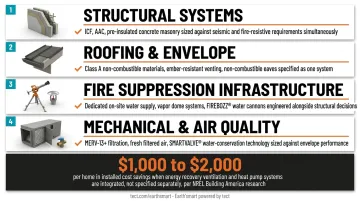
NREL's Building America research found that integrating energy recovery ventilation and heat pump systems — rather than specifying them separately — can reduce installed costs by $1,000 to $2,000 per home. That finding applies to standard high-performance builds. In fully fire-hardened WUI construction, where system interdependencies are far greater, the cost of getting those decisions wrong is substantially larger.
The Adversarial Dynamic in Traditional Delivery
When architect and contractor are on separate contracts, disputes about design errors, scope gaps, and cost overruns default to finger-pointing. Neither party is incentivized to absorb the cost of the other's decisions.
Design-build eliminates that dynamic. One entity is accountable for both design and construction, so the incentive is always to solve problems — not to assign blame for them.
For homeowners in Pacific Palisades and other WUI rebuild zones, earth'smart powered by tect's earth'smart powered by tectApp™ community of 70+ vetted building product manufacturers adds another layer. Manufacturer input happens early in design, when product decisions are still reversible. By the time construction begins, the system choices are confirmed — not still being worked out.
How the Design-Build Process Works
Design-build doesn't run sequentially — it runs in overlapping, integrated phases where construction knowledge directly shapes design decisions.
Pre-Construction and Feasibility
Before a design line is drawn, the design-builder establishes project scope, budget parameters, site conditions, zoning requirements, and permitting strategy. Early cost modeling is grounded in actual construction knowledge — not theoretical estimates from a designer who hasn't priced the work.
For WUI-zone projects, this phase is where permit complexity gets assessed upfront. California's 2025 WUI Code (effective January 1, 2026) adds requirements covering fire spread, accessibility, defensible space, and water supply. Identifying those requirements before design begins prevents costly plan revisions later.
Design Development
The integrated team develops design through iterative cycles — refining plans while maintaining alignment across constructability, budget alignment, and system performance. Architects, engineers, and construction leads work concurrently, not sequentially.
Key advantages during this phase:
- Design decisions are stress-tested against real buildability constraints
- Specialist consultants and product manufacturers contribute input before selections become difficult to change
- Value engineering happens before costs are locked — not after the owner has already approved a budget
Construction
There's no handoff gap — the design and construction teams are the same entity. Work proceeds against performance standards set during design, not handed off through a separate contract. Key advantages on the construction side:
- Subcontractors are coordinated by a team that already knows the project intent, system selections, and substitution history
- Field questions get answered faster because the people building the home are the people who designed it
- No translation loss between what the architect specified and what gets built
Project Closeout
At closeout, all project knowledge — design decisions, system specifications, substitution records — resides with one team. Documentation and system walkthroughs are more complete because nothing was siloed across separate contracts. For WUI homeowners especially, that documentation matters: knowing exactly what fire-resistive assemblies were installed, which substitutions were made, and how suppression systems were commissioned is information you may need for insurance, future maintenance, or a rebuild claim.
Key Factors That Shape Design-Build Outcomes
Team Selection Is the Critical Variable
Design-build concentrates significant project authority in one entity. The quality of that entity is therefore the single most consequential decision an owner makes. Evaluating a design-build team purely on initial cost proposals misses the point.
What to assess instead:
- Demonstrated experience with projects of similar complexity and performance requirements
- A clear, documented communication process
- Evidence of how design decisions are coordinated with construction knowledge from the start
- Track record with the specific building systems and codes applicable to the project
The Owner's Brief Must Be Complete
Design-build's schedule and cost advantages depend on a well-defined performance brief at the outset. Because the design-builder develops both design and cost from the owner's stated goals, vague or shifting requirements create downstream changes that erode the method's core benefits.
Define priorities — performance targets, non-negotiables, budget parameters — before engagement begins.
What the Data Shows
That guidance is grounded in data.
Research from DBIA, CII, and the Pankow Foundation analyzed 212 projects across a broad construction dataset. Results across that sample:
- 102% faster from design through completion vs. design-bid-build
- 36% faster construction speed than traditional delivery
- 3.8% less cost growth over the project lifecycle
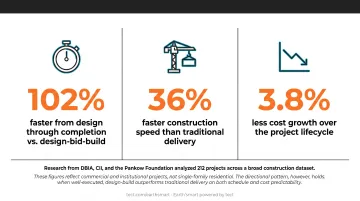
These figures reflect commercial and institutional projects, not single-family residential. The directional pattern, however, holds: when well-executed, design-build outperforms traditional delivery on both schedule and cost predictability.
Common Misconceptions and Limitations of Design-Build
"The Owner Loses Control"
This is the most common objection — and it misunderstands how design-build works. Owner involvement in design-build is front-loaded, not eliminated. Goals, performance requirements, and priorities are defined at the start. The team executes against them.
The owner trades ongoing mediation between separate parties for one accountable team delivering against a clear brief. That shift requires more clarity upfront — and produces less reactive management throughout.
"Design-Build Is Cheaper at Bid Stage"
Not necessarily. A design-build proposal typically includes more complete scope than a design-bid-build bid, which often excludes allowances, contingencies, and post-design changes. The meaningful comparison is total project cost — including change orders, rework, and schedule delays — not the initial number.
The WBDG cautions that overemphasizing price in design-build selection can force quality compromises to meet budget targets, undermining the method's core value.
When Design-Build May Not Be the Right Fit
Design-build works best when owner and team are aligned on what integrated delivery is expected to achieve. It may not be the right structure when:
- Procurement rules require competitive bidding between separate design and construction entities (common in some public-sector contexts)
- Independent design review is a priority — some owners or lenders require a third-party design review that design-build structures can complicate
- The owner has pre-existing team commitments — in that case, an advisory model like earth'smart powered by tect's Earth'smart™ Path B may be a better fit, working alongside an existing architect and contractor to improve coordination without restructuring the whole engagement
Before committing to design-build, owners should be able to name at least one specific outcome — faster delivery, fewer change orders, tighter system integration — that the structure is expected to produce. If that answer isn't clear going in, the method won't supply it.
Frequently Asked Questions
Are design-build contractors collaborative by nature?
Collaboration is structurally built into design-build — all team members share one contract and one set of goals, which removes the adversarial incentive of separate architect and contractor agreements. Collaboration quality still depends on how the team is structured and led. The contract creates the conditions; the people determine the outcome.
How does design-build differ from design-bid-build?
Design-bid-build separates design and construction into sequential contracts with different entities. Design-build unifies both under a single contract and team, eliminating the handoff gap and aligning incentives between the parties who design the project and those who build it.
Is design-build more expensive than hiring separately?
Design-build may carry a higher initial proposal cost than a lowest-bid design-bid-build approach, but the DBIA/CII/Pankow research found design-build delivered 3.8% less cost growth and cost 0.3% less per square foot than design-bid-build. The relevant comparison is total project cost, not opening bid.
What should a homeowner look for when selecting a design-build team?
Prioritize demonstrated experience with similar project types and performance requirements, a clear communication process, and evidence that design decisions are coordinated with construction knowledge from day one. Lowest price is not a reliable selection criterion; it typically signals incomplete scope.
Is design-build a good fit for homeowners rebuilding after a wildfire?
Yes, and it's particularly well-suited to WUI rebuild projects. Fire-resistive homes require deeply integrated structural, envelope, mechanical, and suppression decisions that fragmented teams routinely get wrong. The Palisades Fire destroyed 6,845 structures; rebuilding to withstand the next event requires a coordinated team from day one.