Introduction
On January 7, 2025, Pacific Palisades burned. By 6:30 p.m., firefighters were reporting low hydrant pressure. By January 9, LAFD reported that crews had stopped tapping hydrants altogether due to system failure. LADWP was pumping at a maximum of 37,000 gallons per minute — and it still wasn't enough.
The hard truth, confirmed by both CalEPA and LAFD's after-action review, is that local water infrastructure was never designed for a firestorm consuming an entire neighborhood simultaneously. Burning homes left internal plumbing open, leaking water and dragging down network pressure for every hydrant downstream.
A home sprinkler system is only as good as the pressure feeding it. If that pressure disappears during the event the system was installed to survive, the sprinklers stop working. Fire protection pump systems exist to solve that problem — they're a functional requirement for homes in wildfire-prone areas where municipal pressure is unreliable, insufficient, or absent.
This guide covers what residential fire pump systems are, when you need one, the types available, and the codes that govern them — including NFPA 13D, 13R, and NFPA 20. It also walks through installation requirements and maintenance obligations. Written for homeowners rebuilding in WUI zones, not engineers.
Key Takeaways
- A fire pump boosts water pressure so your sprinkler system can function when supply pressure falls short
- Pump sizing must be calculated by a licensed fire protection designer — not estimated by horsepower range alone
- NFPA 13D governs single-family residential sprinkler systems; NFPA 20 applies when a dedicated fire pump is installed
- Combined domestic/fire pumps are sometimes permitted but carry long-term maintenance risks you should weigh first
- Annual flow testing under NFPA 25 is a real obligation; passing means meeting system demand, not just powering on
What Is a Residential Fire Protection Pump System?
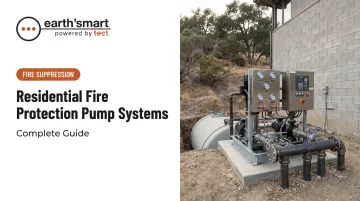
A residential fire protection pump system is a pump, controller, and supporting hardware that ensures your home sprinkler system receives water at the pressure and flow rate its design requires. When the incoming water supply — whether from a municipal main or an on-site storage tank — can't meet those requirements on its own, a pump fills the gap.
Core Components
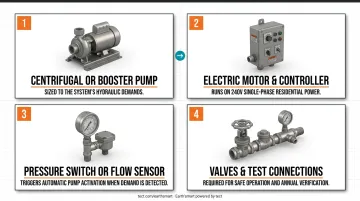
A typical residential fire pump system includes:
- The pump itself — centrifugal or booster type, sized to the system's hydraulic demands
- An electric motor/controller — residential pumps typically run on 240V single-phase power
- A pressure switch or flow sensor — triggers automatic pump activation when demand is detected
- Associated valves and test connections — required for safe operation and annual verification
Residential vs. Commercial: A Key Distinction
Under NFPA 13D, which governs single-family and two-family dwellings, pumps are not required to be UL-listed. This gives homeowners more flexibility in pump selection than commercial fire pump installations face. That flexibility doesn't eliminate the need for proper hydraulic sizing. It means the product universe is wider, but the sizing work is just as critical.
The rules shift for larger residential buildings. NFPA 13R, which covers low-rise buildings up to four stories, requires any installed fire pump to comply with the stricter NFPA 20 standard, including UL listing. Knowing which standard applies to your building type is the first step — it determines exactly which pump products are allowed.
When Does a Home Actually Need a Fire Pump?
The answer is hydraulic, not geographic. A pump is required when the available water supply at your point of connection — municipal main or private tank — cannot satisfy the pressure and flow demand of your sprinkler system's hydraulic calculations.
For most NFPA 13D residential systems, demand is calculated based on the flow needed to run two sprinkler heads simultaneously for 10 minutes. Talco, a manufacturer specializing in residential fire pump systems, cites a common example of 15 gpm per head, totaling 30 gpm — though actual figures vary by design.
The WUI Reality
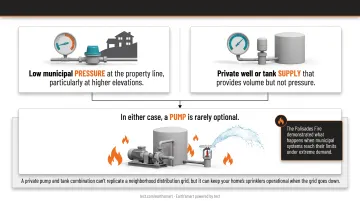
Homes in wildland-urban interface zones frequently face one of two supply problems:
- Low municipal pressure at the property line, particularly at higher elevations
- Private well or tank supply that provides volume but not pressure
In either case, a pump is rarely optional. The Palisades Fire demonstrated what happens when municipal systems reach their limits under extreme demand. A private pump and tank combination can't replicate a neighborhood distribution grid, but it can keep your home's sprinklers operational when the grid goes down.
The Design-Phase Decision Point
Timing matters here. Adding a fire pump after walls are framed and conduit is run means revisiting:
- Pipe sizing and routing
- Electrical panel capacity
- Tank dimensions and placement
Each of those is a trade coordination problem — not a minor adjustment. Earth'smart powered by tect builds fire protection decisions into the design process early, so pump specifications are confirmed before other trades begin work. That prevents expensive rework and ensures the pump integrates properly with the systems around it.
Not every home needs a pump. If municipal pressure at your meter is sufficient to meet the sprinkler system's calculated demand, no pump is required. A flow and pressure test at system design will confirm whether a pump is needed.
Types of Residential Fire Pumps
Standard (Fixed-Speed) Pumps
These pumps operate on a fixed pressure-flow curve: more pressure at lower flow rates, less pressure as flow increases. They're the most common and affordable option for systems where the pump serves only the fire sprinkler system, not domestic water.
Selecting the right fixed-speed pump requires matching the manufacturer's pump curve against the system's design point — the specific flow and residual pressure the sprinkler calculation demands. A pump that looks adequate on paper can still miss the design point if the curve isn't checked carefully.
Variable-Speed (Fixed-Pressure) Pumps
Variable-speed pumps adjust motor speed to maintain constant output pressure regardless of demand fluctuations. They're particularly useful when the pump serves both the sprinkler system and domestic water supply, because everyday fixture use — showers, dishwashers — won't cause pressure swings that interfere with sprinkler performance.
The tradeoff is cost. Variable-speed pumps carry a higher upfront price, but deliver more consistent performance when serving both systems.
Dedicated vs. Combined Domestic/Fire Pumps
NFPA 20 Section 4.7.1 states that fire pumps shall be dedicated to fire protection service. However, Annex A.4.7.1 permits combined domestic/fire arrangements under specific reliability conditions.
The practical implications differ by standard:
| Standard | Combined Pump Approach |
|---|---|
| NFPA 13D (single-family) | More commonly accepted when properly designed and AHJ approves |
| NFPA 13R (low-rise multi-family) | Requires NFPA 20 compliance; AHJ review strongly advised |
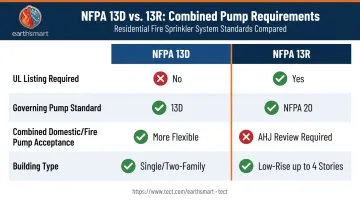
A combined pump may not fall under NFPA 25 fire pump inspection requirements, depending on how the AHJ classifies it. That creates a reliability gap — the pump gets serviced as a domestic water pump, not as fire protection equipment. Before pursuing a combined approach, confirm with the AHJ exactly how the system will be classified and maintained.
Pump Power and California-Specific Requirements
Most residential fire pumps run on a 240V single-phase circuit per NFPA 70. Talco's NFPA 13D Flow-to-Start booster line offers options from 3/4 HP to 5 HP — actual sizing must follow hydraulic calculations for the specific system.
For California projects, if the pump serves only the fire sprinkler system (not domestic water), the California Residential Code includes amendments requiring:
- A stainless steel pump
- Connection to a shared 220V circuit with a major household appliance (oven, dryer, or range)
These requirements affect both product selection and electrical panel planning. They need to be confirmed with your local AHJ and reviewed during design — not discovered during rough-in.
How Residential Fire Pump Systems Work
Automatic Activation
The pump connects to either a pressure switch or a flow sensor that monitors system conditions. When one or more sprinklers open due to heat, water begins moving through the system. The pressure switch detects the pressure drop and signals the pump to start — no manual action required.
Talco's flow-to-start (FTS) system uses a flow sensor instead of a pressure switch, activating only when at least 5 gpm of demand is present. This eliminates pressure-switch field adjustments and reduces the risk of false starts from minor pressure fluctuations. Pump start logic is part of the design — not an afterthought.
Pressure Cycling Risk
One reliability concern with pressure-switch systems is rapid cycling — the pump switching on and off multiple times per second when pressure fluctuates near the switch threshold. Proper switch settings and timers prevent this, which is why pump controls require engineering attention, not just installation.
Jockey Pumps
In larger or estate-scale residential systems, a jockey pump (also called a pressure maintenance pump) maintains baseline system pressure during normal conditions. This prevents the main pump from cycling due to minor leaks or small fluctuations. They're standard in commercial applications and appear in residential systems primarily when the design is larger or more complex.
Test Connections
NFPA 13D requires a test connection downstream of the pump that allows annual performance verification without discharging water through actual sprinklers. This connection simulates sprinkler flow and confirms the pump activates and performs correctly. This test connection is how ongoing system reliability gets confirmed — it's a code requirement, not a convenience.
Code Requirements: NFPA 13D, 13R, and NFPA 20
NFPA 13D: Single-Family and Two-Family Homes
NFPA 13D is the primary standard for one- and two-family dwellings and manufactured homes. For pump installations under 13D, key requirements include:
- Test connection downstream of the pump
- 240V wiring per NFPA 70 (National Electrical Code)
- Approved disconnecting means
- Minimum 1.5-inch floor clearance
- Pumps are not required to be UL-listed (giving homeowners more product flexibility than commercial standards allow)
For California projects, add the stainless steel pump requirement and shared 220V circuit to that list, and verify any additional local amendments with the AHJ.
NFPA 13R: Low-Rise Residential Buildings
NFPA 13R applies to residential occupancies up to four stories — apartment buildings and similar. Any fire pump installed under 13R must comply with NFPA 20, which imposes stricter requirements than 13D: UL listing, dedicated fire protection service, and more rigorous installation and testing standards.
If you're rebuilding a single-family home, 13R almost certainly doesn't apply — but confirming with your AHJ takes five minutes and removes any ambiguity.
NFPA 20 and AHJ Coordination
NFPA 20 governs the selection and installation of stationary fire pumps whenever a dedicated fire pump is involved. Its requirements cover dedicated power supply, acceptance testing, controller specifications, and installation conditions — considerably more involved than what 13D requires.
Regardless of which standard applies, the process is the same: work with a licensed fire protection designer and engage the Authority Having Jurisdiction (AHJ) — your local fire marshal or building department — early. This matters most if you're considering a combined domestic/fire pump arrangement, where one AHJ may accept a shared setup and another won't.
Installation, Maintenance, and Testing
Sizing Is a Calculation, Not an Estimate
Pump selection requires plotting the manufacturer's pump curve against the system's hydraulic design point — the specific flow and residual pressure required at the most demanding sprinklers. Get the sizing wrong in either direction and there are consequences:
- Undersized: Pump fails to meet system demand during a fire event
- Oversized: Excess pressure damages sprinkler heads or supply plumbing
- Estimated (not calculated): Code non-compliance and potential permit failure
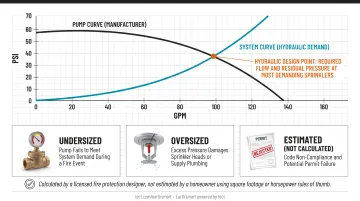
This calculation is performed by a licensed fire protection designer — not estimated by a homeowner using square footage or horsepower rules of thumb.
Ongoing Maintenance Obligations
According to NFPA's data on electric fire pump inspections, fire pumps account for 17% of all deficiencies found during inspections, and the weekly no-flow test alone accounts for 30% of fire pump deficiencies. The same source notes that all fire pump inspections, tests, and maintenance must be documented — with records kept for the life of the system.
A pump that turns on is not the same as a pump that meets system demand. Annual flow testing confirms the difference.
For dedicated fire pumps, NFPA 25 governs the inspection, testing, and maintenance program. Annual flow tests compare current pump performance against the original pump curve data. They must be performed by a licensed fire protection contractor, not a homeowner.
Homeowner responsibilities typically include:
- Visual inspection of the pump room and controller status (weekly or monthly)
- Licensed contractor flow test annually, benchmarked against original design data
- Documentation kept for the life of the system
- California installations: Confirm with your AHJ whether monthly exercise valve operation is required
earth'smart powered by tect's Coordination Advantage
Fire pump systems intersect with a home's electrical infrastructure, water supply, and sprinkler pipe network. When these decisions are made in sequence by separate subcontractors, gaps appear: a pump circuit that doesn't match panel capacity, a tank sized for volume but not for pump inlet requirements, a test connection placed where no one can reach it annually.
Earth'smart powered by tect connects licensed architects, fire protection designers, and the earth'smart powered by tectApp manufacturer community from the earliest design phase, so these decisions are made together — not patched after the fact. Fire protection pump decisions are embedded in the home's overall systems strategy before construction begins, not resolved after problems surface.
Frequently Asked Questions
Do I need a fire pump for my home sprinkler system?
Only if the available water pressure at your supply point is insufficient to meet the sprinkler system's hydraulic demands. A flow and pressure test during system design determines this. Many homes with adequate municipal pressure don't need a pump at all.
What is the difference between NFPA 13D and NFPA 13R for residential fire pumps?
NFPA 13D covers single-family and duplex homes and allows non-UL-listed pumps with simpler installation requirements. NFPA 13R applies to low-rise residential buildings up to four stories and requires any fire pump to comply with the stricter NFPA 20 standard, including UL listing and dedicated fire protection service.
Can one pump serve both my domestic water supply and my fire sprinkler system?
Combined pumps are permitted under certain conditions per NFPA 20 Annex A.4.7.1, but they fall outside standard NFPA 25 maintenance requirements — creating a long-term reliability risk that careful design must address. AHJ approval and thorough design review are essential before committing to this approach.
How often does a residential fire pump need to be tested?
NFPA 25 requires an annual flow test by a licensed fire protection contractor, comparing pump output against original performance curve data. Periodic controller checks and visual inspections are also required. In California, confirm with your AHJ whether monthly exercise valve operation applies to your installation.
What size fire pump do I need for a home in a wildfire-prone area?
Sizing depends on hydraulic calculations for your specific system — factoring in pipe sizing, sprinkler K-factors, and available supply pressure. A licensed fire protection designer needs to match the manufacturer's pump curve against your system's design point to select the right unit.
Are there special fire pump requirements for homes in California or WUI zones?
California's residential code requires sprinkler-dedicated pumps to be stainless steel and wired to a shared 220V circuit with a major appliance. WUI-designated areas often carry additional local ordinances, so verify all requirements with your AHJ before finalizing pump selection or electrical panel design.