California's WUI homeowners have particular reason to think carefully here. With PG&E recording six Public Safety Power Shutoff (PSPS) events in 2024 alone, the case for energy independence has shifted from aspirational to practical.
This article breaks down the real pros, cons, and costs of building a net zero home — so you can make an informed decision before committing to a design direction.
Key Takeaways
- Net zero homes produce as much energy as they consume annually, primarily through solar PV and high-performance building systems
- Upfront construction costs run roughly 5%–8% above a comparable code-minimum home
- Long-term utility savings, outage resilience, and higher resale value make the strongest case for building net zero
- The biggest risk is poor system integration; net zero is an outcome that requires genuine expertise, not just good intentions
- Federal tax credit eligibility has changed; verify current status with a tax advisor before budgeting incentives into your project
What Is a Net Zero Home?
The U.S. Department of Energy defines a zero energy building as one where actual annual delivered energy is less than or equal to on-site renewable energy exported to the grid, measured on a source-energy basis. Put simply, the home produces as much energy as it consumes annually.
The Four Pillars
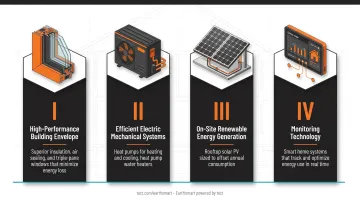
Four systems work together to make this possible:
- High-performance building envelope — superior insulation, air sealing, and triple-pane windows that minimize energy loss
- Efficient electric mechanical systems — heat pumps for heating and cooling, heat pump water heaters
- On-site renewable energy generation — rooftop solar PV sized to offset annual consumption
- Monitoring technology — smart home systems that track and optimize energy use in real time
Net Zero vs. Net Zero Ready
Understanding these four systems also clarifies a terminology distinction that trips up many homeowners. A net zero ready home includes all the efficiency upgrades above but stops short of solar installation. The DOE's Zero Energy Ready Home program certifies homes that are efficient enough for renewables to offset most or all annual energy use — the solar comes later. Since 2013, the program has certified over 12,000 homes, which are typically 40%–50% more efficient than a standard new home.
The Pros of Building a Net Zero Home
Long-Term Energy Cost Savings
The average U.S. household spent $1,884 on energy in 2020, according to the EIA. A well-designed net zero home eliminates most or all of that cost — and shields the homeowner from future utility rate increases, which in California have been significant.
A NIST study of a net zero test facility found a 10.5-year simple payback and $158,743 in life-cycle savings over 30 years compared to a code-compliant base case. That's a Maryland home under specific financing assumptions, so actual results vary — but the directional case is strong for long-term owners.
Energy Independence and Resilience
A net zero home paired with battery storage can operate independently during grid outages. For homeowners in wildfire-prone areas, this is no longer a hypothetical benefit. PSPS events are documented and recurring — six in California in 2024 — and grid-tied solar without storage won't power your home when the utility cuts power.
Earth'smart powered by tect's Earth'smart™ delivery model integrates solar PV and battery storage into the home's core design — built from the start for WUI homeowners who can't afford to assume the grid will be there.
Improved Indoor Comfort and Air Quality
A tight, well-insulated envelope eliminates the drafts and temperature swings common in code-minimum homes. But comfort isn't just thermal — air quality matters, especially in wildfire country.
Earth'smart™ homes integrate ERV/HRV mechanical ventilation with MERV-13+ filtration and HEPA stages, so the home continuously exchanges and filters air rather than simply sealing pollutants in. For homeowners in areas where wildfire smoke is a seasonal health risk, this combination addresses a problem that a conventional rebuild simply doesn't solve.
Higher Resale Value
Research consistently shows verified efficiency improvements translate to measurable sale price premiums:
- Freddie Mac found energy-rated homes sell for 2.7% more than comparable unrated homes
- Better-rated homes command 3%–5% premiums over standard efficiency baselines
- Lawrence Berkeley National Laboratory found owned solar PV added approximately $4/watt to sale prices — roughly $15,000 for an average 3.6 kW system
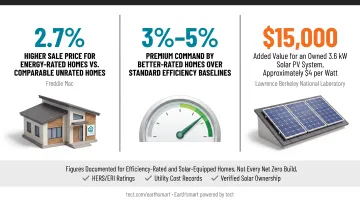
These figures are documented for efficiency-rated and solar-equipped homes specifically, not for every net zero build. Resale premium depends on having verifiable documentation: HERS/ERI ratings, utility cost records, and ownership of the solar system.
Tax Credits and Financial Incentives
Important note for 2026 planning: Federal residential clean energy credits under Section 25D required placement in service by December 31, 2025 to qualify under prior IRA rules. IRS guidance now indicates these credits are not available for post-2025 property without further legislative action. Confirm current eligibility with a tax advisor before building your financial model around federal incentives.
California's Self-Generation Incentive Program (SGIP) still offers storage incentives, subject to budget availability:
- $150/kWh for standard small residential storage systems
- Up to $1,000/kWh under the Equity Resiliency category for qualifying high-risk households
Reduced Carbon Footprint
A fully electrified, solar-powered home eliminates dependence on natural gas for heating, cooling, and hot water. For California homeowners, that alignment also has practical weight: the state's energy codes are tightening on a defined timeline, and homes built to net zero standards today won't require costly retrofits to meet tomorrow's requirements.
The Cons of Building a Net Zero Home
Higher Upfront Construction Costs
Building to net zero standards costs more than a code-minimum home. RMI's analysis found average incremental costs of 7.3% for zero-energy homes and 6.7% for zero-energy-ready homes across multiple U.S. climate zones. A reasonable sourced range is 5%–8%, though California labor markets and custom design choices can push this higher.
The gap has narrowed as solar and heat pump costs have fallen, but it hasn't disappeared.
Specialized Expertise Is Rare
Very few architects and builders have the integrated skills to design and deliver a true net zero home. The DOE requires zero-energy-ready certification to involve rigorous third-party verification, energy modeling, and performance criteria that go well beyond standard code compliance.
Errors in envelope detailing, mechanical system sizing, or solar array design can prevent a home from hitting net zero performance. Fixing those errors after construction is expensive. The expertise gap is the most underappreciated risk in this category of build.
Performance Depends on Correct System Integration
Net zero is a whole-system outcome — envelope, mechanical, solar, and controls must each be sized and coordinated relative to the others. Most net zero aspirations fail at this step. Common breakdowns include:
- A well-insulated envelope paired with an oversized HVAC system, which cancels the efficiency gains
- A solar array sized without accounting for actual load profile, which misses the production target
- Mechanical, energy, and envelope decisions made late in construction rather than coordinated during design
Projects that get this right bring the right system experts in early — before design decisions lock in performance limits that are expensive to undo.
Site and Climate Limitations
Solar generation depends on roof orientation, local shading, and climate. A south-facing roof in Pacific Palisades performs very differently from a north-facing slope on a heavily treed lot. Not every site is equally suited to net zero, and some locations require trade-offs between solar production and other design priorities.
Embodied Carbon Is a Real but Often Overlooked Trade-Off
A net zero energy home reduces operational emissions — but the materials used to build it carry their own carbon cost. Architecture 2030 reports that embodied carbon from cement, iron, steel, and aluminum accounts for roughly 15% of annual global CO2 emissions. High-performance insulation products, concrete, and glass-intensive designs can carry significant embodied carbon even if the home operates at net zero.
For homeowners focused on whole-lifecycle environmental impact, material selection matters — not just operational performance.
What Does It Cost to Build a Net Zero Home?
The Premium Range
The most-cited sourced estimate comes from RMI: a 5%–8% incremental premium above a code-compliant home of the same size. On a $1.5M California custom home, that's roughly $75,000–$120,000 above a standard build. At the $2M–$5M range common in earth'smart powered by tect's project tiers, the dollar figure grows — but so does the baseline efficiency of the comparison point.
These numbers vary widely by climate zone, lot constraints, home size, and chosen systems. Consider them a directional range rather than a fixed quote.
Where the Money Goes
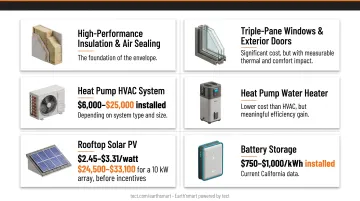
The premium is concentrated in specific, measurable upgrades:
- High-performance insulation and air sealing — the foundation of the envelope
- Triple-pane windows and exterior doors — significant cost but with measurable thermal and comfort impact
- Heat pump HVAC system — installed costs range from roughly $6,000–$25,000 depending on system type and size
- Heat pump water heater — lower cost than HVAC but meaningful efficiency gain
- Rooftop solar PV — California systems currently run approximately $2.45–$3.31/watt, or $24,500–$33,100 for a 10 kW array, before incentives
- Battery storage — adds roughly $750–$1,000/kWh installed in current California data
Incentives That May Reduce Net Cost
Several programs can offset these upfront costs — though eligibility and availability shift frequently:
- Federal tax credits — verify current availability and amount with a tax advisor before budgeting
- California SGIP — storage incentives remain active, subject to category eligibility and program budget
- California Energy Commission HEEHRA — targets low-income homeowners; single-family retrofit slots were fully reserved as of early 2026, so check current status before applying
Long-Term Cost of Ownership
Incentives reduce the gap, but the stronger case for net zero is what happens over decades. Total cost of ownership across 20–30 years is the number that matters most. The NIST test-home study found a net zero home's 30-year life-cycle cost was $158,743 lower than a code-compliant alternative. Homeowners who plan to stay permanently — including those rebuilding after wildfire loss — stand to benefit most from this calculation.
Is a Net Zero Home Worth It for Rebuilding Homeowners?
Rebuilding from scratch after a fire is one of the few genuine opportunities to get everything right from the beginning. There are no existing walls to work around, no systems to match, no compromises forced by an aging structure. The envelope can be designed for performance from day one. Mechanical systems can be sized correctly against a known load. Solar can be oriented and scaled to actual consumption.
Retrofitting a conventional home toward net zero later costs significantly more and delivers less — because the envelope decisions were already made.
Net Zero Plus Resilience: The Compounding Benefit
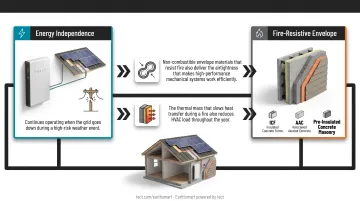
For WUI homeowners, a net zero home with battery storage isn't just an energy strategy: it's a resilience strategy. When the grid goes down during a high-risk weather event, the home continues operating. Pair that with a fire-resistive building envelope using ICF, AAC, or pre-insulated concrete masonry, and the home delivers both fire safety and energy independence in a single coordinated design.
These two goals reinforce each other rather than competing. Non-combustible envelope materials that resist fire also deliver the airtightness that makes high-performance mechanical systems work efficiently. The thermal mass that slows heat transfer during a fire also reduces HVAC load throughout the year.
The Expertise Requirement Is the Critical Variable
Achieving true net zero requires integrated decisions across structure, envelope, and mechanical systems, made early and coordinated across disciplines. Conventional design-bid-build construction (where architect, contractor, and engineers work in sequence rather than together) is not set up to do this well.
Earth'smart powered by tect addresses this through two coordinated paths:
- Earth'smart™ Path A Turnkey Delivery: Architecture, engineering, construction, and manufacturer input in a single aligned team from concept through completion — with earth'smart powered by tectApp™'s 70+ vetted manufacturers involved during design, when system decisions actually determine performance outcomes
- Earth'smart™ Path B Advisory: Owner-side coordination and direct manufacturer access for homeowners whose existing architect or contractor may lack net zero expertise, without displacing that existing team
In both cases, the right expertise is in the room before the critical decisions are locked in — which is the only point at which that expertise can change the outcome.
Frequently Asked Questions
How much more does it cost to build a net zero home?
Industry research puts the premium at roughly 5%–8% above a code-minimum home of comparable size. On a $1.5M California custom home, that's approximately $75,000–$120,000. Costs vary by climate zone, home size, solar array sizing, and local labor — confirm current incentive eligibility with a tax advisor.
Is a net zero house worth it?
For long-term owners — particularly those rebuilding permanently in California — the combination of dramatically reduced utility bills, resilience during PSPS events, and documented resale premiums for energy-rated homes typically justifies the upfront investment. The math is less favorable for short ownership horizons.
What are the main components of a net zero home?
Four systems work together: a high-performance building envelope (insulation, air sealing, triple-pane windows), all-electric mechanical systems (heat pumps, heat pump water heater), on-site solar PV generation, and monitoring technology to optimize usage and verify performance.
Can a net zero home function during a power outage?
Yes — when paired with battery storage. A solar-only system without batteries will shut down during a grid outage under standard interconnection rules. Battery storage allows the home to operate independently, which is particularly relevant in California WUI areas where PSPS events are a documented annual occurrence.
How long does it take to recoup the upfront cost of building net zero?
The NIST net zero test facility study found a 10.5-year simple payback under its assumptions. California's higher utility rates typically shorten that timeline, and available federal and state incentives can shift the calculation significantly — confirm eligibility early in planning.