Choosing the wrong delivery method can fragment your project. Systems end up disconnected, material decisions happen too late, and you receive a home that looks finished but underperforms where it matters most.
This article breaks down both approaches clearly — definitions, a side-by-side comparison, and a practical framework for choosing the right fit for your rebuild.
Key Takeaways
- Design-build = one team handles both design and construction, with the owner actively involved throughout
- Turnkey = contractor owns the entire process from concept to handover; owner receives a finished product
- The real differences come down to: owner control, responsibility allocation, cost structure, and timeline
- Neither is universally better — it depends on how involved you want to be and how complex your performance requirements are
- In WUI rebuilds, coordination depth matters more than the label on your contract
Turnkey vs. Design-Build: At a Glance
| Factor | Design-Build | Turnkey |
|---|---|---|
| Owner Control | Active — approves design, materials, decisions throughout | Minimal — owner defines vision, contractor drives all execution |
| Contractor Responsibility | Shared — owner handles some coordination | Total — design, permitting, procurement, construction, handover |
| Cost Structure | Iterative — more budget flexibility, more owner exposure | Fixed-price — contractor absorbs overruns, but price reflects that risk |
| Timeline | Variable — owner decision points affect schedule | Typically faster — contractor controls all phases |
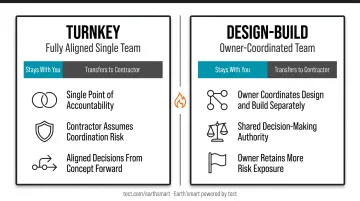
Both approaches eliminate the traditional architect/contractor silo. The real distinction is how much decision-making responsibility — and risk exposure — stays with you versus transfers to your contractor.
What Is Design-Build Construction?
The Design-Build Institute of America (DBIA) defines design-build as one entity — the design-builder — entering a single contract with the owner to provide both design and construction services. The AIA's 2023 project delivery primer confirms the same: one contract, one entity, design and construction under a single point of responsibility.
That single point of responsibility is what changes the project dynamic. When the same team designs and builds, they catch constructability issues early, optimize material choices before they're locked in, and close the communication gaps that open when architects and contractors work in separate silos.
The Owner's Role
In design-build, you're an active participant — not just a signatory. You review design packages, contribute to material decisions, and adjust scope throughout. This involvement is both the model's strength and its time commitment.
The contractor's field knowledge informs design decisions in real time. That means impractical specifications get caught before construction begins.
DBIA/FMI research found that 74% of respondents associate design-build with final cost closest to budget, and 74% with fewer disputes — outcomes that trace directly back to early, integrated decision-making.
Where Design-Build Works Best
Design-build fits projects where:
- Projects where the owner has strong opinions on materials, layout, or system performance
- Complex residential rebuilds where structural, envelope, and mechanical decisions are deeply interdependent
- High-risk WUI areas where California Building Code Chapter 7A triggers specific requirements for roofing, wall assemblies, vents, windows, and soffits
- Situations where early architect-engineer-builder coordination prevents expensive rework
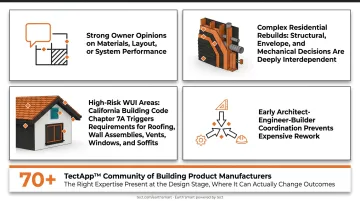
Earth'smart powered by tect's approach builds on this model. Beyond integrating architecture, engineering, and construction under one team, it extends coordination to include the earth'smart powered by tectApp™ community of 70+ building product manufacturers — so the right expertise is present at the design stage, where it can actually change outcomes.
What Is Turnkey Construction?
Turnkey means the contractor takes complete responsibility for a project from start to finish — design, permitting, procurement, construction, and final handover. The name reflects the intent: the owner simply turns the key to a finished building.
LexisNexis defines a turnkey contract as one in which the contractor engineers, procures, constructs, and commissions a project so it is ready to operate on handover. Under this structure, cost overruns and schedule delays are the contractor's problem to solve, not the owner's.
Risk Transfer and Cost Structure
This fixed accountability structure is one of turnkey's most cited advantages. Under firm-fixed-price contracts, the Federal Acquisition Regulation places "maximum risk and full responsibility for all costs" on the contractor. The price doesn't adjust based on what the contractor actually spends.
The trade-off: contractors price that risk into their bids. Higher base costs often reflect contingency buffers for unknowns the contractor is absorbing. The apparent simplicity of a single price can mask a meaningful risk premium.
What Owners Give Up
Less involvement also means less influence. In a turnkey arrangement, the contractor generally controls:
- Subcontractor selection
- Material and product sourcing
- Day-to-day site decisions
That's a reasonable trade when the project scope is well-defined and standard performance requirements apply. For homeowners building in fire-prone areas, though, that loss of control has real consequences. Specific assembly choices — fire-resistive cladding, vent protection, non-combustible materials — determine how a home actually performs under wildfire exposure, and those decisions shouldn't be delegated by default.
An Important Nuance
Many articles treat turnkey and design-build as opposing categories. They're not. Turnkey describes the ownership and accountability model — who is responsible for what, under what contract structure. Design-build describes the execution method — how design and construction are coordinated. A turnkey contractor frequently uses a design-build team internally.
"Turnkey design-build" is a real and common hybrid, and for most residential projects it's more practical than treating either label as a fixed category.
Key Differences Between Turnkey and Design-Build
Control and Collaboration
In design-build, the owner approves design packages, contributes to material decisions, and can adjust scope mid-project. In turnkey, the owner steps back after defining the vision. The contractor drives all execution decisions.
The right fit depends on how much the owner wants — or needs — to be involved. Some homeowners want that level of input. Others want to hand off the complexity entirely.
Scope of Contractor Responsibility
Design-build consolidates design and construction under one contract, but the owner may still coordinate external consultants or site-specific decisions. Turnkey consolidates everything — permitting, procurement, site work, commissioning — under one contract and one party.
For homeowners managing a rebuild while also navigating temporary housing, insurance claims, and debris removal timelines, that difference in coordination burden is real.
Cost Structure
Turnkey contracts are typically priced at a fixed total. The contractor absorbs risk for overruns but prices that risk into the base number. Design-build allows for more iterative budgeting: owners can influence cost decisions in real time but also carry more exposure to scope changes.
Total cost depends on scope, complexity, and performance requirements — not on delivery method alone.
Timeline
Turnkey projects can move faster because the contractor controls all phases without waiting on owner approvals at each decision point. Design-build timelines are more variable, but owner involvement enables mid-project adjustments that can prevent costly corrections later.
For post-wildfire rebuilds in Los Angeles County, the LA County Fire Rebuild FAQ notes that debris removal must be completed before a building permit is issued, additional agency approvals may be required, and timelines can be extended by material availability and consultant scheduling. These external constraints apply regardless of delivery method.
Where the Line Blurs
Many modern construction firms offer hybrid approaches — labeled "turnkey design-build" — where the contractor handles everything end-to-end but the owner retains meaningful input during design phases. For homeowners evaluating either path, the label matters less than the specifics:
- Who makes material and system decisions?
- At what stage are those decisions made?
- How are structural, envelope, and mechanical systems coordinated with each other?
Which Approach Is Right for Your Home Project?
Three questions frame the decision:
How involved do you want to be? If you want direct input on materials, layout, and system performance, design-build gives you more leverage. If you want a competent team to handle all of it, turnkey suits you better.
How complex are your performance requirements? Standard scope in a low-risk area is a reasonable fit for turnkey delivery. A WUI rebuild that must comply with California Chapter 7A requirements — Class A roofing, ember-resistant vents, multipane glazed windows, noncombustible exterior wall assemblies — demands coordinated decision-making from the start.
How much does early system integration matter? In high-risk rebuilds, decisions about the building envelope, mechanical systems, and structural assemblies affect each other. A contract label doesn't guarantee those decisions are coordinated. The delivery structure does.
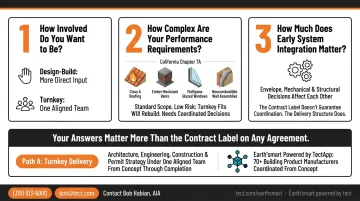
Your answers to these questions matter more than the contract label on any agreement. For homeowners rebuilding in Pacific Palisades or other high-risk WUI areas, a turnkey contract that doesn't integrate structural engineering, fire-resistant envelope systems, and mechanical systems early is still a fragmented project.
Earth'smart powered by tect's Earth'smart™ model addresses this directly. Path A — Turnkey Delivery — brings architecture, engineering, construction, and permit strategy under one aligned team from concept through completion. Early coordination with the earth'smart powered by tectApp™ community of 70+ building product manufacturers means system decisions are made with the right expertise involved, not resolved later through change orders.
If you're rebuilding in a high-risk zone and want a coordinated approach that connects architecture, engineering, and manufacturer-level product expertise under one aligned system, reach out to Bob Habian, AIA at (310) 913-5000 or bob@tect.com.
Frequently Asked Questions
What is the difference between design-build and turnkey?
Design-build is a delivery method where one entity handles both design and construction with active owner involvement throughout. Turnkey means the contractor takes complete end-to-end responsibility — from design through final handover — with minimal owner input. The two can overlap when a turnkey contractor uses a design-build team internally to execute the project.
What does a turnkey contractor mean?
A turnkey contractor manages every aspect of a project — design, permitting, procurement, construction, and handover — so the owner receives a completed, ready-to-use building under a single contract, with no need to coordinate trades, architects, or suppliers separately.
Can a project be both turnkey and design-build?
Yes. "Turnkey" describes the accountability structure — one contract, full contractor responsibility. "Design-build" describes how design and construction phases are executed. A turnkey contractor can and often does use a design-build team internally, making turnkey design-build a common and effective hybrid.
Is design-build or turnkey more expensive?
Turnkey contracts typically carry a higher base price because the contractor absorbs all risk and complexity, pricing contingencies into the bid. Design-build can offer more budget flexibility through ongoing owner-contractor decisions as the project evolves. Either way, the final number reflects how much risk the owner is willing to carry versus transfer.
Which approach is better for rebuilding a home after a wildfire?
For post-fire rebuilds in wildfire-prone zones, turnkey typically performs better. The coordination complexity — fire-resistive assemblies, envelope decisions, suppression systems — benefits from a single accountable team making integrated decisions from day one. Design-build can work too, but only when the owner is prepared to stay actively involved throughout.
Who controls material and product selection in each approach?
In design-build, the owner typically has more direct influence over material and product choices throughout the process. In turnkey, the contractor generally makes those selections based on project specifications, with the owner having less direct input unless specific choices are contractually defined upfront.