This is the stage where an architect translates your vision, site conditions, and spatial requirements into a concrete concept: establishing the home's layout, massing, and character before any detailed drawings are produced. For luxury homeowners planning a custom build — or rebuilding after a disaster like the 2025 Palisades Fire, which destroyed 6,845 structures across 23,448 acres — schematic design isn't a formality. It's the phase that determines how your home performs, what it costs, and whether it's insurable for the next 50 years.
The problem is that schematic design is frequently discussed but rarely explained. Most homeowners arrive at their first meeting without knowing what to bring, what to expect, or what's actually being decided.
This article addresses that gap.
Key Takeaways
- Schematic design establishes floor plans, massing, orientation, and spatial relationships — not finishes or fixtures
- Changes cost far less here than anywhere else in the process — schematic design is where your budget leverage is highest
- Luxury homes require lifestyle programming, complex site relationships, and system performance to be resolved together at the schematic level
- In fire-prone or WUI areas, structural systems, envelope strategy, and egress routes must be decided at schematic design — retrofitting them later is expensive and often ineffective
- A well-executed schematic design phase prevents budget overruns, scope conflicts, and the need to redesign in later phases
What Is Schematic Design in Luxury Home Architecture?
The AIA defines schematic design as the first phase of basic architectural services, following pre-design and programming. The architect develops initial design concepts — typically site plans, floor plans, sections, preliminary elevations, and massing studies — that establish the project's scope, scale, and spatial relationships. A preliminary cost estimate is also part of this phase.
What schematic design is not matters just as much:
- Not a finished drawing set — permit-ready documents come much later
- Not a material or fixture specification — those decisions belong in design development
- Not a construction document — schematic design is a resolved concept, not an instruction manual
SD vs. Design Development
These two phases trip up homeowners regularly, so here's the direct version.
Schematic design answers what and where: What spaces exist? Where do they sit on the site? How do they relate to each other? Design development answers how: What materials? Which structural assembly? How are the systems sized and routed?
For luxury homes, the SD phase often also includes mood boards, precedent imagery, and site response diagrams — tools that help clients visualize spatial intent before detailed drawings exist. Floor plans alone are difficult for non-architects to read, and experienced architects account for this early — using visual tools that translate spatial decisions into something tangible before committing to detail.
Why Schematic Design Is Critical for Luxury Homes
The Cost-of-Change Curve
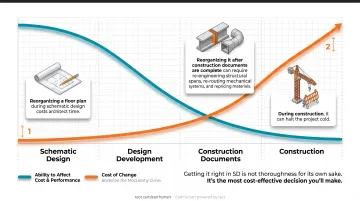
The MacLeamy Curve is widely referenced in architecture and construction. It shows that the ability to affect cost and performance is highest early in a project, while the cost of making changes rises sharply as the project advances. For luxury custom homes, that leverage is especially large.
In practical terms: reorganizing a floor plan during schematic design costs architect time. Reorganizing it after construction documents are complete can require re-engineering structural spans, re-routing mechanical systems, and repricing materials. During construction, it can halt the project cold.
For luxury homes with complex programs and high material costs, this leverage is enormous. Getting it right in SD is not thoroughness for its own sake — it's the most cost-effective decision you'll make.
What Luxury Programs Demand
Standard homes have bedrooms, bathrooms, and a kitchen. Luxury homes have competing functional zones that must all work simultaneously:
- Private family retreat separated from guest quarters
- Formal and casual entertaining spaces with distinct flow paths
- Staff or service areas that function independently
- Home office, wellness spaces, and outdoor living zones
- Garage and utility relationships that don't intrude on primary living
Every one of these relationships must be resolved in schematic design. Discovering in design development that the guest wing blocks the primary view corridor or that the home office requires cutting through the main circulation path is expensive and demoralizing.
The Resilience Dimension
For homes in Wildland-Urban Interface (WUI) areas, fire zones, or seismic regions, schematic design carries an additional layer of consequence. California's Chapter 7A building code governs exterior materials and assemblies for new construction in WUI Fire Areas, covering roofs, vents, walls, windows, decks, eaves, and gutters.
These are not finish choices. They are structural and envelope decisions that must be integrated from the start.
Headwaters Economics found that a new wildfire-resistant home can be built for roughly the same cost as a standard home, adding less than 3% to construction cost when decisions are made correctly from the start. That number changes dramatically when resilience is treated as a retrofit layer applied after the spatial concept is already locked.
At earth'smart powered by tect, structural system type, envelope strategy, and egress are addressed at the schematic level because these decisions are inseparable from spatial layout. Massing, resilience, and systems get resolved together — or they get resolved expensively later.
How the Luxury Home Schematic Design Process Works
Pre-Design and Programming
Before a single sketch is drawn, the architect needs information. AIA guidance for owners outlines what to prepare: project goals, budget ceiling, site information, desired spaces, quality expectations, decision-maker structure, and known constraints.
For luxury homes, the program goes much deeper than a room list. It captures how the household actually lives:
- How often do you entertain, and at what scale?
- Do overnight guests need full separation from family areas?
- Is there household staff, and do they need independent circulation?
- What views are non-negotiable, and which exposures should be minimized?
- Are there accessibility requirements now or anticipated in the future?
The written program is the architect's contract with the client about what the house needs to do. Vague programs produce vague schemes. Specific programs produce homes that work.
For WUI rebuilds, the pre-design phase also includes site analysis with fire-specific dimensions: topography and how it affects fire behavior, access routes, vegetation management zone layout, and water supply options — including dedicated on-site supply for fire suppression, which influences site planning from day one.
Concept Development and Scheme Presentation
With the program and site analysis in hand, the architect develops multiple design schemes — typically two to three distinct concepts showing different ways to organize the home on the site. Each scheme explores different tradeoffs:
- Views vs. privacy — optimal view orientation may conflict with street or neighbor exposure
- Indoor-outdoor connection vs. weather and fire protection — particularly relevant in WUI contexts
- Formal vs. casual flow — how the house moves people from arrival through entertaining to private retreat
- Massing and coverage — how the building sits on the site relative to setbacks, access, and defensible space zones
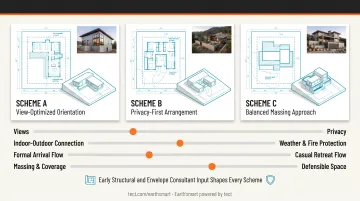
Inspiration imagery is presented alongside floor plans so clients can visualize spatial intent, not just geometry. An experienced architect working on fire-resilient luxury homes — like earth'smart powered by tect's Bob Habian, AIA — brings early input from structural and envelope consultants into this stage, so the schemes presented reflect what's technically achievable, not just what looks good on a diagram.
Client Feedback and Scheme Refinement
Once schemes are presented, schematic design becomes iterative. Client feedback drives a revision cycle in which the preferred direction is refined, tested, and developed until it's ready to advance.
The goal is not a perfect drawing — it's a resolved concept that the full team agrees on and can build all subsequent work from. In practice, a resolved scheme means:
- Floor plan organization is settled and tested against the program
- Site positioning reflects both client priorities and site constraints
- Structural and envelope approaches are confirmed as feasible
- No major open questions remain before design development begins
What Gets Decided During Schematic Design (and What Doesn't)
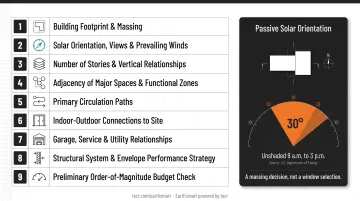
Resolved in SD
- Overall building footprint and massing
- Orientation relative to sun, views, and prevailing winds
- Number of stories and vertical relationships between floors
- Adjacency of all major spaces and functional zones
- Primary circulation paths — how people move through the home
- Indoor-outdoor connections and their relationship to site
- Garage, service, and utility relationships
- For resilient homes: structural system type and envelope performance strategy at a conceptual level
- Preliminary order-of-magnitude budget check
Passive solar orientation is one concrete example of why SD decisions cascade. The Department of Energy recommends primary glazing face within 30 degrees of true south, unshaded between 9 a.m. and 3 p.m. That's a massing decision, not a window selection — and it has to be made in SD.
Deliberately Left Open
- Specific materials and finishes
- Fixture and equipment selections
- Detailed MEP system routing
- Structural engineering calculations
- Product specifications
Premature decisions in these areas during SD waste time. They almost always have to be revisited anyway once the design development process begins refining spatial dimensions and structural coordination.
The Budget Checkpoint
At the close of schematic design, the architect prepares a preliminary cost estimate based on area, volume, or unit costs. For luxury homes, this is where scope-to-budget alignment is confirmed — or adjusted — before the project enters the more expensive design development phase. A budget misalignment caught here costs a revision; caught after construction documents are complete, it can mean starting over.
Common Mistakes in Schematic Design
Treating SD as "Just Preliminary Drawings"
Schematic design has a defined endpoint: a resolved concept ready to carry forward. Homeowners who treat it as open-ended ideation either freeze decisions too early — locking in a scheme before it's been sufficiently tested — or drag revisions past the point when the design should have advanced.
Both directions waste time and budget.
Chasing Finishes Before Nailing Spatial Organization
Luxury homeowners naturally gravitate toward materials, style, and aesthetics in early meetings. An architect's job is to redirect that energy toward spatial organization and system performance — the decisions that actually determine how the home functions. Finishes can be refined once the plan works. They can't compensate for a plan that doesn't.
Under-Resourcing the SD Phase
Compressing schematic design to save money early is one of the most reliable ways to overspend a luxury home project. Resolving a flawed spatial concept during construction costs far more than additional SD time would have.
For homes in regulated environments like WUI fire zones — where code analysis and early consultant coordination are genuinely complex — this compression is especially costly.
Waiting Too Long to Bring in Specialists
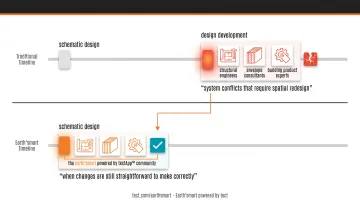
In high-performance and fire-resilient projects, waiting until design development to engage structural engineers, envelope consultants, or building product experts creates system conflicts that require spatial redesign. Earth'smart powered by tect addresses this by integrating manufacturer and engineering input through the earth'smart powered by tectApp™ community during schematic design, when changes are still straightforward to make correctly.
Frequently Asked Questions
How much does luxury home design cost?
Architect fees for luxury residential projects vary based on project scale, scope, and complexity. They're typically structured as a percentage of construction cost, a fixed fee, or a hybrid. The AIA's B101 agreement outlines these fee structures without specifying a universal range. Schematic design is one of several phase fees within the total architectural fee.
What is the difference between schematic design and design development?
Schematic design establishes the concept: layout, massing, orientation, and spatial relationships. Design development refines those decisions into specific materials, system specifications, and coordinated drawings. SD answers "what and where"; design development answers "how."
How long does the schematic design phase take for a luxury home?
Timelines vary by project complexity and client decision-making pace. Luxury custom homes usually run four to twelve weeks in schematic design. Projects in WUI fire zones or other regulated environments tend to take longer due to additional site analysis, code review, and early consultant coordination.
What should I prepare for my first schematic design meeting?
Bring a detailed list of all spaces and their priorities, imagery of homes or spaces you find inspiring, an honest description of how your household actually lives day-to-day, and any hard constraints you already know about — budget ceiling, non-negotiable views, required adjacencies. The more specific your input, the more useful the first schemes will be.
Can the schematic design be changed after it's approved?
Changes are possible after SD approval but become progressively more expensive as the project advances. Reorganizing spatial relationships in design development or construction documents can require significant re-work across multiple disciplines. Changes that cost an hour in SD can cost days — and significant fees — once construction documents are underway.
Why does schematic design matter more for resilient or high-performance homes?
Homes built for wildfire, seismic, or flood exposure require structural system type, envelope strategy, and egress to be addressed at the schematic level — because these decisions are spatially inseparable. A fire-resistive wall assembly has different thickness, weight, and structural behavior than a standard wood-frame wall. Those differences affect room dimensions, structural spans, and massing — none of which can be retrofitted once the concept is locked.