Introduction
Home construction budgets have a well-documented tendency to collapse — not during construction, but before it. In the traditional design-bid-build model, an architect completes a full design, a contractor prices it, and the homeowner discovers the gap. By that point, they've made emotional and financial commitments that make scope cuts painful and delays costly.
For homeowners rebuilding after wildfire, or building in California's Wildland-Urban Interface, this problem is worse. WUI compliance requirements, fire-resistive assemblies, and integrated system specifications add layers of complexity that fragmented teams routinely underprice. The corrections come later — during construction, when changes cost far more.
Design-build addresses this structurally. It moves cost decisions into the design phase, where changes are manageable, rather than into construction, where every revision carries a premium.
This article explains the specific mechanisms that make design-build a more reliable delivery method for budget control — particularly for the complex, specification-heavy builds that WUI and wildfire-risk sites demand.
Key Takeaways
- Design-build places design and construction under one contract, so pricing and scope decisions are made together from day one
- Integrated teams catch cost conflicts during design, when fixes are cheap — not mid-construction, when they're not
- Fewer change orders and clearer accountability mean fewer surprises at final billing
- For WUI and post-wildfire rebuilds, integrated delivery reduces the risk of mid-project redesigns caused by code, material, or system conflicts
- Early system decisions shape long-term maintenance costs, not just the build budget — design-build gives homeowners direct control over both
What Is Design-Build?
Design-build is a project delivery method where a single entity manages both design and construction under one contract, making that entity jointly accountable for cost, quality, and timeline. The Design-Build Institute of America defines it as a model where "one entity, the design-builder, enters into a single contract with the owner to provide both design and construction services."
This contrasts directly with design-bid-build, where design and construction are separate contracts. An architect draws plans, contractors bid on them, and no single party is fully accountable when the numbers don't align. The AIA/AGC project delivery primer describes this as a strictly linear process: the owner contracts with an architect, the architect produces documents, the contractor bids and builds.
At no point does the builder have formal input into design decisions as they're being made.
That gap is where budgets break.
Design-build's primary operational advantage isn't aesthetic or philosophical — it's that cost feasibility is tested continuously during design, not revealed after plans are complete. The builder's real-time input as design decisions are made means the budget reflects construction reality at every stage, not just at bid time.
Key Advantages of Design-Build for Managing Home Construction Budgets
The three advantages below aren't marketing claims. They're structural features of how design-build is organized — features that directly determine where money goes and how tightly it can be controlled. Each one maps to a specific place where traditional construction loses budget control.
Advantage 1: Design and Pricing Develop Together
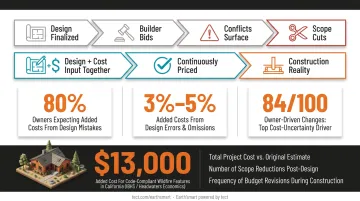
In traditional construction, homeowners frequently approve a complete design before receiving accurate pricing. The builder then bids against finished drawings and finds conflicts, impractical details, or specifications that don't match material availability. The result: scope cuts after the homeowner has already committed.
Design-build closes this gap. The builder participates in design decisions as they happen, providing cost input on materials, layouts, and structural systems in real time. By the time a design is finalized, it has already been priced against construction reality.
Why this matters:
- A 2014 McGraw Hill/DBIA study found 80% of owners expected added costs from design mistakes on future projects, with 3%–5% in added costs from design errors and omissions specifically
- Owner-driven program and design changes scored 84/100 as the top cost-uncertainty driver in that same study — meaning decisions made (or deferred) during design have the most direct impact on final cost
- When cost visibility is continuous, homeowners make trade-offs with full information, not under pressure after concrete is poured
KPIs this affects:
- Total project cost vs. original estimate
- Number of scope reductions post-design
- Frequency of budget revisions during construction
When it matters most: Complex rebuilds, high-specification homes, and projects in WUI zones where fire-resistive material requirements significantly affect cost. California wildfire-resistant construction adds approximately $13,000 over standard construction costs for code-compliant wildfire features alone, per IBHS and Headwaters Economics. That figure needs to be in the design budget from the first conversation — not discovered at bid time.
Advantage 2: Fewer Change Orders Through Single-Team Accountability
Change orders are among the most consistent drivers of construction budget overruns. They happen when designers and builders aren't working from the same reality — when a specified material is unavailable, a detail isn't buildable, or a system conflicts with field conditions.
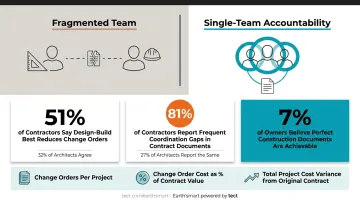
A McGraw Hill/DBIA buildings-sector study found that 51% of contractors and 32% of architects identified design-build as the best delivery system for reducing change orders. The underlying reason is structural: with one team accountable for both design and construction, there's no translation layer where intent gets lostand no finger-pointing when something doesn't work.
Why this matters:
- The same research found 81% of contractors reported frequent coordination gaps in contract documents compared to only 27% of architects. The people who discover conflicts are rarely the same people who created them
- Only 7% of owners believed perfect construction documents are achievable on a reasonably complex project; design-build doesn't eliminate imperfection, but it puts the people most likely to catch conflicts into the process before decisions are locked in
- For homeowners managing fixed insurance payouts, change orders aren't just inconvenient — they can determine whether the project finishes at all
What this affects in practice:
- Number of change orders per project
- Change order cost as a percentage of contract value
- Total project cost variance from original contract
When it matters most: Projects with complex specifications, multiple integrated systems, or where material substitutions are likely due to supply chain constraints or WUI regulatory requirements. When a fire-rated assembly requires a specific product substitution, an integrated team resolves it internally — a fragmented team resolves it through additional change orders.
Advantage 3: Early System Decisions Protect Build Quality and Long-Term Cost
The cost of a home doesn't end at move-in. Energy use, system replacements, maintenance cycles, and insurance premiums all accumulate over decades — and most of those costs are locked in by decisions made during design. A peer-reviewed study by Kovacic and Zoller (2006) found that early design stages determine up to 80% of building operational costs and environmental impacts.
Design-build creates the conditions to get these decisions right the first time. Structural, mechanical, and envelope systems are specified with both design intent and construction reality in mind — preventing the under-specification or over-specification that compounds into long-term costs.
Why this matters for complex systems:
- ASHRAE notes that rule-of-thumb HVAC sizing "almost always" leads to oversized equipment — increasing initial cost, operating expense, and comfort problems
- Rework from design errors and omissions costs 0.5%–2.6% of total construction cost directly; all-cause rework runs 4%–6%, and total rework including indirect costs reaches 7%–10.89%, according to the McGraw Hill/DBIA research
- An undersized fire suppression system or an incorrectly detailed fire-rated assembly isn't just a repair cost — it's a safety, insurability, and habitability issue
Earth'smart powered by tect's Earth'smart™ model takes this further through the earth'smart powered by tectApp™ community of 70+ vetted building product manufacturers. Rather than relying on generic product research or contractor preference, earth'smart powered by tect engages manufacturer experts during the design phase — so structural, mechanical, envelope, and fire suppression systems are coordinated and validated by the companies that make the materials, not guessed at during bidding.
Long-term costs this protects:
- Energy performance and operating expense
- Insurance risk rating
- Maintenance cycles and system replacement frequency
- Cost of rework post-construction
When it matters most: High-risk and high-specification builds — wildfire-resilient construction, WUI-zone homes, and any project where performance requirements drive material and system selection.
What Happens When Design-Build Is Missing
The failure patterns in fragmented delivery are consistent and predictable:
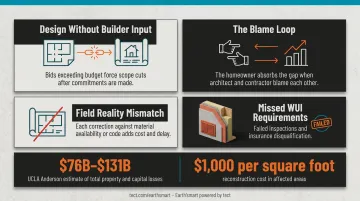
- Architects produce plans without builder input. The homeowner approves a design, then receives bids that exceed budget — forcing scope cuts after emotional and financial commitments are already made
- Plans that reach the builder often don't reflect field reality, material availability, or current code requirements. Each correction adds cost and delay
- When costs rise, the architect points to the contractor, the contractor points to the architect, and the homeowner absorbs the gap
- Fragmented teams routinely miss integrated WUI system requirements — fire-rated assemblies, ember-resistant detailing, seismic connections — resulting in failed inspections, costly corrections, or homes that don't qualify for insurance
The California rebuild environment sharpens every one of these risks. UCLA Anderson estimated total property and capital losses from the January 2025 LA fires at $76B–$131B, with reconstruction costs in some affected areas reaching $1,000 per square foot. Homeowners navigating Chapter 7A compliance, fire-resistive system requirements, and constrained insurance payouts — with a fragmented team — face all of these failure modes at once.
How to Get the Most Value from Design-Build
Design-build delivers its budget advantages only when the team is genuinely integrated — not just marketed as such. Before engaging a team, homeowners should verify that design and construction expertise are present from day one, not handed off between disciplines at a later stage.
Once you've confirmed that genuine integration is in place, three practices determine how much value you actually extract from it:
Bring construction input in before 20% of design is complete. DBIA identifies this threshold as a critical success factor. The earlier cost thinking enters the design process, the more effectively the team can shape decisions that determine final project costs — not react to them.
Engage actively at key decision points. Material selections, system specifications, and scope adjustments all carry cost implications that aren't always visible without context. Homeowners who understand the trade-offs at these moments are better positioned to protect both quality and budget.
Confirm manufacturer input is happening from the start. In complex builds — fire-resistive assemblies, integrated mechanical systems, WUI compliance — specifications made without direct manufacturer involvement are educated guesses at best. Earth'smart powered by tect addresses this through the earth'smart powered by tectApp™ community, connecting the design and construction team with 70+ vetted manufacturers across structural, envelope, roofing, fire suppression, and mechanical systems from concept design forward.
Conclusion
Across every variable covered in this guide, design-build's budget management advantage is structural. It comes from having cost and design move together, from one team accountable for the full outcome, and from making system decisions correctly before construction begins rather than correcting them mid-build.
For homeowners building or rebuilding to a long-term standard in California's WUI zones, these advantages compound. A home delivered by an integrated team is more predictable to construct, easier to insure, and built to stay that way.
The Palisades Fire context makes this concrete: homeowners navigating $1,000/sq ft reconstruction costs and tightening insurance markets cannot absorb the budget variance that fragmented delivery routinely produces.
Design-build isn't a one-time structural choice. Its full value comes from integration discipline applied consistently — from the first conversation through final delivery. That means asking the right questions early, locking system decisions before permits, and working with a team that treats cost as a design constraint rather than an afterthought. That's where the budget gets protected.
Frequently Asked Questions
What is the design-build method of construction?
Design-build places design and construction services under one contract with one entity, eliminating the separate architect and contractor relationships that typically drive cost misalignment. One team is accountable for both design and construction outcomes, from concept through completion.
What are the 5 phases of the design-build process?
The core phases are: pre-construction/project brief, design and planning, pre-construction pricing, construction, and closeout. What separates this process from traditional delivery is that builder cost input begins in phase one — DBIA's progressive design-build framework introduces transparent pricing during preliminary services, not after design is finished.
What is an advantage of the design-build system?
The primary budget-related advantage is reduced change orders and more accurate upfront pricing. Because the builder participates during design, cost conflicts are identified and resolved before construction begins rather than discovered on-site, when corrections cost significantly more.
What is the difference between design-build and construction management?
In construction management, the owner holds separate design and construction contracts while a CM coordinates between them. In design-build, one entity is responsible for both — so accountability for cost overruns and schedule delays is clear, with no room for parties to dispute ownership of the problem.
How does design-build help control construction costs?
Design-build controls costs by aligning design decisions with real-time builder pricing, reducing change orders through single-team communication, and identifying costly conflicts early before framing begins or materials are ordered. Fewer surprises. Less variance between the estimate and the final invoice.
Is design-build more expensive upfront than traditional construction?
Early-phase fees can be higher since design and construction expertise are engaged together from day one. Total project costs are typically lower, though — fewer change orders, less rework, and tighter initial estimates offset that upfront investment.