Flooring is both a fuel source and a flame-travel pathway. A floor that ignites early or spreads fire across its surface can undermine the fire resistance of the entire floor-ceiling assembly, no matter how well everything else was specified. For homeowners in Wildland-Urban Interface (WUI) zones like Pacific Palisades, this isn't a cosmetic decision — it intersects directly with code compliance, insurance eligibility, and how the floor system integrates with the structure below it.
This article breaks down what fire resistance ratings actually measure, which testing standards govern them, how common flooring materials perform against those benchmarks, and the most consequential mistakes homeowners make when selecting "fire-resistant" floors.
Key Takeaways
- No flooring material is truly fireproof: ratings measure ignition response, flame spread, and smoke output under controlled test conditions
- The two primary U.S. rating systems for flooring are ASTM E84 (flame spread and smoke development) and ASTM E648/NFPA 253 (critical radiant flux — the correct standard for floor coverings)
- Concrete, ceramic tile, and porcelain tile are non-combustible and achieve the highest fire performance; vinyl and treated wood offer moderate resistance with trade-offs
- Fire ratings apply to the finish material alone — subfloor, underlayment, and adhesives all affect real-world assembly performance
- California WUI codes often exceed IBC minimums — verify requirements for your specific zone and occupancy type
What Fire Resistance Means for Flooring
Fire resistance isn't a single property — it's a set of performance characteristics measured under controlled test conditions. For flooring, that means:
- Ignition resistance — how readily the material catches fire from an external heat source
- Flame spread — how quickly fire travels across the surface
- Smoke development — the volume and toxicity of gases produced during combustion
- Structural integrity — whether the material maintains its form under sustained heat
Three terms appear constantly in code documents and product literature. They don't mean the same thing:
- Non-combustible: Cannot ignite, burn, or support combustion under anticipated conditions. A code-specific classification under the IBC, defined by ASTM E136 testing.
- Fire-resistant: Describes how long an assembly resists fire penetration or structural failure under test conditions. Applies to assemblies, not individual finish materials.
- Fire-retardant-treated: Combustible materials (typically wood) chemically treated to achieve a Flame Spread Index of 25 or less under ASTM E84 or UL 723.
Using these terms interchangeably is a common source of confusion and a real code compliance risk.
Combustibility vs. Fire Rating: Why the Distinction Matters
A product can carry a fire resistance rating and still be combustible. The rating reflects how a material performs under a specific test protocol — not whether it will burn under all conditions.
Laminate flooring is a clear example. Treated laminate products can achieve ASTM E84 Class B or even Class A ratings, but the material itself is wood-based and combustible. Under sustained fire exposure, it will burn.
That gap between rating and combustibility matters most when you're rebuilding to stricter standards. The IBC classifies buildings by construction type (Type I through V), and that classification governs which materials are permissible. Homeowners rebuilding in HFHSZs should confirm their construction type and understand which flooring materials it permits — product labels alone aren't enough.
Installation matters too. NIST testing shows that variables like adhesive type, backing material, substrate, and conditioning can shift measured fire performance significantly. A lab rating generated on bare material doesn't always transfer directly to an installed assembly.
Fire Rating Systems and Standards for Flooring
Two primary test standards govern how flooring fire performance is classified in the U.S. They measure different things, apply in different code contexts, and are not interchangeable.
ASTM E84: Surface Burning Characteristics
ASTM E84 (also referenced as UL 723) is the "Steiner Tunnel Test." It measures how quickly flame spreads across a material's surface and how much smoke it generates, producing two outputs:
- Flame Spread Index (FSI) — rate of flame travel across the surface
- Smoke Developed Index (SDI) — volume of smoke generated relative to a reference material
IBC Class ratings under ASTM E84:
| Class | FSI Range | SDI Range |
|---|---|---|
| A | 0–25 | 0–450 |
| B | 26–75 | 0–450 |
| C | 76–200 | 0–450 |
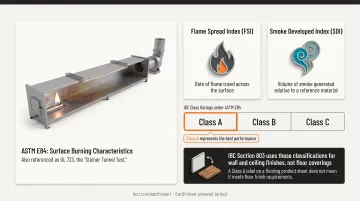
Class A represents the best performance. IBC Section 803 uses these classifications for wall and ceiling finishes — not floor coverings. A Class A label on a flooring product sheet does not mean it meets floor finish requirements.
ASTM E648 / NFPA 253: Critical Radiant Flux
ASTM E648 is the correct standard for interior floor finishes. It measures Critical Radiant Flux (CRF) — the minimum radiant heat energy a horizontal floor covering can withstand before it continues burning on its own.
IBC Section 804 and NFPA 101 Section 10.2.7 use this classification for floor finish requirements:
- Class I: CRF ≥ 0.45 W/cm² — required in egress corridors and exit enclosures
- Class II: CRF ≥ 0.22 W/cm² — required in other occupied areas where floor finish is regulated
ASTM E648 Class I is the stricter standard. If a floor is in or adjacent to an egress path, this is the test result that matters — not the ASTM E84 Class A label on the product sheet.
Certification and Verification
Third-party testing bodies — including Intertek and SGS — conduct and verify ASTM E648 and ASTM E84 testing for flooring products. UL maintains a searchable product certification database through Product iQ.
A manufacturer's data sheet may list a Class A rating without third-party verification. When specifying materials, request the actual test report directly from the certification body — not the marketing summary. Confirm the report covers the specific product construction you're installing, since ratings on composite, treated wood, and vinyl products can differ between product variants from the same manufacturer.
Fire-Resistant Flooring Materials: How They Compare
Material selection is a trade-off between fire performance, practicality, cost, and how the finish material integrates with the assembly below it. Here's how common categories perform.
Non-Combustible Options: Highest Fire Performance
Polished or sealed concrete, ceramic tile, porcelain tile, and natural stone are the only truly non-combustible flooring finish materials. As mineral-based or inorganic products, they qualify as non-combustible under IBC criteria, produce no meaningful flame spread, and generate no combustion-driven smoke.
Practical considerations for these materials:
- Installation cost is higher than most alternatives, particularly for stone and large-format porcelain
- Thermal comfort is lower — these surfaces are cold underfoot without radiant heating
- Weight loading matters on upper floors; mortar-bed tile, stone, and concrete toppings can exceed standard floor joist assumptions and should be verified against the actual structural assembly capacity
- Sealers and adhesives can introduce combustible components — even on a non-combustible substrate, the installation system should be reviewed for fire performance
For WUI rebuilds where the goal is genuine fire resilience, these materials are the most defensible choice from a code and performance standpoint.
Moderate Fire Resistance: Vinyl, Rubber, and Treated Wood
LVT, LVP, VCT, and SPC/WPC composite vinyl products are PVC-based — not non-combustible under IBC definitions. With fire-retardant additives, many products achieve ASTM E84 Class A or Class B ratings. Under sustained fire exposure, however, PVC-based flooring will melt, burn, and release toxic gases.
NIST identifies CO, HCl, HCN, and acrolein as key combustion toxicants in PVC-based materials. Backing material and rigid vs. flexible core construction both affect smoke behavior, so product-specific test data is required before specifying these products.
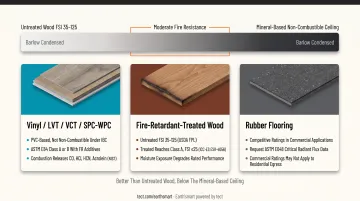
Fire-retardant-treated (FRT) engineered wood can reach Class A under ASTM E84. The USDA Forest Products Laboratory confirms that untreated domestic wood species typically fall around FSI 35–125 — outside Class A — and that treatment is required wherever Class A performance is needed.
Specific FRT products, including those covered under ICC-ES ESR-4056, have demonstrated FSI ≤25 under extended ASTM E84 testing. One critical limitation: treatment effectiveness degrades with moisture exposure over time. In WUI climates where seasonal humidity fluctuates, the original rated performance should be re-verified rather than assumed.
Rubber flooring can achieve competitive fire ratings — but most published data comes from commercial applications. For residential egress paths, request product-specific ASTM E648 critical radiant flux data before specifying. Not all rubber products tested for commercial corridors will carry residential-applicable ratings.
Each of the material types above sits in a middle range: better than untreated wood, but none of them match the performance ceiling of mineral-based options.
Lower Resistance: Carpet and Untreated Wood
Carpet performance under fire conditions varies more than any other category. Most carpets require chemical treatment to meet minimum ASTM E648 Class I or Class II requirements. Fiber type alone — natural vs. synthetic — is not a reliable predictor of fire performance; the installed product's tested CRF is the only defensible selection criterion.
NFPA 101 specifically regulates carpet in egress corridors and exit paths, where Class I critical radiant flux is required. Carpet specified in those locations without a verified ASTM E648 Class I rating is a code compliance problem, not a design preference.
Untreated wood — solid hardwood, standard engineered wood, and most laminate — is typically Class C or unrated under ASTM E84. It contributes meaningfully to fuel load and flame travel, particularly when installed over a combustible subfloor.
Assembly, Subfloor, and WUI Code Considerations
The most consequential misunderstanding about flooring fire ratings is also the most common: a material's tested rating applies to that finish product in isolation. In a real building, the subfloor assembly — sleepers, underlayment, adhesives, and the structural deck — collectively determines how the floor performs.
IBC Section 805 governs combustible flooring-related components in Type I and II construction. It regulates sleepers, nailing blocks, noncombustible fill, and fireblocking requirements. A Class A finish layer doesn't satisfy Section 805 compliance on its own.
WUI-Specific Subfloor Risk
California's 2025 WUI Code (Title 24, Part 7, effective January 1, 2026) focuses primarily on the building envelope — exterior wildfire exposure, underfloor enclosure provisions, and ventilation openings. It does not establish a separate interior flooring fire rating class.
The subfloor risk in WUI zones concentrates at crawl spaces and raised foundations. IBHS research has confirmed that standard foundation vents can allow wind-blown ember entry into enclosed underfloor spaces. CALFire's Ready for Wildfire guidance recommends ember- and flame-resistant vents or corrosion-resistant mesh with small openings to address this pathway.
Once embers enter a crawl space, combustible subfloor materials, wood joists, and untreated blocking become the fuel source. The fire can establish itself beneath the structure before it's visible inside.
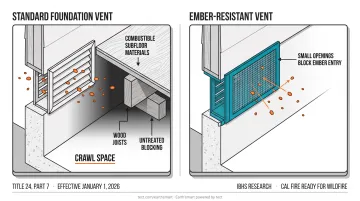
For homeowners rebuilding in Pacific Palisades and similar WUI zones, the flooring decision doesn't start with the finish material — it starts with whether the underfloor assembly is protected.
Integrated System Specification
This is where fragmented project delivery creates real risk. When finish flooring, underlayment, adhesive, and subfloor assembly are each selected by separate contractors at different phases, the system-level fire performance is unknown — regardless of what individual product ratings say.
The components most commonly left uncoordinated include:
- Underlayment fire ratings relative to the finish floor specification
- Adhesive compatibility with fire-rated assemblies
- Subfloor material selection against IBC Section 805 requirements
- Fireblocking continuity across framing and finish phases
Earth'smart powered by tect addresses this through coordinated delivery: flooring systems are specified alongside structural and envelope decisions from the start, with input from the earth'smart powered by tectApp community of 70+ building product manufacturers integrated while those decisions are still reversible. The result is a floor assembly where every layer is understood before a single component is ordered.
Common Misunderstandings About Flooring Fire Ratings
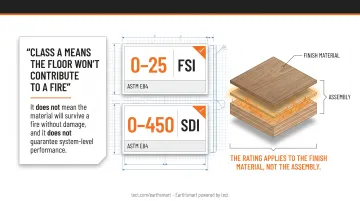
"Class A means the floor won't contribute to a fire"
A Class A rating under ASTM E84 means FSI 0–25 and SDI 0–450 under that specific test method — nothing more. It does not mean the material will survive a fire without damage, and it does not guarantee system-level performance.
A Class A floor covering installed over a combustible subfloor with a flammable adhesive can still contribute to rapid fire spread. The rating applies to the finish material, not the assembly.
"Fire-resistant flooring protects the floor from fire damage"
Fire resistance ratings exist to slow flame propagation, reduce smoke generation, and preserve egress time. Even Class A materials can be destroyed in a structure fire. The purpose of the rating is to buy time — for evacuation and suppression response — not to make the floor fireproof. ASTM itself describes E84 as providing "comparative measurements of surface flame spread and smoke density," not a real-fire survival guarantee.
"A commercial Class A rating works for my WUI home"
An ASTM E84 Class A result is not interchangeable with an ASTM E648 Class I result. If the code question involves interior floor finish — especially in an egress corridor — ASTM E648/NFPA 253 is the applicable standard. A product rated Class A under E84 for a commercial warehouse may not meet the critical radiant flux threshold required for a residential egress hallway.
This gap matters especially in California HFHSZ jurisdictions, where local AHJ requirements can go beyond baseline code. Before specifying any product, cross-reference the test standard against the building code requirement for the specific room type, occupancy classification, and local jurisdiction.
Frequently Asked Questions
What is the most fire-resistant flooring?
Polished concrete, ceramic tile, and porcelain tile are the top options. They are non-combustible under IBC definitions, produce no flame spread or smoke under fire conditions, and meet IBC interior finish requirements without additional test documentation.
Is LVP flooring considered non-combustible?
No. LVP is a PVC-based material that can achieve Class A or Class B fire ratings through fire-retardant additives, but it will melt, burn, and emit toxic gases under prolonged fire exposure. It should not be specified where non-combustible materials are required by code.
Is epoxy flooring non-combustible?
Standard epoxy is not non-combustible — it begins to soften at relatively low temperatures and is typically rated Class B or C. Fire-rated epoxy formulations are available, but epoxy is not equivalent to concrete or tile in fire resistance and should not be treated as a non-combustible substitute.
What does a Class A fire rating mean for flooring?
Under ASTM E84, Class A means a Flame Spread Index of 0–25 and a Smoke Developed Index of 0–450. This is the best performance tier — lowest flame spread and smoke output among rated materials. For floor coverings specifically, the applicable standard is ASTM E648, not ASTM E84, so always confirm which test applies to your code requirement.
Does flooring fire resistance affect homeowners insurance in WUI zones?
California's Safer from Wildfires regulation requires admitted insurers to offer discounts for qualifying wildfire mitigation actions. No flooring-specific premium or eligibility rule has been established, but fire-resilient assemblies — including compliant subfloor and finish materials — factor into the broader risk profile insurers evaluate for coverage eligibility in high-risk zones.
What flooring is required in WUI or high fire hazard severity zones?
Most WUI codes focus on the building envelope rather than interior finish materials. However, subfloor assemblies in homes with raised foundations or crawl spaces are regulated to prevent ember intrusion ignition. Verify requirements with your local Authority Having Jurisdiction (AHJ) and confirm that both finish and subfloor materials meet applicable standards before construction begins.