For homeowners rebuilding after events like the 2025 Palisades Fire — which destroyed 6,845 structures across 23,448 acres — the decking decision carries real consequences. Choose the wrong material category and you may fail inspection, lose insurance coverage, or discover mid-rebuild that your specified product isn't actually approved for WUI use in your jurisdiction.
The confusion usually starts with terminology. "Non-combustible," "fire-resistant," and "Class A" sound interchangeable. They're not — and the difference determines whether your deck survives embers or contributes to losing the house. This guide clarifies each term and gives you a practical framework for making the right call.
Key Takeaways
- Non-combustible materials (concrete, aluminum, steel) don't ignite or sustain combustion — fire-resistant materials slow flame spread but can still burn
- Class A is the highest flame-spread rating, but a Class A product is not automatically non-combustible
- The full deck assembly must perform as a system — surface, framing, and substructure together, not just the walking surface
- In California WUI zones, the California OSFM Building Materials Listing determines which specific products are approved — not just material categories
- Debris removal and behavioral changes during red flag conditions matter as much as material choice
What "Non-Combustible" Really Means for Decking
"Non-combustible" is a technical classification, not a marketing term. Under ASTM E136, a material is non-combustible when it does not ignite, burn, support combustion, or release flammable vapors under specified laboratory furnace conditions. That standard is distinct from ASTM E84, which measures surface burning behavior — not whether a material burns at all.
Understanding Fire Class Ratings
ASTM E84 reports two values: Flame Spread Index (FSI) and Smoke Developed Index. The three classes based on FSI:
| Class | Flame Spread Index | What it means |
|---|---|---|
| A | 0–25 | Slowest flame spread |
| B | 26–75 | Moderate flame spread |
| C | 76–200 | Higher flame spread |
Class A gives more time for evacuation and slows fire transfer to the main structure. Class A does not mean non-combustible. A treated composite board can achieve a Class A flame spread index while still being made of combustible materials that will ignite under sustained exposure.
ASTM E84 was never designed to classify whether a material burns — only how fast flames spread across its surface.
Non-Combustible vs. Fire-Resistant vs. Fire-Retardant
| Term | Definition | Examples |
|---|---|---|
| Non-combustible | Does not ignite or sustain combustion (ASTM E136) | Concrete, steel, aluminum |
| Fire-resistant | Resists ignition, slows flame spread, but can eventually burn | PVC, capped composites, dense hardwoods |
| Fire-retardant | Combustible material chemically treated to slow ignition | FRT lumber, treated composites |
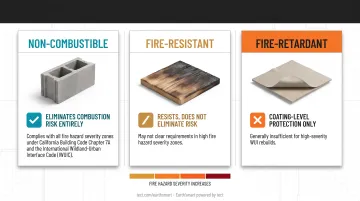
Only the first category eliminates combustion risk entirely. This distinction carries real code and insurance implications — and for homeowners in wildfire-prone areas, it determines what's actually permitted on your property. California Building Code Chapter 7A and the International Wildland-Urban Interface Code (IWUIC) specify which categories qualify in WUI zones, with requirements tightening as fire hazard severity increases. If you're rebuilding or building in a high-risk area, "fire-resistant" may not clear the bar.
Non-Combustible and Fire-Resistant Decking Materials Compared
Material choice cannot be evaluated without considering the full deck assembly. IBHS research is direct on this point: combustible joists provide a fire pathway from above-deck embers and under-deck flame impingement, regardless of what's on the walking surface. IBHS recommends metal substructure paired with non-combustible walking surfaces for new deck construction.
Truly Non-Combustible Deck Surface Options
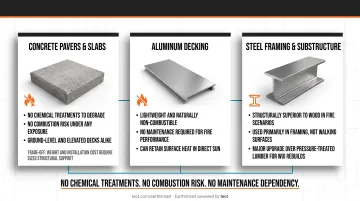
Concrete pavers and slabs are the most fire-inert option available, with no chemical treatments to degrade and no combustion risk under any exposure. They work for ground-level and elevated decks alike, provided drainage is accounted for in the design. The trade-offs are weight and installation cost: structural support must be sized accordingly.
Aluminum decking is lightweight and naturally non-combustible, with no maintenance required to retain its fire performance. It can retain surface heat in direct sun — worth noting for comfort — but its fire performance doesn't degrade over time regardless of maintenance history.
Steel is used primarily in framing and substructure rather than walking surfaces, but it's structurally superior to wood in fire scenarios and carries no combustion risk. For WUI rebuilds, steel framing is a significant upgrade over pressure-treated lumber.
None of these materials depend on chemical treatments that wear off. In high-risk zones where maintenance compliance can't be guaranteed every year, that's a real long-term advantage.
High-Performance Fire-Resistant Alternatives
When truly non-combustible surfaces aren't feasible, these options provide the next level of protection:
- PVC decking : some products achieve Class A FSI and WUI compliance; verify the specific product in OSFM Category 8110 before specifying
- Capped polymer composite decking : select product lines offer Class A ratings and WUI listings; TimberTech's AZEK collections, for example, carry ignition-resistance and WUI compliance claims, though current OSFM listing status should always be confirmed
- Dense tropical hardwoods (ipe, cumaru) : IBHS found high-density boards like ipe resisted ignition from embers accumulated between boards in controlled testing; they require no chemical treatment but do need consistent maintenance and are not code-listed for all WUI jurisdictions
Verification is non-negotiable. A brand that markets itself as "Class A" may not be individually listed for WUI use in your jurisdiction. Always check the OSFM Building Materials Listing for the specific product name and manufacturer under Category 8110, not just the material category.
Safety During Selection and Installation
Material selection is the most critical safety decision in the entire project. Choices made incorrectly at the design stage cannot be corrected by maintenance later — and in WUI zones like Pacific Palisades, where code requirements and insurer expectations are both tightening, getting this right before construction starts prevents costly rework.
This is where early manufacturer involvement pays off. Earth'smart powered by tect's earth'smart powered by tectApp community connects projects directly with 70+ building product manufacturers, so material decisions get direct input from the companies behind those products — not assumptions drawn from marketing datasheets. Systems are understood, integrated, and verified before a single board is installed.
Substructure and Framing Safety
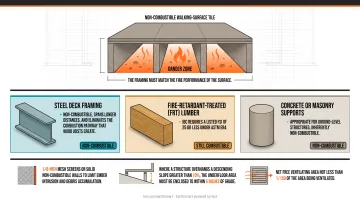
The framing must match the fire performance of the surface. A non-combustible walking surface over standard pressure-treated wood joists still creates a combustion pathway beneath your feet. Options include:
- Steel deck framing — non-combustible, spans longer distances, and eliminates the combustion pathway that wood joists create
- Fire-retardant-treated (FRT) lumber — IBC requires a listed FSI of 25 or less under ASTM E84; Class A rated, but still combustible — not non-combustible
- Concrete or masonry supports — appropriate for ground-level structures, inherently non-combustible
Below-deck enclosure is also decided at this phase. Open undersides allow ember accumulation against framing members. Under IWUIC, where a structure overhangs a descending slope greater than 10%, the underfloor area must be enclosed to within 6 inches of grade. IBHS recommends enclosing low-elevation decks with 1/8-inch mesh screens or solid non-combustible walls to limit ember intrusion and debris accumulation. Any enclosure must include ventilation meeting the IBC minimum: net free ventilating area not less than 1/150 of the area being ventilated.
Site Preparation and Environmental Safety Factors
Site conditions affect how any material performs:
- Slope — USDA Forest Service research shows slope dramatically increases fire spread rate; decks overhanging steep grades face longer flame reach from below
- Vegetation clearance — CAL FIRE defines Zone 0 (0–5 ft), Zone 1 (5–30 ft), and Zone 2 (30–100 ft); California Government Code Section 51182 requires 100 ft defensible space where applicable
- Deck-to-wall junction — CAL FIRE Home Hardening specifies a minimum 6-inch metal flashing applied vertically at this intersection; it's one of the most vulnerable ignition points on the structure
If you're overseeing installation, verify that your contractor is meeting OSHA's construction silica standard when cutting concrete or fiber cement boards — it requires engineering controls and respiratory protection matched to assigned protection factor, not just any N95. Steel and aluminum edges also require cut-resistant gloves on site.
Keeping Your Non-Combustible Deck Safe Over Time
Even a fully non-combustible deck surface becomes a fire hazard through accumulation. Pine needles, dried leaves, and debris collecting in board gaps or under the deck create combustible fuel that embers can ignite directly. Regular clearing — especially during dry season and before red flag warning periods — is the single most important ongoing maintenance action regardless of deck material.
Fire-Retardant Treatment Degradation
If any portion of your deck uses FRT framing or treated composite products, their fire performance relies on chemical treatments that degrade with weathering, UV exposure, and moisture cycling. A deck that met Class A standards at installation may not retain that rating years later, often with no visible sign of the change. Follow manufacturer re-treatment schedules and factor this into long-term maintenance planning.
Truly non-combustible materials — concrete, aluminum, steel — carry no equivalent risk. Their fire performance is intrinsic to the material, not dependent on a chemical layer. That permanence is why earth'smart powered by tect's WUI rebuilds default to non-combustible systems throughout the home, not just on deck surfaces.
Behavioral Safety During Wildfire Season
The deck's material doesn't matter if combustible items are sitting on it. When red flag warnings are declared or active fire is nearby:
- Move wicker furniture, cushions, umbrellas, and doormats indoors or well away from the structure
- Remove LP tanks for grills from the deck entirely
- Clear stored firewood from under or adjacent to the deck
- Don't leave combustible debris to accumulate between clearing cycles during dry months
Common Safety Mistakes to Avoid
These three errors show up repeatedly in WUI construction — and each one can undermine an otherwise well-planned deck system.
Selecting by fire rating class without checking the product's WUI listing. A product labeled "Class A" in marketing materials may not be individually tested and listed for WUI construction. The OSFM Building Materials Listing (Category 8110) verifies listed products by standard — category-level compliance is not the same as a listed product. Always confirm the specific product name and the manufacturer's test documentation.
Treating the deck surface as the only fire safety variable. A non-combustible walking surface does not make the deck system non-combustible if the joists, posts, and enclosed underside are standard combustible lumber. IBHS research identifies combustible joists as a fire pathway from both above-deck embers and under-deck flames. The deck must be evaluated as an assembly.
Assuming fire-retardant treatments are permanent. FRT wood and chemically treated composites require periodic re-evaluation. Treatments applied at manufacture do not last indefinitely under exterior conditions. There is no visible indication when performance has degraded below the rated level, so build inspection and re-treatment into your maintenance schedule from the start.
Frequently Asked Questions
What decking is non-combustible?
Truly non-combustible deck materials include concrete pavers and slabs, aluminum decking, and steel framing — materials that don't ignite or sustain combustion under ASTM E136. Many materials marketed as "fire-resistant" or "Class A" are combustible materials that resist or slow ignition, not eliminate it.
What wooden board does not catch fire?
No wood species is fully non-combustible. Fire-retardant-treated (FRT) lumber achieves a Class A flame spread rating by significantly slowing ignition, but it remains a wood product. FRT treatment must be maintained over time and does not make wood equivalent to non-combustible materials like concrete or steel.
What is the difference between non-combustible and fire-resistant decking?
Non-combustible materials — concrete, aluminum, and steel — physically cannot sustain combustion. Fire-resistant materials (certain composites, dense hardwoods, PVC) slow flame spread and resist ignition but will eventually burn under sustained exposure. The distinction affects code requirements in WUI zones and real-world survival outcomes.
Is non-combustible decking required by code in WUI zones?
California Building Code Chapter 7A and the IWUIC require decking to meet ignition-resistance standards across moderate, high, and extreme fire hazard areas — with stricter requirements at each risk level. For specific product approvals, check the OSFM Building Materials Listing (Category 8110) and your local AHJ.
Do non-combustible deck materials require maintenance to stay fire-safe?
These materials do not require maintenance to retain their fire performance — it's intrinsic to the material itself. That said, all decks require regular debris removal from surfaces and under-deck areas to prevent combustible fuel buildup from defeating the system.
Can I safely use a fire pit on a non-combustible deck?
A non-combustible surface reduces risk compared to wood, but it doesn't replace safe fire-pit practices. Safe use still requires:
- A fire-pit model rated for deck use
- A non-combustible pad underneath
- Adequate clearance from railings and furniture
- A readily accessible fire extinguisher