That's the core insight behind the Home Ignition Zone (HIZ) — the framework fire scientists use to understand exactly why some homes survive wildfires while neighbors don't. Survivability is largely determined by conditions within 100 feet of your structure, not the overall fire behavior in the broader landscape.
This guide walks through how ignition actually happens, what the three HIZ zones require, and the specific actions that close each vulnerability.
Key Takeaways
- The HIZ is the area around and including your home that most determines whether it survives a wildfire
- Embers — not direct flame — are the primary ignition threat; the 0–5 foot zone is where most losses begin
- Three zones, each with distinct priorities: Zone 0 (0–5 ft), Zone 1 (5–30 ft), Zone 2 (30–100 ft)
- Structural hardening and landscape management must be addressed together; either one alone leaves ignition pathways open
- HIZ management requires seasonal maintenance and long-term design decisions, not a single fix
How Homes Ignite During Wildfires
Fire scientist Jack Cohen's research, documented by FEMA, identified three ignition pathways: ember intrusion, radiant heat exposure, and direct flame contact. Understanding each one changes how you prioritize your mitigation work.
Ember Intrusion
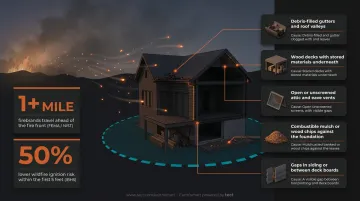
Wind-lofted embers (firebrands) are the most dangerous and least intuitive threat. According to FEMA and NIST research, firebrands can travel more than a mile ahead of a fire front, landing on roofs, in gutters, on decks, and inside attic vents long before the fire itself arrives.
The ember doesn't need much to ignite a home. Common ignition points — spots where embers take hold — include:
- Debris-filled gutters and roof valleys
- Wood decks with stored materials underneath
- Open or unscreened attic and eave vents
- Combustible mulch or wood chips against the foundation
- Gaps in siding or between deck boards
A single ember landing in any of these locations can start a fire that spreads to the structure within minutes. IBHS research shows that creating an ember-resistant buffer in the first 5 feet around a home cuts wildfire ignition risk in half.
Radiant Heat Exposure
Intense radiant heat from burning vegetation or neighboring structures can ignite a home without any direct flame contact. NIST research shows single-pane glass can fail at exposures as low as 8–20 kW/m², and wood siding can begin smoldering under sustained heat before any flame touches it.
Combustible materials in the 0–30 foot zone pull that thermal exposure closer to the structure. Managing vegetation in this zone controls how much heat your home's exterior actually sees.
Direct Flame Contact
Where radiant heat requires distance and vegetation control, direct flame contact comes down to fuel bridges — physical connections that carry fire directly to your structure. Wood fencing running to the siding, dense shrubs touching the foundation, propane tanks stored against the wall, patio furniture left on a wood deck: each one is a path flame can follow.
Of the three pathways, this is the most preventable. Every fuel bridge is something a homeowner placed or planted there — and can remove.
The Three Zones of the Home Ignition Zone
The HIZ framework, developed by Jack Cohen and adopted by NFPA, CAL FIRE, and the USDA Forest Service, divides the land around a home into three concentric zones. Work from the structure outward — Zone 0 first, then Zone 1, then Zone 2.
Zone 0 — The Immediate Zone (0–5 Feet)
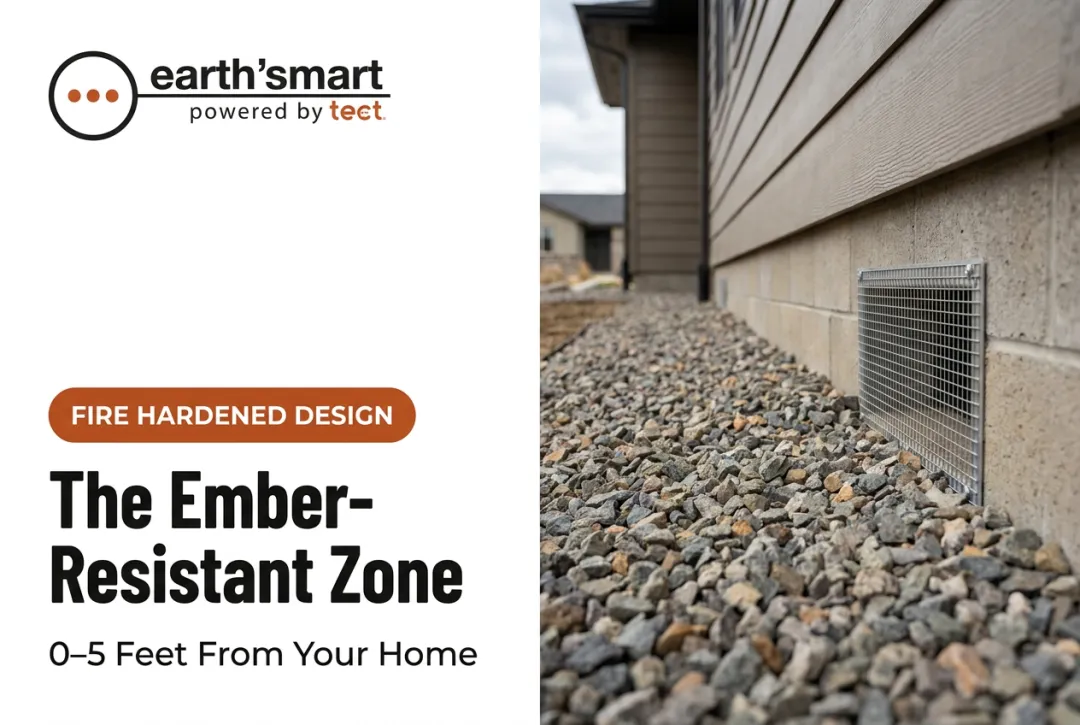
Zone 0 is the highest-leverage area for risk reduction. Embers accumulate here, and ignition in this zone can spread to the structure in minutes. Every material choice within these 5 feet matters.
Zone 0 priorities:
- Replace combustible mulch with gravel, pavers, or concrete
- Clear all debris from gutters, roof surfaces, and under-deck areas
- Remove stored items, firewood, and propane tanks from this zone entirely
- Replace wood fencing within 5 feet of the home with non-combustible metal alternatives
- Maintain a 6-inch vertical clearance between siding and ground level
Zone 1 — The Intermediate Zone (5–30 Feet)
Zone 1's goal is to slow fire's movement and reduce flame height through managed vegetation. The main hazard here is ladder fuels: low shrubs that allow a surface fire to climb into tree canopies, carrying flame directly toward the structure.
Zone 1 priorities:
- Remove dead plants, dried grass, and accumulated debris
- Prune tree branches to at least 6 feet from the ground
- Maintain 10-foot spacing between tree crown edges on flat ground (more on slopes — see below)
- Eliminate shrubs growing beneath trees that create vertical fuel continuity
- Keep lawns trimmed and irrigated; relocate wood piles to Zone 2
On sloped lots, CAL FIRE's spacing requirements expand significantly:
| Slope | Shrub Spacing | Tree Crown Spacing |
|---|---|---|
| 0–20% | 2x shrub height | 10 ft between crowns |
| 20–40% | 4x shrub height | 20 ft between crowns |
| Over 40% | 6x shrub height | 30 ft between crowns |
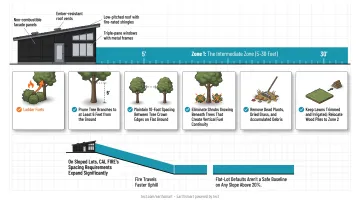
These numbers matter most in hillside communities like Pacific Palisades. Fire travels faster uphill, and radiant heat from below-grade vegetation compounds the exposure — which is why flat-lot defaults aren't a safe baseline on any slope above 20%.
Zone 2 — The Extended Zone (30–100+ Feet)
Zone 2 focuses on interruption: breaking continuous fuel loads so any fire reaching this range stays low, moves slowly, and loses intensity before it enters Zone 1.
Zone 2 priorities:
- Trim annual grasses to a maximum of 4 inches
- Remove dead and decaying plant material and small conifers growing between larger trees
- Allow fallen leaves and small branches up to 3 inches deep
- Create fuel breaks using driveways, paths, or gravel beds
- Maintain a 10-foot cleared strip around any exposed wood piles or LPG tanks
How to Reduce Wildfire Risk in the Home Ignition Zone
Start at the structure and work outward. Structural hardening and landscape management must be addressed together — closing one without the other leaves ignition pathways open.
Hardening the Structure and Zone 0
Structural hardening targets the specific vulnerabilities that embers and radiant heat exploit. California's Chapter 7A sets the baseline for WUI construction, but the following components represent the critical priorities:
- Roofing: Class A fire-rated assembly (metal, tile, or fire-rated asphalt), tested to ASTM E108 or UL 790; replace any missing or damaged shingles that expose the roof deck
- Vents: Install 1/8-inch metal mesh screening over all attic, eave, and foundation vents — unscreened vents are one of the leading entry points for embers
- Windows: Multi-pane tempered glass; single-pane windows are a known failure point under radiant heat exposure
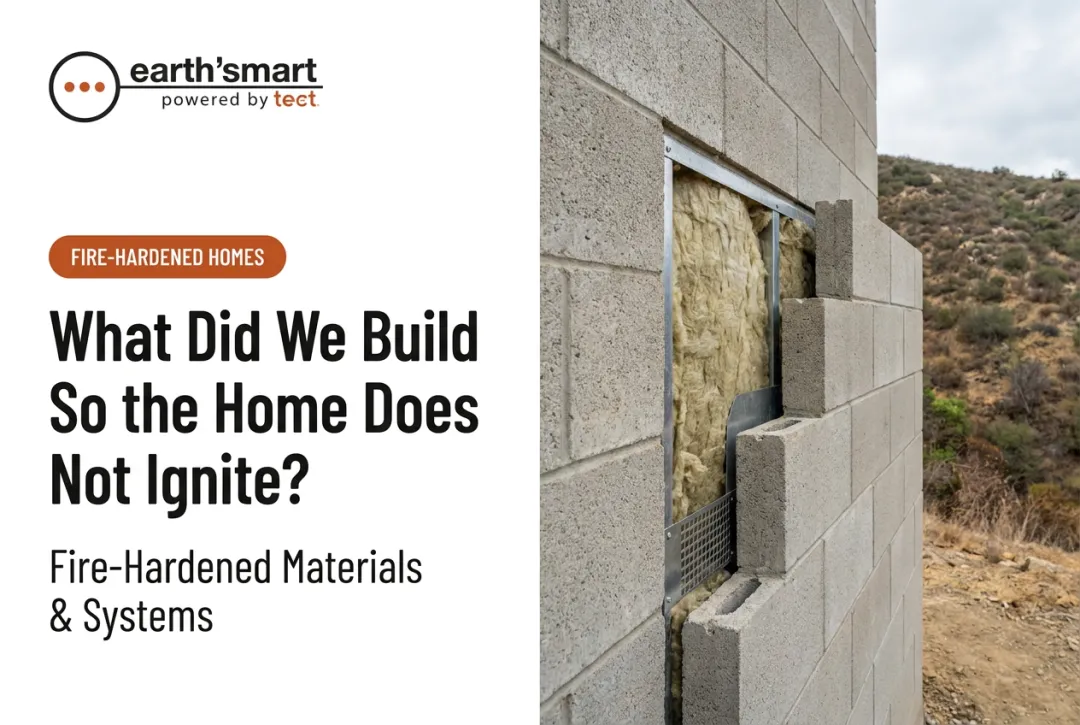
- Siding: Non-combustible or ignition-resistant materials — stucco, fiber cement, or treated products; untreated wood siding abutting the structure is a direct flame contact risk
- Zone 0 surface: Gravel, pavers, or concrete instead of combustible mulch; no stored items on or under decks
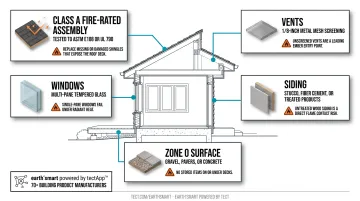
For homeowners rebuilding in Pacific Palisades, these material selections are high-stakes decisions — not just code checkboxes. Earth'smart powered by tect's integrated approach connects clients with 70+ building product manufacturers through the earth'smart powered by tectApp™ community, so fire-resistive roofing, wall systems, and suppression technologies are selected with direct input from the people who engineer them — whether you're building from scratch or working with an existing team.
Managing Vegetation in Zones 1 and 2
Once the structure and its immediate surroundings are hardened, vegetation management in Zones 1 and 2 limits how much fuel a fire can carry toward the building. Core actions include:
- Select fire-resistant plant species — low-resin, high-moisture content varieties that don't readily ignite
- Maintain vertical clearance between shrubs and lower tree branches equal to 3x shrub height
- Keep branches at least 10 feet from chimneys
- Revisit plantings as they mature — a plant that was well-spaced at installation may create ladder fuels three years later
Local fire departments and state forestry offices often offer free site assessments — an underused resource for homeowners who want an expert eye before fire season.
Long-Term Maintenance and the Insurance Connection
HIZ management isn't a single installation. A seasonal inspection routine keeps the work from eroding:
- Before fire season (late spring): Clean gutters and roof surfaces; re-check Zone 0 for any combustible materials introduced over winter; inspect vent screens for damage or gaps
- After wet seasons: Assess vegetation regrowth across all three zones — rain accelerates plant growth and can quickly rebuild the ladder fuels you removed
- Annually: Review plant selection as plantings mature and change character
The Insurance Dimension
California's Safer from Wildfires framework, administered by the California Department of Insurance, requires insurers to recognize mitigation measures including Class A roofs, ember-resistant vents, multi-pane windows, defensible space, and Zone 0 practices. Documented mitigation work strengthens your position with insurers — both for coverage access and for contesting non-renewals. In high-risk zones where standard policies have been withdrawn, demonstrated fire-resistant construction can be the difference between insurability and not.
Document everything: photos, contractor records, inspection reports, product specifications. Insurers must account for recognized wildfire safety measures under CDI guidance, but only if you can show the work was done.
Building Fire-Resistant from the Start
NIST SP 1198 data from post-fire studies found that 70% of homes with non-flammable roofs survived the 1990 Santa Barbara Paint Fire, compared to just 19% with flammable roofs. The same research found 67% structure loss where vegetation was present in the 0–30 foot zone, versus 32% where it was absent. The performance gap between hardened and unhardened homes is measurable and large.
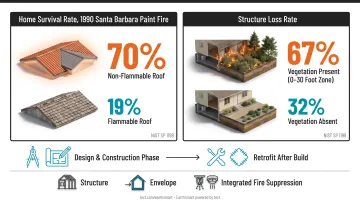
For homeowners planning a rebuild or major renovation, the most effective — and most cost-efficient — moment to address structural ignitability is during design and construction. Retrofitting fire-resistant systems after a home is built is significantly more disruptive and expensive than planning them correctly from the start.
A coordinated approach that integrates fire-resistive materials, systems, and envelope decisions into the build process avoids the cost overruns and system gaps that retrofitting typically creates. Earth'smart powered by tect works from exactly this principle — bringing together structure, envelope, and integrated fire suppression as a single coordinated system, so every decision is made correctly before construction begins rather than corrected after.
Frequently Asked Questions
What is the Home Ignition Zone?
The HIZ is the area around a home, divided into three zones extending up to 100+ feet from the structure, that most determines whether a home survives a wildfire. Developed by USDA Forest Service fire scientist Jack Cohen, it is now the basis for NFPA, CAL FIRE, and IBHS homeowner guidance.
How far should defensible space extend from my home?
Defensible space should extend at least 100 feet from the structure, or to the property line. The most critical area is the first 5 feet immediately around the home. On sloped lots — common throughout Pacific Palisades — required spacing increases significantly, especially in the downhill direction where fire travels fastest.
Are embers really the main way homes catch fire in wildfires?
Yes. NIST workshop findings report firebrands as responsible for 50% of structure ignitions, and FEMA and USFA research confirms embers can travel well over a mile ahead of a fire front. Vent screening, debris removal, and Zone 0 hardening address this directly and are the highest-priority actions for most homeowners.
What building materials are most fire-resistant for homes in high-risk areas?
The primary materials are Class A-rated roofing (metal, concrete tile, or fire-rated asphalt), non-combustible or ignition-resistant siding (fiber cement, stucco, or treated products), multi-pane tempered glass windows, and 1/8-inch metal mesh vent screens. California's Chapter 7A sets the compliance baseline; IBHS guidance identifies opportunities to exceed it in Zone 0.
Does creating defensible space lower my homeowner's insurance?
Outcomes vary by insurer, but California's Safer from Wildfires framework requires insurers to formally recognize documented mitigation measures — which in some cases improves coverage access in high-risk zones where standard policies have been withdrawn. Document all mitigation work with photos and records, then consult your insurer directly.
When is the best time to address Home Ignition Zone risk?
For existing homeowners, the best time is before fire season each year — typically late spring. For homeowners rebuilding or undertaking major renovation, the design and construction phase is the most effective and cost-efficient point to address structural ignitability, at a fraction of what retrofitting costs later.