Introduction
Starting a major build or rebuild forces a decision that shapes every phase of the project: hire a design-build firm that handles everything under one contract, or bring in a general contractor and coordinate design and engineering separately.
This isn't just a process preference. The model you choose determines who is accountable when something goes wrong, how well your home's systems perform together, and whether decisions get made early or surface as conflicts mid-construction.
For homeowners in high-risk areas rebuilding after wildfires, the stakes are higher. Getting fire-resistant assemblies, structural systems, and building envelope decisions right requires coordination from the very start. The wrong delivery model can mean misaligned systems, costly change orders, and a home that fails to hold up for decades.
This article breaks down exactly what each model includes, compares them side by side, and helps you decide which fits your project.
Key Takeaways
- Design-build integrates architecture, engineering, permitting, and construction under one contract — one team, one handoff, one accountable outcome
- A general contractor handles construction only; design, permits, and team coordination fall on the homeowner
- Design-build reduces change order risk because structure, systems, and budget are aligned before construction starts
- For post-wildfire rebuilds and performance homes, the integrated model provides coordination the GC model structurally cannot replicate
- A GC makes sense for narrow, well-defined scopes where detailed drawings already exist
Design-Build vs General Contractor: Quick Comparison
| Factor | Design-Build | General Contractor |
|---|---|---|
| Scope of Work | Design + engineering + permits + construction | Construction only |
| Single Point of Contact | Yes — one contract, one accountable team | No — owner manages separate architect, GC, and others |
| Permits and Approvals | Handled by the firm | Owner's responsibility (requires separate architect or expediter) |
| Design-Construction Alignment | Built in — same team makes both sets of decisions | Dependent on quality of handoff between separate parties |
| Change Order Risk | Lower — conflicts caught before construction begins | Higher — GC executes plans they didn't develop |
| Timeline Predictability | Higher — fewer mid-project surprises | Variable — depends on coordination between independent parties |
| Owner Coordination Burden | Low — owner makes decisions, not manages vendors | High — owner coordinates architect, GC, and subcontractors |
| Best Fit For | Full-scope new builds, wildfire rebuilds, and performance homes in high-risk areas | Narrow scopes with existing drawings and minimal design input |
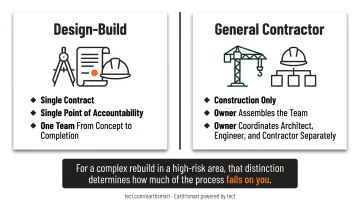
A design-build firm operates on a single-contract, single-accountability model. A general contractor handles construction only — the owner is responsible for assembling and coordinating the broader team. For a complex rebuild in a high-risk area, that distinction determines how much of the process falls on you.
What Is a Design-Build Firm?
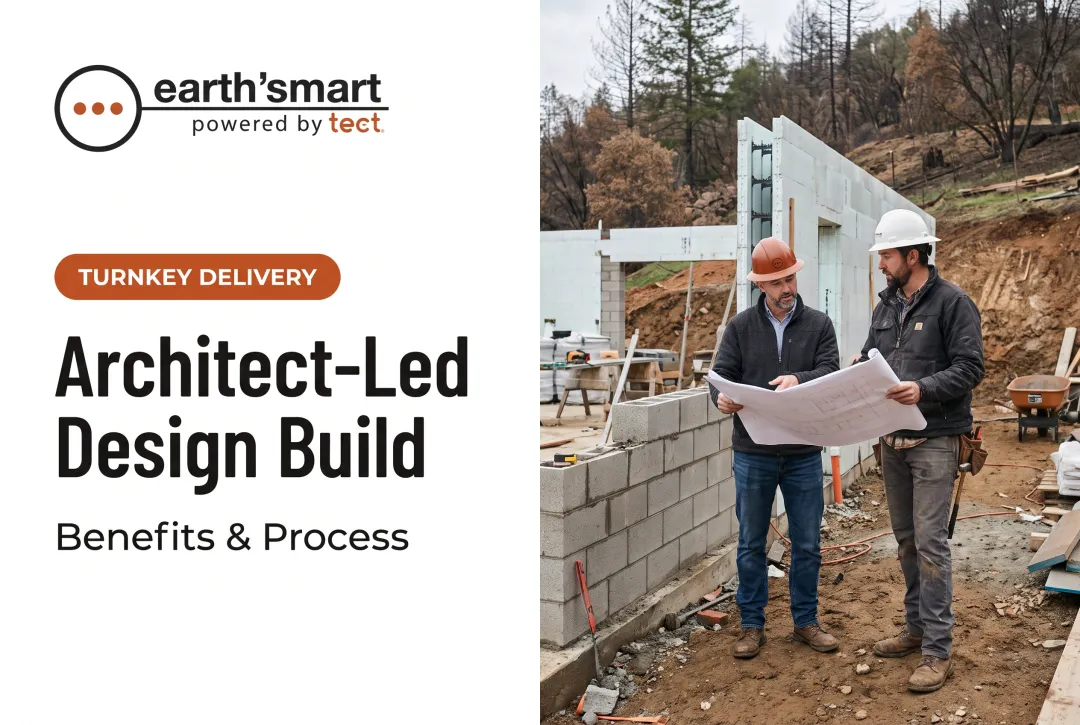
A design-build firm is a single entity where architects, engineers, and builders work as one integrated team — from concept through construction. There are no handoffs between separate parties. One contract, one accountable outcome.
According to the Design-Build Institute of America, design-build accounted for 42% of all design and construction dollar volume across the industry as of 2021, driven largely by the model's delivery advantages over traditional design-bid-build.
What's Typically Included
A full design-build engagement generally covers:
- Architectural design and structural engineering
- Mechanical, electrical, and systems planning
- Permit applications and regulatory coordination
- Material selection and procurement
- Construction management through final inspections
- Early coordination with building product specialists
The homeowner's primary obligation is making decisions — not managing vendors.
The Operational Advantage
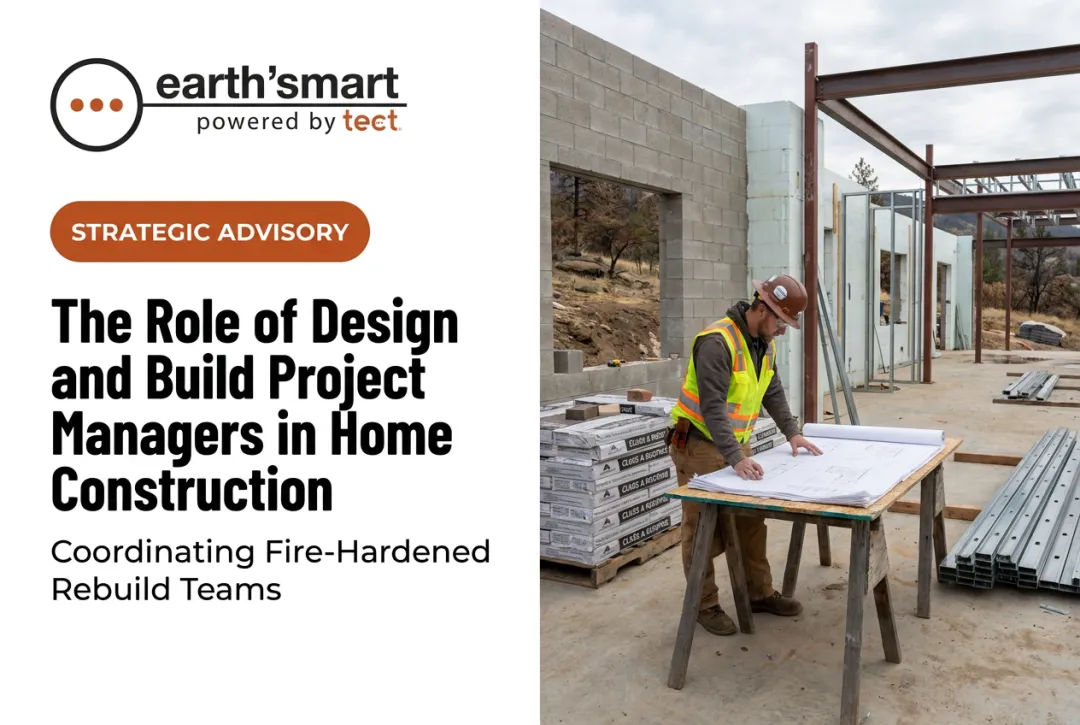
Because the team designing the project is the same team building it, design decisions get made with full awareness of constructibility, budget impact, and how systems interact. Conflicts between design intent and field conditions get resolved on paper, not during framing.
Earth'smart powered by tect's Earth'smart™ Turnkey Delivery operates this way — architecture, engineering, construction, and permit strategy coordinated under one aligned team, with direct input from the earth'smart powered by tectApp™ community of 70+ building product manufacturers integrated from the start.
Where Design-Build Performs Best
Design-build is the stronger model when:
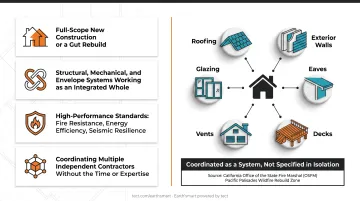
- The project is full-scope new construction or a gut rebuild
- Structural, mechanical, and envelope systems need to work as an integrated whole
- The home must meet high-performance standards — fire resistance, energy efficiency, seismic resilience
- The homeowner doesn't have the time or expertise to coordinate multiple independent contractors
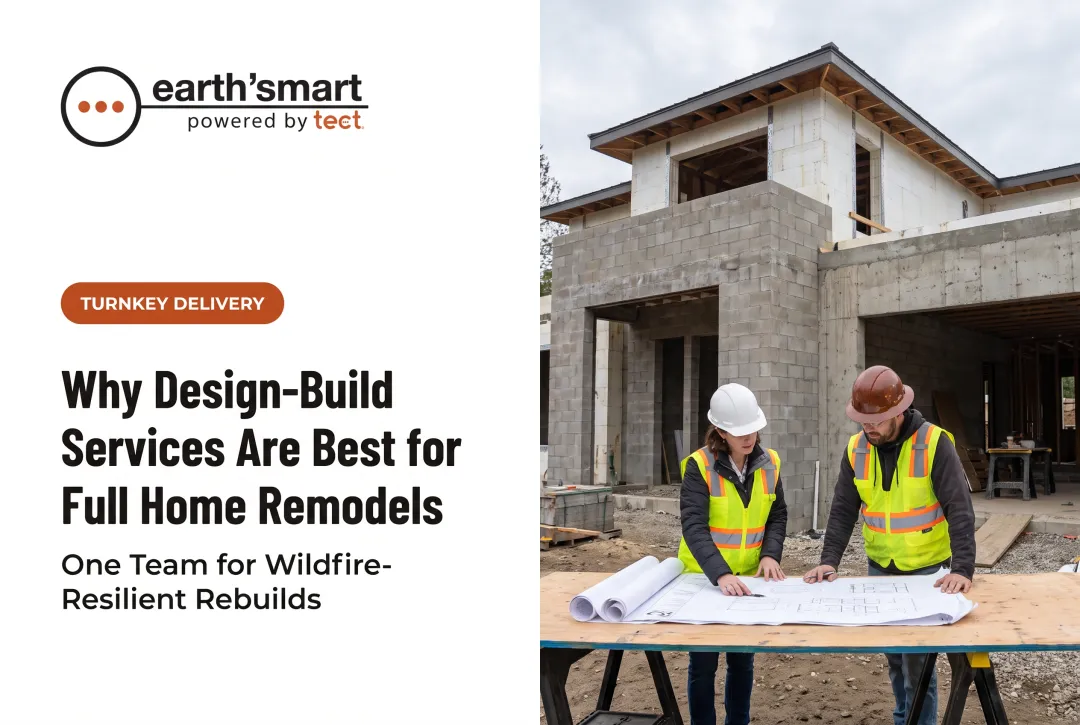
For post-wildfire rebuilds in places like Pacific Palisades, this matters even more. Research from OSFM confirms that California WUI requirements cover roofing, exterior walls, eaves, decks, vents, and glazing — all components that must be coordinated as a system, not specified in isolation. Getting those assemblies right requires the designer and builder working together from day one.
What Is a General Contractor?
A general contractor manages and executes the construction phase of a project. Their scope begins when construction begins. Architecture, interior design, permit filing, and regulatory approvals sit outside their scope — the homeowner contracts and coordinates those separately.
Under California's CSLB licensing framework, a B General Building Contractor is defined as one whose principal business involves structures built for shelter and enclosure, with the ability to take on projects involving at least two unrelated building trades. That's a construction scope — not a design scope.
The Structural Limitation
A GC builds from plans created by a team they weren't part of. They are executing someone else's decisions. When field conditions don't match those plans — concealed structural issues, outdated wiring, systems conflicts — the result is a change order. The cost and timeline impact lands with the owner.
That's not a knock on GC quality. It's simply how the model is structured: a GC inherits decisions they had no part in making, and no amount of operational skill changes that.
Where a GC Makes Sense
A general contractor is the right fit when:
- The scope is narrow and fully defined — a targeted kitchen refresh, flooring replacement, or cosmetic renovation
- Detailed architectural drawings already exist
- Permits are straightforward or already filed
- The homeowner has construction experience or a dedicated project manager in place
That said, the potential upside of the GC model — competitive bidding on construction — must be weighed carefully against the cost of hiring a separate architect, designer, and permit expediter, plus the coordination burden the owner absorbs throughout the project.
Which Approach Fits Your Project?
The right model depends on four factors: project scope, the homeowner's available time, risk tolerance for change orders and timeline slippage, and the performance requirements of the finished home.
Choose Design-Build When:
- You're building new or doing a full rebuild
- Structural or mechanical systems need reconfiguration
- The home must meet integrated performance standards — fire resistance, envelope performance, seismic or wind resilience
- You want one accountable partner from first drawing to final walkthrough
On Cost — The Honest Comparison
A GC proposal covers construction only. To compare fairly, add the cost of a separate architect, structural engineer, and permit expediter, plus your own time managing those relationships. On complex projects, that total frequently matches or exceeds an all-inclusive design-build fee — with considerably more coordination risk attached.
The DBIA cites research showing design-build delivers projects 3.8% less costly and 102% faster than traditional design-bid-build across the construction industry. That's a cross-industry figure, not residential-specific — but it reflects the same mechanism that keeps complex home projects on budget: fewer handoffs, fewer gaps.
Why Performance Homes Require Integration
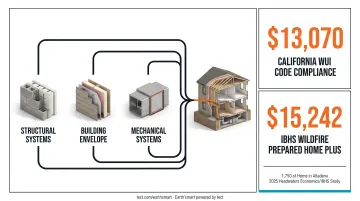
In a fire-resilient 100+ year home, structural systems, building envelope, and mechanical systems have to perform as a unit. Those decisions must be made together — before construction begins, not during it.
A 2025 Headwaters Economics/IBHS study modeled a 1,750-sf home in Altadena and found wildfire-resistant material increments of $13,070 for California WUI Code compliance and $15,242 for IBHS Wildfire Prepared Home Plus. These are discrete, planned costs — and they only stay discrete when specification happens early. That's coordination a GC handed finished drawings cannot replicate.
Choose a GC When:
- The scope is narrow and fully designed
- No significant permitting complexity exists
- Detailed drawings are already in hand
- You're prepared to manage the project independently or have a dedicated PM in place
Conclusion
Design-build and the general contractor model aren't the same choice with different names. They serve different project types and different owners — and for homeowners rebuilding in fire-prone areas, that distinction carries real consequences.
For complex, full-scope construction — especially where performance, durability, and long-term value matter — the integrated design-build model removes the coordination risk the GC model structurally carries. For simpler, well-defined scopes with existing plans, a skilled GC executes efficiently.
The model you choose shapes who owns accountability when something goes wrong and how your home performs under real conditions. For homeowners rebuilding in wildfire-prone areas, the right delivery model isn't a procedural detail — it's what determines whether the right decisions get made before the concrete is poured.
Frequently Asked Questions
What is a design-build general contractor?
A "design-build general contractor" is a firm that handles both design and construction under one contract, combining the roles of architect and GC into a single team with one point of accountability. Unlike the traditional model, the owner isn't managing coordination between two independent parties.
How much does a design-build firm charge?
Design-build firms typically price by project rather than hourly rate, with the fee covering design, permitting, and construction as an integrated scope. The total varies based on project size, complexity, finish level, and location — ask for a project-based proposal during an initial consultation to get a realistic cost range.
Is design-build more expensive than hiring a general contractor?
The comparison is misleading. A GC proposal covers construction only, while a design-build fee includes design, permitting, and construction. When all costs are added together, the totals are often comparable, and the design-build model typically carries lower risk of cost overruns on complex projects.
Who handles permits and approvals in each model?
In a design-build model, permits, regulatory filings, and approvals are handled by the firm as part of their scope. With a GC, those responsibilities fall to the homeowner, who must separately hire an architect or permit expediter unless the GC's contract explicitly states otherwise.
Which approach is better for rebuilding after a wildfire?
For post-wildfire rebuilds or construction in high-risk areas, design-build is strongly preferred. Resilient homes require early coordination across structural, envelope, and systems decisions. That level of alignment is built into the design-build model and difficult to replicate with a GC without placing a significant coordination burden on the homeowner.
What are the biggest risks of using a GC for a complex home build?
The primary risks are change orders from conditions the GC didn't anticipate in plans they weren't part of, communication breakdowns between the design and build teams, extended timelines, and the owner absorbing the project management burden across multiple independent vendors.