Introduction
After the January 2025 Palisades Fire destroyed more than 6,000 structures, the framing system question moved from theoretical to urgent. The material a home is built from determines whether it survives a wildfire, earthquake, or extreme weather event — or becomes a statistic.
Steel frame construction has moved from commercial applications into serious residential consideration, particularly in Wildland-Urban Interface (WUI) zones where wind-blown embers are the principal cause of building ignitions and wood-frame homes routinely face total loss.
The California insurance market is compounding that pressure. Carriers are non-renewing policies across high-risk zones, and the state's Safer from Wildfires framework now requires insurers to reflect documented mitigation measures in their rating plans — which means construction choices have direct financial consequences beyond the build itself.
This article covers what steel frame homes actually deliver — structurally, financially, and architecturally — and where the performance claims hold up versus where results hinge on assembly details, material integration, and WUI-specific design decisions.
Key Takeaways
- Steel is non-combustible and does not ignite or feed fire spread — a meaningful structural advantage in WUI zones
- Engineered steel frame systems are designed to flex under seismic load rather than fracture
- Long-term lifecycle costs (maintenance, termite damage, major repairs) run lower for steel than wood
- Design flexibility enables open-plan layouts, large spans, and cantilevered forms without load-bearing wall constraints
- Performance is system-level: poorly coordinated builds underperform regardless of materials, so early coordination determines outcomes
What Is a Contemporary Steel Frame Home
A steel frame home is a residential structure built around a skeleton of structural steel members. In practice, this means one of two systems:
- Light-gauge cold-formed steel (CFS): Thin-gauge steel members used for walls, floors, roof framing, and trusses in residential applications. Governed by AISI S230-19 for one- and two-family dwellings up to three stories.
- Hot-rolled structural steel: Heavier W, S, and C-shape sections used for custom beams, columns, and long-span configurations. Governed by AISC 360 for structural buildings.
Many contemporary residential projects use both — CFS for repetitive framing elements and hot-rolled sections where large spans, cantilevered forms, or multi-story structural loads require engineered solutions.
Where steel frame construction is most commonly applied:
- New custom builds in fire-hazard severity zones and WUI areas
- Post-disaster rebuilds after wildfire or earthquake events
- High-performance residential projects where open plans, large glazing, or complex site topography demand structural solutions wood framing can't reliably deliver
- Hybrid structural systems combining steel, concrete masonry, and other non-combustible materials
Steel framing is a structural decision — one that shapes what a home can withstand, how it can be configured, and what it costs to own over decades. The choice has consequences well before and long after construction ends.
Key Advantages of Steel Frame Homes
The advantages below reflect real-world performance outcomes in the contexts where they matter most.
Built-In Resilience Against Fire, Seismic, and Extreme Weather
Steel is non-combustible. It does not ignite, does not feed fire spread, and does not contribute to structural collapse from ember ignition (the mechanism responsible for most WUI home losses).
CAL FIRE defines home hardening as using construction features and materials to increase ignition resistance from direct flame, radiant heat, and embers. A non-combustible structural frame is a core component of that hardening strategy.
BuildSteel has documented cases where steel-framed homes in Southern California survived wildfires while adjacent wood-frame structures burned to ash. That's not a controlled study (it's an industry source), but it reflects a structural reality: steel that doesn't combust doesn't collapse from fire the way wood framing does.
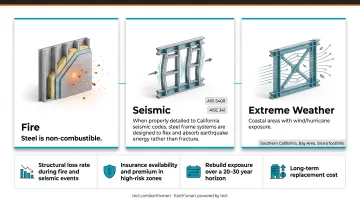
For seismic performance, the claim requires precision. AISI S400 governs cold-formed steel seismic force-resisting systems and diaphragms. AISC 341 covers structural steel seismic force-resisting systems. These are engineered system standards — seismic resilience is a connection and system-level outcome, not a property of steel in isolation. When properly detailed to California seismic codes, steel frame systems are designed to flex and absorb earthquake energy rather than fracture. That ductile behavior is the design goal.
KPIs this affects:
- Structural loss rate during fire and seismic events
- Insurance availability and premium in high-risk zones
- Rebuild exposure over a 20–30 year horizon
- Long-term replacement cost
When this matters most: WUI zones, coastal areas with wind/hurricane exposure, seismically active regions (Southern California, Bay Area, Sierra foothills), and any location where state or local fire agencies classify wildfire risk as high or extreme.
Design Flexibility That Supports Contemporary Architecture
Steel's strength-to-weight ratio enables structural spans that wood framing cannot match without intermediate load-bearing walls. This directly unlocks design configurations characteristic of contemporary residential architecture:
- Open-plan great rooms without column interruption
- Large glazed openings and clerestory windows
- Cantilevered volumes and rooftop terraces
- Mixed-material facades on complex hillside topography
- Multi-story configurations where seismic and gravity loads exceed wood-frame capacity
AISI S230-19 includes prescriptive span tables for CFS floor joists, ceiling joists, rafters, and headers. Custom hot-rolled steel spans require project engineering under AISC standards — not unlimited, but significantly more generous than prescriptive wood framing allows.
On sloped coastal lots and narrow urban footprints (contexts common in Pacific Palisades) steel framing allows architects to resolve structural problems that would otherwise force design compromises. For rebuild projects, this means homeowners can upgrade the spatial quality of the original structure, not just replicate it.
One honest note on resale value: a 2023 NAR survey found that 51% of Americans prefer open floor plans and 49% prefer traditional closed layouts. Open-plan design is a buyer preference, not a guaranteed premium. The value case for design flexibility is livability and customization scope, not a specific resale number.
KPIs this affects:
- Usable interior square footage
- Natural light and sightline continuity
- Architect/builder coordination efficiency
- Design scope on constrained lots
When this matters most: Hillside and coastal lots, narrow urban footprints, and any rebuild where homeowners want to improve on the original structure rather than replicate it.
Long-Term Cost Reduction and Insurance Positioning
The upfront cost of steel framing is generally higher than wood. The lifecycle cost picture is a different calculation.
Steel does not rot, warp, or attract pests — and it doesn't settle over time the way wood-frame structures do. The EPA estimates termites cause billions of dollars in structural damage annually, with property owners spending over $2 billion per year on treatment. Steel framing eliminates that exposure entirely. SCI modeling has found that Z275 galvanized light steel framing in residential applications can have a predicted design life exceeding 200 years — a model-based finding, not a warranty, but one that contrasts sharply with the 50-year assumed service life built into most wood-frame residential codes.
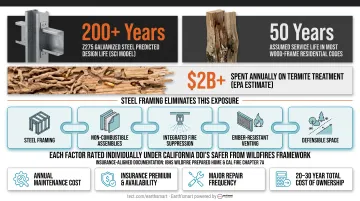
On insurance, the picture is more nuanced than the industry sometimes presents. California DOI's Safer from Wildfires framework requires insurers to give discounts to policyholders who document mitigation measures — but each mitigation factor is rated individually.
Steel framing is one component of a broader documented mitigation package. It does not guarantee premium reductions or insurance availability on its own. What it does is support a stronger overall risk profile when combined with non-combustible assemblies, integrated fire suppression, ember-resistant venting, and defensible space.
Earth'smart powered by tect's Earth'smart™ delivery model produces insurance-aligned documentation packages : system-level performance records, manufacturer specifications, fire-suppression engineering, and documentation aligned with IBHS Wildfire Prepared Home and CAL FIRE Chapter 7A standards. Brokers, MGAs, and underwriters can use that package directly to support coverage and pricing decisions.
KPIs this affects:
- Annual maintenance cost
- Insurance premium and availability
- Major repair frequency
- 20–30 year total cost of ownership
When this matters most: Homeowners rebuilding after total loss, those in California's high-risk fire zones facing non-renewal exposure, and anyone planning to hold a home for decades rather than sell in the short term.
What Happens When Steel Frame Construction Is Done Without Proper Coordination
Steel framing's advantages are system-level, not material-level. A steel skeleton paired with an uncoordinated envelope delivers neither the resilience nor the energy performance that makes the construction worthwhile.
The most documented coordination failure in CFS construction is thermal bridging. Building Science Corporation states that steel is approximately 400 times more conductive than wood. A 2021 peer-reviewed study found that thermal bridging can reduce cavity insulation effectiveness to roughly 50–55% of nominal value in CFS wall assemblies.
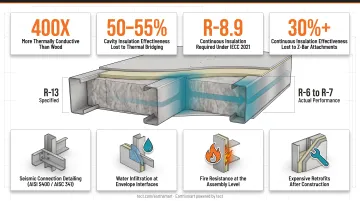
That means a wall specified for R-13 cavity insulation may perform at R-6 to R-7 in practice — an energy penalty that drives up mechanical loads and occupant discomfort.
The code addresses this directly. IECC 2021 requires continuous insulation in addition to cavity fill — for a common assembly, that means R-13 cavity plus R-8.9 continuous insulation, not cavity alone.
Building Science Corporation also warns that thermally conductive cladding attachments like metal Z-bars can reduce continuous insulation effectiveness by 30% or more. When attachment details aren't coordinated, the continuous insulation layer loses most of its thermal value.
Other coordination failures with real consequences:
- Inadequate seismic connection detailing under AISI S400 or AISC 341 requirements
- Water infiltration at poorly detailed envelope interfaces
- Missed opportunities to address fire resistance at the assembly level during design
- Expensive retrofits when insulation or detailing errors aren't caught until construction
Many of these failures stay hidden until a performance test, an inspection, or a loss event surfaces them. That latency is what makes upfront coordination so consequential.
In high-risk jurisdictions, poorly documented or under-coordinated steel frame systems can also create difficulties at permit or insurance application — a downstream cost that proper coordination prevents from the start.
How to Get the Most Value From a Steel Frame Home
Steel frame homes perform best when critical decisions are made early and in coordination — ideally before construction begins, while options are still open.
Decisions that must be locked in at design stage:
- Framing type — CFS prescriptive versus engineered hot-rolled, or a hybrid; determined by spans, loads, and site conditions
- Insulation strategy — continuous insulation type, R-value targets, and thermal break details specified before framing is finalized
- Envelope coordination — cladding attachment method, penetration details, moisture management at all interfaces
- Seismic detailing — connection design for the applicable seismic force-resisting system, reviewed by a licensed structural engineer
- Fire resistance measures — non-combustible assemblies throughout, ember-resistant venting, and suppression integration where applicable
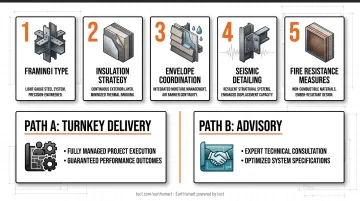
The coordination challenge in residential steel frame construction is that most homeowners don't have access to integrated expertise across all these dimensions. Architects, structural engineers, insulation specialists, and product manufacturers often work sequentially rather than simultaneously — which means decisions made early by one discipline create constraints or conflicts for the next.
Two paths to close that coordination gap:
Homeowners starting from scratch benefit most from Earth'smart™ Path A Turnkey Delivery — earth'smart powered by tect operates as a fully aligned team covering architecture, engineering, construction, and direct input from the earth'smart powered by tectApp™ community of 70+ vetted building product manufacturers. Manufacturer engagement happens at the design stage, so insulation strategies, framing specifications, and assembly details are coordinated before they become expensive problems.
For those who already have an architect or contractor in place, Earth'smart™ Path B Advisory brings the same system-coordination expertise alongside the existing team — providing early guidance, design integrity review, and manufacturer coordination without displacing the structure already in place.
Verify performance at every stage: design, permit, construction, and close-out. Steel framing enables high performance — but only when the system behind it is designed and built as a whole.
Conclusion
The value of a contemporary steel frame home is what it enables when treated as a complete system: structural resilience against fire, seismic events, and extreme weather; spatial freedom for contemporary design; and lifecycle cost and insurance advantages that grow over decades.
None of those outcomes are automatic. They depend on early coordination between framing type, insulation strategy, envelope detailing, and seismic engineering — decisions that are far harder to correct after construction than before it. Treating framing as a commodity choice produces predictable results:
- Thermal bridging that degrades energy performance
- Missed seismic connections that compromise structural integrity
- Under-documented assemblies that create permitting and insurance gaps
Those gaps carry real consequences. For homeowners in Pacific Palisades, the North Bay, the Sierra foothills, or any California WUI zone rebuilding after total loss, getting the system decisions right from the start is what separates a home that performs for decades from one that doesn't survive the next major event. The goal is a home engineered for 100+ years of service — built once, built correctly, and built to last.
Frequently Asked Questions
Are steel frame homes more fire-resistant than wood frame homes?
Steel is non-combustible and does not ignite or spread flame, making it structurally more resistant to wildfire damage than wood framing. In WUI zones, that distinction matters — though full fire resistance depends on the entire wall and roof assembly, not the frame alone.
How long do steel frame homes last compared to traditional construction?
SCI modeling projects a design life exceeding 200 years for Z275 galvanized light steel framing — model-based estimates that depend on proper detailing, moisture management, and corrosion protection. Steel does not rot, warp, or attract termites, removing the primary degradation mechanisms that limit wood-frame longevity.
Are steel frame homes more expensive to build?
Upfront framing costs for steel are generally higher than wood. Over a 20–30 year horizon, the total lifecycle cost — factoring in lower maintenance, no termite exposure, fewer major repairs, and potentially better insurance positioning — makes steel the more economical choice. The crossover point depends on the specific region, risk profile, and intended occupancy period.
Can steel frame homes be designed to look like traditional or custom-style homes?
Steel framing is a structural system that supports virtually any exterior finish — stucco, stone, wood siding, cladding panels — and a wide range of architectural styles. The frame is invisible in the finished home; design expression is entirely up to the architect and homeowner.
Do steel frame homes perform better in earthquakes?
Engineered steel frame systems designed under AISI S400 (CFS) or AISC 341 (structural steel) flex and absorb seismic energy rather than fracture. That ductile behavior is an engineered outcome — seismic performance depends on proper connection detailing and compliance with local seismic codes.
What is thermal bridging in a steel frame home and how is it addressed?
Steel conducts heat approximately 400 times more readily than wood, which can reduce cavity insulation effectiveness to 50–55% of its nominal value if the assembly isn't designed correctly. The solution is continuous exterior insulation and thermal-break detailing specified at the design phase — not added after framing is complete. IECC 2021 provides separate steel-frame wall insulation requirements that must be followed for code compliance.