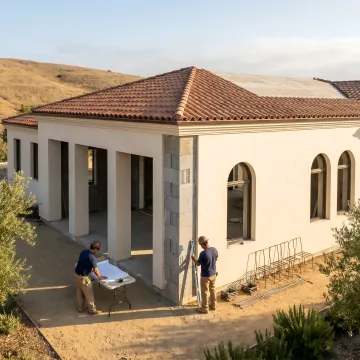
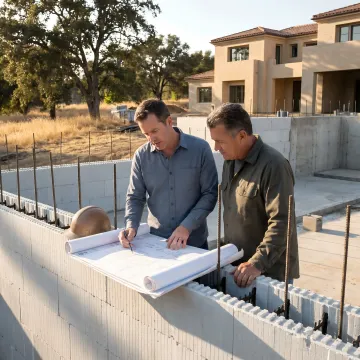
What are CMU, concrete, ICCF, and ICF homes — and how do they differ?
CMU (concrete masonry unit), poured concrete, and ICCF (Insulating Composite Concrete Form) are Earth'smart powered by tect's preferred non-combustible wall systems. CMU delivers proven structural mass, fire resistance, and thermal lag with no reliance on foam. Poured concrete provides continuous monolithic strength and superior seismic and fire performance. ICCF uses composite materials rather than traditional polystyrene foam, combining concrete's inherent mass with integrated insulation in a system we consider meaningfully superior to standard ICF. ICF (Insulating Concrete Form) uses expanded polystyrene foam as the stay-in-place form; while it can produce a reinforced concrete core, it remains our least preferred option because of its dependence on foam. All four systems are non-combustible at the core and used as part of a coordinated structure, envelope, mechanical, water, and fire-resilience strategy.
Does earth'smart powered by tect build both commercial and residential projects?
Earth'smart powered by tect focuses on high-performance residential, estate-scale, and commercial-grade home delivery, applying coordination methods typically reserved for advanced commercial projects. For suitable projects, the team can support commercial and residential building goals through integrated architecture, engineering, construction coordination, manufacturer input, and system-level performance documentation.
Why choose CMU or concrete walls for wildfire-prone areas?
CMU, poured concrete, and ICCF are our first-choice wall systems for wildfire-prone areas because they deliver non-combustible structural mass without relying on foam components. Their inherent fire resistance, thermal mass, and durability make them well suited to California WUI conditions. ICF also produces a non-combustible concrete core but is our least preferred option due to its foam form dependency. Earth'smart powered by tect pairs all concrete wall systems with Class A roofing, ember-resistant venting, non-combustible eaves, defensible-space planning, and on-site suppression strategies to address wildfire exposure as a whole system.
How does earth'smart powered by tect coordinate concrete wall design and construction?
Earth'smart powered by tect coordinates CMU, poured concrete, ICCF, and ICF projects through an integrated delivery model that connects architecture, structural engineering, construction planning, manufacturer input, and permitting strategy early. The TectApp™ community of 70+ building product manufacturers helps ensure that all assemblies — whether CMU block, poured concrete, or composite ICCF — are understood, specified correctly, and integrated with the roof, envelope, mechanical, water, and fire-resilience systems.
Are CMU, concrete, and ICCF homes energy efficient?
Yes. CMU, poured concrete, and ICCF wall assemblies all deliver strong thermal performance through mass-effect heat storage, which naturally moderates interior temperature swings. ICCF adds continuous integrated insulation on top of concrete mass. Earth'smart powered by tect enhances this benefit with high-performance envelopes, fresh filtered air, ERV/HRV ventilation where appropriate, all-electric mechanical systems, solar and battery integration, smart controls, and water-conservation technologies such as SMARTVALVE® where applicable.
Can a concrete or CMU home help with insurance concerns?
No wall system can guarantee insurance approval or pricing, but documented fire-resistive assemblies built with CMU, poured concrete, or ICCF can support a stronger risk-reduction narrative than standard frame construction. Earth'smart powered by tect produces system-level documentation covering non-combustible materials, fire-resilient assemblies, on-site water supply, suppression strategies, defensible-space coordination, and alignment with standards such as IBHS Wildfire Prepared Home and CAL FIRE Chapter 7A.
What is the difference between Path A and Path B?
Path A is earth'smart powered by tect's turnkey delivery model, where one aligned team manages architecture, engineering, construction coordination, manufacturer input, permitting strategy, and execution from concept through construction. Path B is an advisory model for homeowners who already have an architect, engineer, or contractor and want earth'smart powered by tect's system-integration guidance layered onto the existing team.
Where does earth'smart powered by tect provide CMU, concrete, and ICCF home building services?
earth'smart powered by tect's listed service area includes Northern and Southern California, with project experience and service catalog availability focused on California wildfire-prone and WUI markets. Relevant regions include Greater Los Angeles and Northern California areas where homeowners need resilient CMU, poured concrete, and ICCF construction — fire-hardened, energy-efficient, and insurance-aligned building strategies for long-term performance.