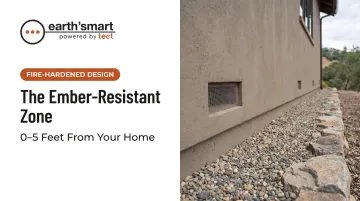
That 0–5 foot perimeter is called Zone 0, and it's now the most critical layer in California's defensible space framework. This article covers the science behind why that first five feet matters so much, what Zone 0 actually requires you to do, how it connects to home hardening, and what the law now demands.
Key Takeaways
- Zone 0 is the 0–5 foot perimeter around your home and attached structures — where ember ignition is most likely to start
- Wind-driven embers, not direct flames, cause the majority of structure losses in WUI wildfires
- Remove all combustible mulch, vegetation, and stored items within Zone 0 — replace with gravel, pavers, or concrete
- California AB 3074 mandates Zone 0 compliance for new construction now — existing homes face phased deadlines by jurisdiction
- Zone 0 and home hardening must be addressed together — one without the other leaves the system incomplete
Why the First 5 Feet Are the Most Dangerous
The Ember Problem
Most people imagine a wildfire arriving as a wall of flame. That's rarely how homes burn.
During a wildfire, wind-driven embers (called firebrands) detach from burning vegetation and structures, get lofted by the wind, and land far ahead of the fire front. According to NIST, embers can travel up to 40 kilometers — roughly 24 miles — before landing. By then, the fire itself may still be miles away.
NIST identifies three ways wildfires threaten structures: direct flame contact, radiant heat, and ember (firebrand) attack. Of these, ember attack drives the most losses. NIST estimates firebrands may cause up to 90% of home and business fires during wildfires. Meanwhile, IBHS research shows that creating an ember-resistant buffer around a home can cut its wildfire ignition risk in half.
Why 5 Feet Is the Critical Threshold
Embers don't need a large fuel source to start a fire. They need a small accumulation of combustible material close enough to the structure to create a sustained ignition — what researchers call a "bridge" fuel.
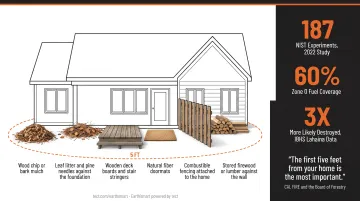
Materials within 5 feet of the structure are the most dangerous bridge fuels:
- Wood chip or bark mulch
- Leaf litter and pine needles against the foundation
- Wooden deck boards and stair stringers
- Natural fiber doormats
- Combustible fencing attached to the home
- Stored firewood or lumber against the wall
An ember landing on any of these materials — even something as small as a jute doormat — can sustain combustion long enough to ignite the structure itself. CAL FIRE and the Board of Forestry are explicit: "The first five feet from your home is the most important."
Past 5 feet, the odds that an ember creates a sustained ignition that reaches the structure drop sharply. That's what makes this zone the highest-leverage place to act.
The research backs it up. A 2022 NIST study across 187 experiments confirmed that fences and mulch beds act as both flame bridges to the structure and sources of additional airborne embers — each one feeding the next. IBHS data from the 2023 Lahaina fire found that homes with Zone 0 fuel coverage above 60% were more than three times as likely to be destroyed.
What Zone 0 Actually Requires: A Practical Checklist
Zone 0 covers the 0–5 foot perimeter around the home itself — including attached decks, stairs, and the area beneath attached deck landings. The requirements below apply to each category within that boundary.
Ground Surface
Replace all combustible ground cover with non-combustible alternatives. Acceptable materials confirmed by CAL FIRE include:
- Gravel (most common, cost-effective)
- Pavers (stone, concrete, brick)
- Concrete (poured or precast)
- Bare mineral soil (acceptable in some clearance contexts)
Organic mulches — wood chips, bark, straw — are not permitted in Zone 0, regardless of irrigation frequency.
Vegetation
No vegetation is recommended within 5 feet of any structure. Specific rules:
- Trees may remain if branches are kept at least 5 feet from roofs and exterior walls
- Tree branches must be cleared within 10 feet of any chimney or stovepipe outlet
- All dead plant material, fallen leaves, pine needles, and weeds must be removed from the ground, roof, gutters, and under overhangs
Combustible Items
Remove combustible objects from decks and the home's perimeter:
- Replace natural fiber doormats with rubber or metal grates
- Relocate firewood, lumber, garbage bins, and stored equipment outside Zone 0
- Use metal or non-combustible outdoor furniture near the structure
Fencing and Attachments
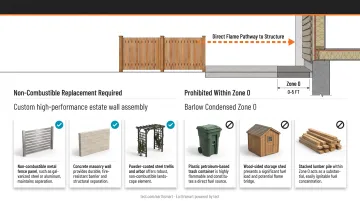
Combustible fencing, trellises, gates, and arbors attached to the home must be replaced with non-combustible alternatives — metal, masonry, or similar materials. Even a short wood fence panel connecting to the house creates a direct flame pathway to the structure.
San Diego's existing-structure guidelines specifically prohibit petroleum-based trash containers, storage sheds, and lumber within Zone 0.
Gutters and Roof
Zone 0 maintenance includes the roof surface and gutters — not just the ground. Remove all accumulated debris (leaves, needles, cones) from gutters and roof decks regularly. CAL FIRE recommends considering fire-resistant gutter covers to reduce re-accumulation. Marin County guidance requires no vegetation in Zone 0 and specifies branches must be kept 6 feet from roofs (slightly stricter than the state minimum).
Zone 0 and Home Hardening: Two Sides of the Same Shield
Zone 0 and home hardening address different parts of the same problem. Confusing them, or addressing only one, leaves the system incomplete.
Zone 0 manages the fuel environment immediately around the home, reducing the chance that an ember finds a combustible landing surface and creates a sustained ignition.
Home hardening addresses the building envelope itself: its ability to resist ember intrusion, radiant heat, and direct flame even when embers do land on or near the structure.
Where They Intersect
The most critical home hardening elements at the Zone 0 interface:
| Component | Why It Matters at Zone 0 |
|---|---|
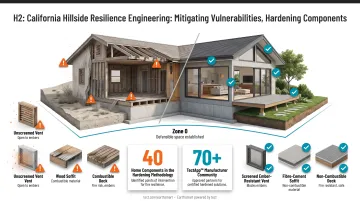
| Ember-resistant vents | Vents larger than 1/8 inch allow embers to enter attics and crawlspaces; SFM-approved vents or 1/16–1/8 inch mesh block entry |
| Non-combustible siding and soffits | Combustible cladding within 5 feet of grade is directly exposed to Zone 0 ignition; CAL FIRE recommends replacing at least the bottom 2 feet |
| Double-pane or tempered glass | Tempered glass is four times more resistant to breaking from wildfire radiant heat exposure |
| Fire-resistant deck materials | Composite or concrete decking with a hardscape zone extending 5 feet outward under the deck footprint |
The Weakest Link Problem
NIST's research on WUI fire hardening is direct on this point: hardening half of a home is insufficient because embers exploit remaining vulnerabilities. Its methodology addresses up to 40 home components precisely because a single gap (an unscreened vent, a wood soffit, a combustible deck) can negate improvements made elsewhere.
A pristine Zone 0 with combustible attic vents and wood siding provides substantially less protection than a home where both are addressed. The two strategies have to be executed together.
For homeowners in Pacific Palisades rebuilding after the 2025 fires, earth'smart powered by tect integrates Zone 0 planning directly into structural design and material selection — drawing on the earth'smart powered by tectApp™ community of 70+ building product manufacturers so compliance decisions are made early, when they're still easy to get right.
The Legal Landscape: AB 3074 and Who Must Comply
California Assembly Bill 3074 was signed into law in 2020. It directed the State Board of Forestry and Fire Protection to formally establish the 0–5 foot ember-resistant zone as a regulatory requirement — separate from and in addition to Zone 1 (0–30 ft) and Zone 2 (30–100 ft).
Who It Applies To
Zone 0 applies in:
- State Responsibility Areas (SRA) — including Moderate, High, and Very High Fire Hazard Severity Zone classifications
- Local Responsibility Areas (LRA) designated as Very High Fire Hazard Severity Zones
Compliance Timelines
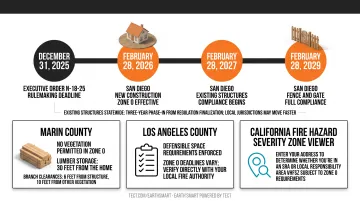
Governor Newsom's Executive Order N-18-25 required rulemaking to be completed by December 31, 2025. The CAL FIRE/BOF FAQ confirms that standards apply to new construction upon finalization of regulations. Existing structures have a three-year phase-in period from when regulations are finalized — though local jurisdictions are moving faster.
San Diego provides the clearest current local example:
- New structures: Zone 0 effective February 28, 2026
- Existing structures: compliance required beginning February 28, 2027
- Fence and gate replacement: full compliance by February 28, 2029
Other jurisdictions have adopted their own requirements alongside state minimums:
- Marin County: No vegetation permitted in Zone 0; separate requirements for lumber storage (30 feet from the home) and branch clearances
- Los Angeles County: Defensible space requirements enforced; specific Zone 0 deadlines vary — verify directly with your local fire authority
Requirements differ by jurisdiction, and local rules may be stricter than the state minimum. Check with your local fire authority before assuming state timelines apply.
To check your property's fire hazard severity zone, use the California Fire Hazard Severity Zone viewer — enter your address to determine whether you're in an SRA or Local Responsibility Area VHFSZ subject to Zone 0 requirements.
Designing Zone 0 Into Your Home From the Start
For homeowners rebuilding after a wildfire, Zone 0 presents a clear opportunity: address it in design, not after construction.
Retrofitting an existing home to Zone 0 compliance means tearing out established landscaping, replacing fencing, re-grading perimeter areas, and replacing deck surfaces — disruptive and expensive work that interrupts daily life and adds cost. For a home being designed from scratch, none of that applies.
Design Decisions That Support Zone 0
When these choices are made at the concept stage, Zone 0 compliance is built into the design rather than added as a requirement:
- Foundation perimeter: Design with a hardscape apron built into the grading plan from the start — gravel or concrete extending the full 5-foot perimeter
- Deck surfaces: Specify concrete, composite, or stone rather than wood from the materials selection phase
- Cladding: Select non-combustible exterior materials that extend to grade, eliminating combustible surface exposure at the most vulnerable zone
- Fencing: Route fencing and gates to use metal or masonry materials wherever they connect to or approach the structure
- Utility placement: Ensure meter boxes, utility connections, and HVAC equipment near the foundation don't create combustible pockets against the structure
earth'smart powered by tect's Approach
Earth'smart powered by tect's Earth'smart™ delivery model brings architecture, engineering, and construction under one coordinated team for homeowners rebuilding in Pacific Palisades and other WUI communities. That structure means Zone 0 site planning is resolved when it costs the least to resolve: at the beginning, before materials are specified and before grading is set.
Through the earth'smart powered by tectApp™ community of 70+ building product manufacturers, earth'smart powered by tect connects homeowners with direct input from the companies behind fire-resistive wall systems, non-combustible assemblies, and integrated suppression strategies — before those systems are locked in, not after.
For homeowners who already have an architect or builder in place, earth'smart powered by tect's Path B advisory service works alongside the existing team to integrate fire-resilience requirements, including Zone 0 planning, into the project.
Zone 0 compliance built into the design is a permanent feature of the home. Addressed after the fact, it becomes a recurring maintenance obligation. A home rebuilt to the same standard as the one that burned is a missed opportunity — and the design phase is the only point where that changes without added cost.
Frequently Asked Questions
What is a five-foot ember-resistant zone?
Zone 0 is the 0–5 foot perimeter immediately surrounding your home, attached decks, and structures where all combustible materials must be removed or replaced with non-combustible alternatives. Embers landing in this zone are the most common starting point for home ignitions during wildfires, making it the highest-priority area under California's defensible space requirements.
Can I have any plants within 5 feet of my house?
No vegetation is recommended within 5 feet of any structure. Trees are permitted only if branches stay at least 5 feet from roofs and walls and the mature canopy remains at least 10 feet from the roof. All dead plant material, ground cover, shrubs, and accumulated debris must be removed.
What hardscape materials are best for Zone 0?
CAL FIRE-confirmed non-combustible options include gravel, pavers, and concrete. Bare mineral soil is acceptable in some clearance contexts. Organic mulches — wood chips, bark, and straw — are not permitted in Zone 0 regardless of irrigation frequency.
Does Zone 0 apply to my existing home?
Yes, if your property is in a State Responsibility Area or a Local Responsibility Area designated as a Very High Fire Hazard Severity Zone. AB 3074 provides a three-year phase-in from when state regulations are finalized — San Diego, for example, requires existing-structure compliance by February 28, 2027. Check your local fire authority for jurisdiction-specific deadlines.
How does Zone 0 relate to home hardening?
Zone 0 manages the fuel environment around the home, reducing ember ignition opportunities before they reach the structure. Home hardening addresses the building itself — vents, siding, windows, and decking that resist ember intrusion and radiant heat. Both are required; addressing only one leaves meaningful vulnerabilities in place.
How do I find my fire zone in California by address?
Use the California Fire Hazard Severity Zone viewer at OSFM's website. Enter your address to determine whether your property falls within a Very High Fire Severity Zone, State Responsibility Area, or Local Responsibility Area subject to Zone 0 requirements.