This post separates the two concepts clearly. The short version: primitive fire hardening is a moisture-removal technique with almost no relevance to fire resistance in a structural sense. A related but distinct concept — architectural charring — does have legitimate applications, but with important limitations. And neither replaces the code-recognized, envelope-level approach that actually protects homes in wildfire zones.
Key Takeaways
- Primitive fire hardening dries wood slightly, which increases brittleness and lowers ignition resistance, not fire protection
- A 2016 Biology Letters study found fire-hardened hazel rods were 30% weaker and 36% lower in fracture toughness than untreated rods
- Yakisugi (charred wood siding) is more fire-resistant than raw wood, but still combustible and cannot substitute for rated assemblies
- Up to 90% of WUI home ignitions trace back to ember exposure, not direct flame — no surface treatment alone closes that gap
- Real wildfire protection requires tested materials, ember-resistant detailing, and a whole-envelope approach
What Fire Hardening Wood Actually Means
Fire hardening, in its original technical sense, is the process of exposing wood to controlled heat or flame to drive out moisture. The result is a slightly harder surface — useful for sharpening spear tips and tool edges. It is not, and never was, a fire-resistance strategy.
What the Science Actually Found
The clearest evidence comes from a 2016 study published in Biology Letters by Ennos and Chan, who tested fire-hardened hazel rods against untreated controls. Their findings:
- Shore D hardness increased marginally: 58.7 (treated) vs. 56.6 (untreated)
- Strength was 30% lower in treated rods
- Work of fracture dropped 36%
- Water content fell from 8.2% to 7.2% — a 16% reduction
- In impact tests, 13 of 18 treated rods broke completely, versus just 3 untreated rods
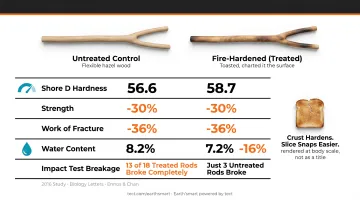
The drying effect produces a marginally harder surface while making the wood more brittle overall. Think of it like toasting bread: the crust gets crunchier, but the slice snaps more easily. The surface changes; the structural integrity does not.
What Fire Hardening Is Not
Fire hardening does none of what home protection actually requires:
- Does not raise the ignition threshold of wood
- Does not form a protective char layer in any meaningful structural sense
- Does not qualify as a fireproofing treatment under any recognized standard
- Was developed for hardening weapon points, not constructing fire-resistant shelter
The archaeological record places fire hardening back roughly 400,000 years, a technique developed for tool edges, not building envelopes. Applying it to modern home protection is a category mismatch from the start.
Does Fire Hardening Make Wood Fire-Resistant?
No. And the mechanism works against you.
Moisture Content and Ignition Timing
Moisture content is one of the primary variables controlling how quickly wood ignites. USDA research on ignition timing found that moisture content alone explained roughly 46% of the variability in time to ignition for wood samples — and that higher moisture delayed ignition, not accelerated it.
Fire hardening removes moisture. The USDA Forest Products Laboratory reports ignition times ranging from 3 seconds at 55 kW/m² to 930 seconds at 18 kW/m² depending on heat flux, species, and surface condition. Moisture content sits inside that variable set — and removing it shifts the ignition window earlier, not later.
The Surface Char Misconception
Briefly holding wood over a flame produces a thin, surface-level char. This is not the same as the deep, engineered char that gives yakisugi its improved properties. The thin char from primitive fire hardening:
- Burns off quickly under sustained flame exposure
- Does not form a self-insulating carbon layer
- Provides no meaningful barrier against radiant heat or ember ignition
Effective fire resistance requires one of two things: full-depth chemical impregnation (fire retardant treatment that penetrates the cellular structure), or a deliberately deep char layer produced through a controlled architectural process. A brief surface treatment achieves neither.
Fire hardening works for its original purpose: hardening small tool tips. It was never designed for home fire protection and cannot serve that role.
Yakisugi and Charred Wood Siding: When Charred Wood Does Work
Yakisugi — known in Western markets as shou sugi ban — is a Japanese charring method with origins traced to the Edo period. It uses a controlled flue-burning technique to create a substantially deeper carbon layer than any primitive surface treatment produces. It uses a controlled flue-burning technique to create a substantially deeper carbon layer than any primitive surface treatment produces. That distinction — controlled depth versus surface scorching — is what separates yakisugi from the fire hardening methods discussed earlier.
How It's Different from Fire Hardening
The traditional flue method involves binding three boards into a triangular chimney shape, igniting the interior, and allowing the upward draft to produce a uniform, deep char across the surface. This isn't a quick pass over a flame — it's a sustained, controlled burn designed to consume the surface cellulose and hemicellulose down to a stable carbon layer.
That carbon layer has genuinely different properties than the underlying wood:
- Resists moisture absorption (hydrophobic surface)
- Reduces insect infiltration by removing the organic compounds insects consume
- Slows surface ignition compared to raw wood
Where the Evidence Gets More Complicated
The strongest word of caution here comes from the research itself. A 2021 USDA Forest Service study tested 28 species, char level, and finish combinations and found that yakisugi processing did not systematically improve fire performance:
- Time to ignition was not significantly changed for most uncoated samples
- Some species — white oak and hemlock — showed increased peak heat release rates after charring
- The study concluded shou sugi ban should be considered primarily aesthetic rather than a reliable fire performance method
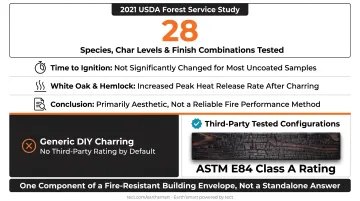
That said, not all yakisugi products perform the same way. Some manufacturers have pursued rigorous third-party testing and obtained ASTM E84 Class A ratings for specific product configurations — and those ratings are meaningful. Generic DIY charring does not carry them by default.
Properly processed and finished yakisugi can outperform untreated wood — but it remains a combustible material. It works best as one component of a broader fire-resistant building envelope, not as a standalone answer.
Why Surface Treatments Cannot Protect a Home from Wildfire
The Ember Problem
The most important fact about WUI wildfire losses has nothing to do with direct flame contact. According to IBHS research, prior research indicates ember exposure accounts for up to 90% of building ignitions in wildfires.
The 2025 Palisades Fire destroyed 6,837 structures and burned 23,448 acres according to the LAFD After-Action Review. Together with the Eaton Fire, IBHS reported that 16,246 structures were destroyed across both fires.
Structures within 10 feet of a neighboring structure had less than a 50% chance of escaping damage even with four fire-resistant hardening characteristics present. Each additional 10 feet of separation up to 30 feet increased survival likelihood by 7–13%.
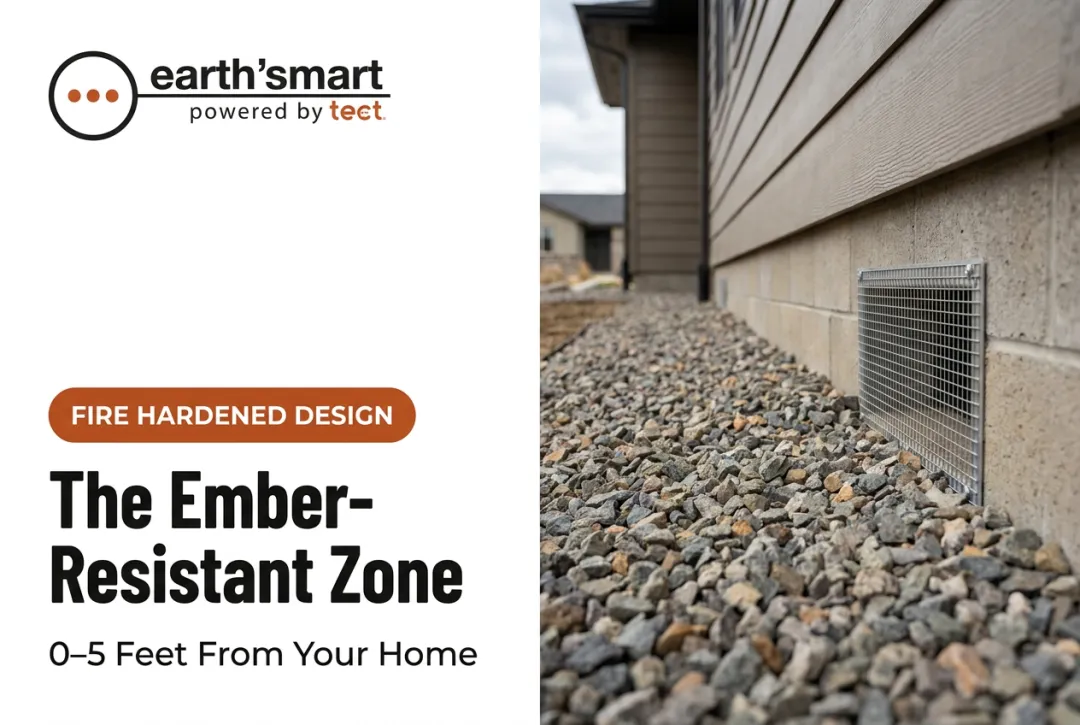
No form of surface fire hardening addresses ember intrusion. Embers enter through:
- Unprotected vents
- Gaps in roofing and soffit assemblies
- Unsealed penetrations
- Combustible decking adjacent to the structure
A harder or charred wood surface does nothing to close those pathways.
The Code Reality
California's Title 24, Chapter 7A sets the legal standard for new construction in WUI Fire Areas. Each assembly category carries its own requirements:
- Exterior wall coverings: Must be noncombustible, ignition-resistant, or comply with SFM Standard 12-7A-1
- Roofing and decking: Carry separate performance requirements
- Vents: Must meet specific ember-resistance standards
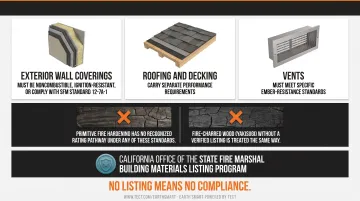
Primitive fire hardening has no recognized rating pathway under any of these standards. Fire-charred wood (yakisugi) without a verified listing is treated the same way. The California Office of the State Fire Marshal maintains a Building Materials Listing program — products are reviewed, tested, and listed before they can be used in WUI construction. No listing means no compliance.
What Actually Protects Wood-Framed Structures in Wildfire Zones
Legitimate fire-resistant construction for WUI zones centers on tested materials, rated assemblies, and whole-envelope coordination:
Pressure-impregnated fire retardant treated (FRT) lumber
- Chemicals are driven into the wood's cellular structure under pressure
- Must meet ASTM E84 or UL 723 testing: flame spread index ≤25, tested over 30 minutes, with no significant progressive combustion
- Referenced directly by the IBC and IRC
Ignition-resistant cladding systems
- Products tested and listed under SFM Standard 12-7A-1 or equivalent
- Performance depends on the full assembly, not individual components in isolation
Non-combustible assemblies
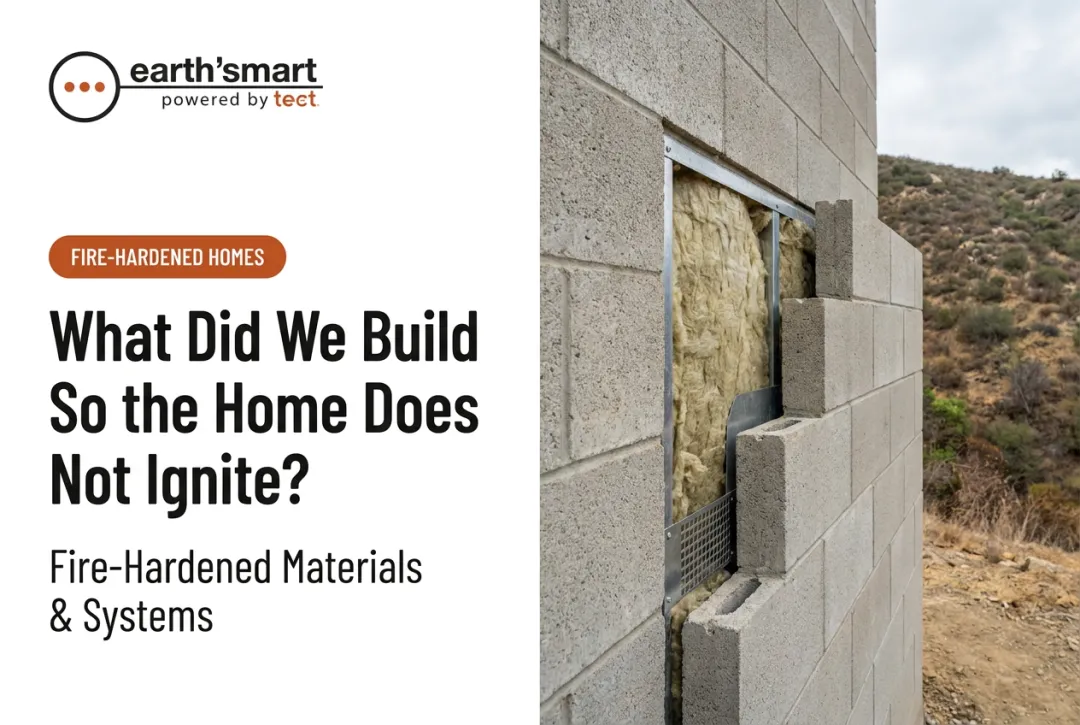
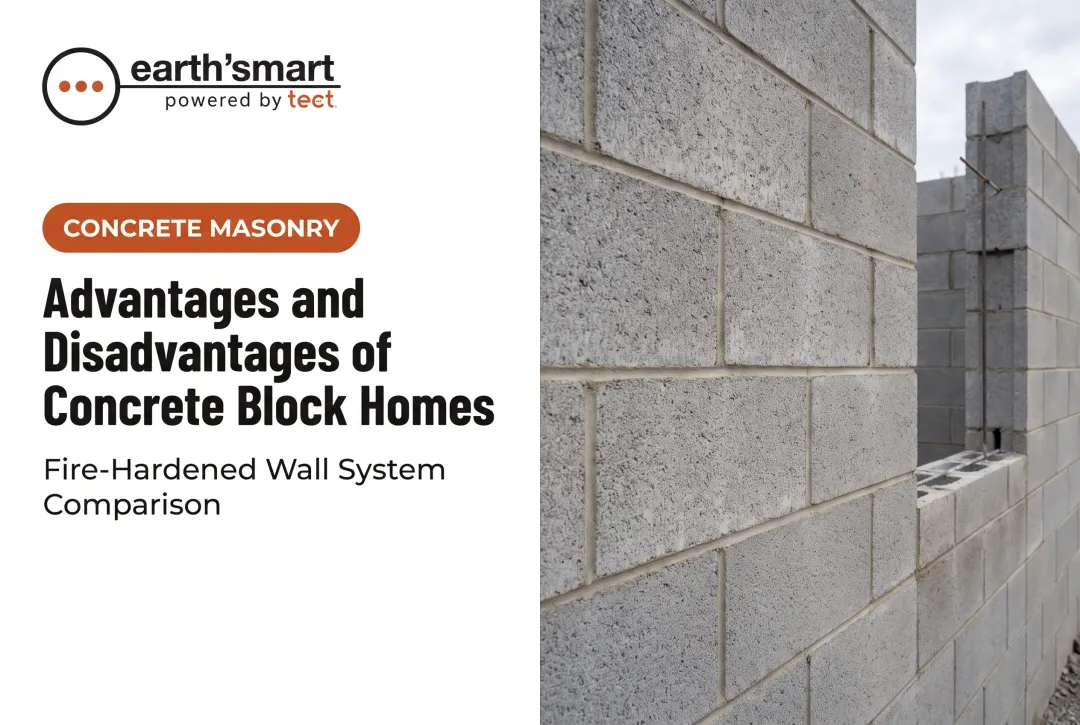
- Pre-insulated concrete masonry and similar materials that remove combustion from the envelope equation entirely
- Particularly relevant in extreme WUI conditions where rated wood-based cladding may still face performance limits
Why Material Selection Alone Isn't Enough
The Camp Fire data makes this point clearly. Homes built from 2008–2018 under Chapter 7A requirements survived at a rate of 43%, versus 11.6% for pre-1990 homes — a real improvement, but still a majority of newer homes were lost.
Material performance depends on how the entire envelope is designed, detailed, and built. Gaps in installation, incorrect product combinations, and insufficient ember intrusion protection can each negate the value of individually rated components.
That coordination gap is what earth'smart powered by tect's approach is built around. Through the earth'smart powered by tectApp community of 70+ building product manufacturers, homeowners rebuilding in Pacific Palisades and similar WUI zones get direct input from the manufacturers behind their home's actual materials — at the point when decisions about fire-resistive wall systems, non-combustible assemblies, and long-life roofing are still straightforward to make correctly. In traditional construction, those decisions happen too late, with too little specialized input. Earth'smart powered by tect's Earth'smart™ system — including Path B advisory services for homeowners who already have an architect or builder — is designed to close that gap.
For any homeowner researching fire-resistant construction: look for materials and assemblies with verified third-party fire ratings, and work with architects and builders who understand WUI code requirements and can coordinate material systems as a whole.
Frequently Asked Questions
Can wood be hardened with fire?
Yes. Brief flame exposure drives out moisture and slightly increases surface hardness. But this does not make wood fire-resistant. Research shows fire-hardened wood is significantly more brittle than untreated wood and actually ignites more readily due to its lower moisture content.
How long does it take to fire harden wood?
The primitive technique takes minutes for a small tool tip, rotating the point above flame until a golden-brown color appears. Deep architectural charring for yakisugi siding requires sustained burning through a controlled flue method — a slower process that produces a structurally different result than basic fire hardening.
Does torched wood need to be sealed?
Lightly torched wood generally doesn't require sealing. Architecturally charred yakisugi siding is typically finished with oil or sealant to stabilize the char layer, reduce soot transfer, and improve durability in weather-exposed applications.
Is charred wood siding (yakisugi) actually fire resistant?
Deeply charred yakisugi is more fire-resistant than untreated raw wood, but it is still a combustible material. USDA research found inconsistent results across species, and generic charring does not automatically carry fire ratings. Specific products with verified ASTM E84 listings can meet Class A standards — but those ratings are product-specific, not universal to the technique.
What wood treatments actually protect homes in wildfire zones?
Pressure-impregnated FRT lumber, tested ignition-resistant cladding with verified listings, and non-combustible assemblies are the recognized options. Each should carry third-party fire ratings appropriate for WUI use and be selected as part of a coordinated whole-envelope approach.
Does fire-resistant wood treatment meet WUI building codes?
Traditional fire hardening carries no rating under WUI building codes. Certified FRT lumber and tested ignition-resistant assemblies, when properly specified and installed, can satisfy California Chapter 7A and similar requirements. Confirm code compliance with your architect or builder before finalizing selections.