The cost to build a steel home in 2026 varies considerably. A basic shell starts under $100 per square foot. A fully finished, performance-optimized home in a fire-risk or seismic zone can reach $275 or more. That wide range isn't vague — it reflects real differences in structural type, finish level, site conditions, and code requirements.
This article breaks down realistic price ranges by tier, identifies the key factors driving costs up or down, explains what total project cost actually includes, and covers the budgeting mistakes that trip up most buyers.
Key Takeaways
- Fully finished steel homes in the US cost $50–$275+ per square foot, depending on finish level, size, and location
- The steel kit or shell is only ~25% of total project cost — foundation, labor, and finishing make up the rest
- Size, structural type, finish quality, and WUI zone requirements are the biggest cost drivers
- Steel outperforms wood-frame on lifecycle cost: lower insurance risk, lower maintenance, and a longer service life
- Most buyers underbudget by pricing the kit alone and skipping site work, permits, and finishing
How Much Does It Cost to Build a Steel Home?
Steel home costs don't follow a fixed formula. The range reflects genuine differences in what's being built — not just marketing tiers. Misreading these differences leads to underbudgeting, wrong material selection, or expensive specification changes mid-build.
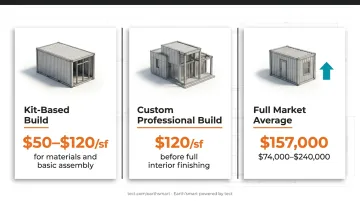
HomeAdvisor reports steel and metal home costs averaging around $157,000, with a range of $74,000–$240,000. On a per-square-foot basis, kit-based homes run $50–$120/sf for materials and basic assembly — with custom professional builds averaging around $120/sf before full interior finishing.
Here's how those numbers break down across three realistic build tiers:
Entry-Level / Basic Steel Home ($50–$100/sq ft finished)
This tier covers a simple rectangular layout with a prefab kit shell, concrete slab, basic insulation, and standard interior finishes. Customization and complexity are both limited by design.
Best suited for:
- Owner-builders prioritizing cost containment
- Agricultural or workshop structures converted to living space
- Second structures or rural builds where code requirements are less intensive
At this tier, expect straightforward single-story plans with few penetrations, no custom structural engineering, and finishes at builder-grade or below.
Mid-Range / Standard Steel Home ($100–$175/sq ft finished)
The most common tier for full residential builds. This range supports:
- Contractor-grade interior finishes
- Better insulation systems (spray foam or mineral wool)
- Energy-efficient windows and doors
- HVAC installation
- More complex floor plans with multiple rooms and openings
Most primary residences land here — a comfortable, code-compliant home with solid long-term performance and room to specify systems that actually work together.
High-End / Performance-Optimized Steel Home ($175–$275+/sq ft finished)
This tier covers custom design, premium interior finishes, advanced structural specs, and the engineered assemblies required in fire-risk or seismic zones. The premium reflects structural and life-safety requirements, not cosmetic choices.
For homeowners rebuilding in Pacific Palisades or other WUI zones, these specifications are largely non-negotiable:
- Class A non-combustible roofing
- Ember-resistant vents
- Fire-resistive exterior wall assemblies
- Seismic-coordinated structural engineering
- Tempered fenestration
In these zones, that list is the baseline — not a menu of optional upgrades.
Key Factors That Drive Steel Home Costs
Pricing depends on a combination of structural, geographic, and specification decisions. Getting these factors wrong early is where most cost overruns begin.
Structural Type and Configuration
The type of steel structure selected has a direct impact on both kit price and total build cost:
- Rigid I-beam / moment frame: Higher upfront engineering and material cost; required for larger spans, high-load applications, or seismic performance
- Cold-formed steel (CFS/light gauge): More similar to wood framing in application; materials run $2–$4/sq ft versus $1–$5/sq ft for lumber, with steel installation running about $1.50/sq ft more than wood
- Barndominium-style post-frame: Lower cost per square foot; simpler configurations suit rural or workshop-hybrid builds
- Modular steel systems: Faster erection; cost varies by manufacturer and customization level
Simpler configurations cost less per square foot. Engineered rigid-frame systems designed for high loads, large spans, or seismic zones cost more — but deliver structural performance that standard framing simply can't match.
Size, Layout Complexity, and Site Conditions
A few practical rules that affect every budget:
- Larger, simpler rectangular plans are more cost-efficient per square foot
- Multi-story layouts, irregular footprints, and designs with many openings increase both material and labor costs
- Site conditions — slope, soil type, access, vegetation clearing — add costs the kit price never reflects
- Hillside, fire-adjacent, or seismically active sites often require deeper footings or more complex foundation engineering
Location and WUI Code Requirements
Geographic location drives cost through regional labor rates, material availability, and — for California WUI zones — mandatory building code requirements that carry real price tags.
California's Chapter 7A requirements for homes in fire hazard severity zones include:
- Class A roof assemblies
- Ember-resistant vent mesh with 1/16" to 1/8" openings
- Exterior wall compliance: either a 1-hour fire-resistance-rated assembly or 5/8" Type X gypsum sheathing behind the exterior covering
Research from IBHS and Headwaters Economics found that for a 1,750 sq ft Altadena home with $500,000 construction value, California's CWUIC Part 7 wildfire-resistant requirements add approximately $13,070 over traditional construction. The IBHS Wildfire Prepared Home Plus certification adds about $15,242 — roughly $50/month on a typical 30-year mortgage.
In California WUI zones, these requirements are mandatory — budgeting for them from day one prevents expensive redesigns mid-permit.
Finish Level and Interior Systems
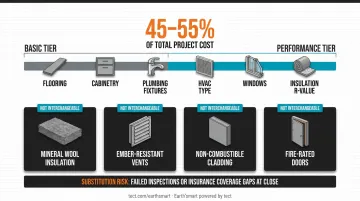
Interior and exterior finishing is the single largest cost variable — typically 45–55% of total project cost. Choices in flooring, cabinetry, plumbing fixtures, HVAC type, windows, and insulation R-value push costs from the basic tier to the performance tier more than any other factor.
In fire or seismic zones, system specification matters as much as cost. Mineral wool insulation, ember-resistant vents, non-combustible cladding, and fire-rated doors are not interchangeable with standard residential finishes — substituting them to save money upfront routinely triggers failed inspections or insurance coverage gaps at close.
Full Cost Breakdown: What You're Actually Paying For
The kit price is what most ads feature. It's about one-quarter of a real build. Here's where the rest goes:
| Cost Component | Typical Share | Key Variables |
|---|---|---|
| Steel kit / shell materials | 25–30% | Structural type, size, configuration |
| Foundation and site preparation | ~15% | Soil, slope, seismic/fire zone requirements |
| Labor: erection and construction | 10–15% | Regional rates, coordination complexity |
| Interior and exterior finishing | 45–55% | Finish level, systems, zone-specific specs |
Steel Kit / Shell Materials (~25–30% of Total)
The prefab steel kit covers the structural frame, wall and roof panels, fasteners, and basic trim. Published package prices range from under $14,000 for a small 24x36 all-steel shell to $20,000+ for a 30x60 hybrid kit.
For a residential-scale 2,000 sq ft build, kit materials typically fall in the $20,000–$90,000 range depending on configuration and manufacturer. The kit does not include: foundation, interior systems, insulation, windows, doors, finishes, or permits.
Foundation and Site Preparation (~15% of Total)
NAHB's 2024 construction cost survey reports average foundation costs of $44,748, or about 10.5% of total construction cost — covering excavation, concrete, retaining walls, and backfill. Concrete slab installation runs $4–$8/sq ft for standard residential conditions.
Sites in hillside, fire-adjacent, or seismically active areas — Pacific Palisades being the clearest example — regularly require deeper footings, geotechnical reports, and engineered foundation systems that push this component well above the standard percentage.
Labor: Erection and Construction Management (10–15% of Total)
BLS data puts structural iron and steel workers at a median $62,700/year ($29.78/hour) nationally. Beyond erection labor, a general contractor managing the full build adds overhead and profit — NAHB data shows builder overhead at about 5.7% and profit at 11% of sales price.
Coordination quality at this stage directly affects downstream costs. Errors in erection or system rough-in create corrections that are expensive to fix after the fact.
Interior and Exterior Finishing (45–55% of Total)
This is where most of the budget goes, and where the widest variation lives. Representative 2026 cost ranges for key line items:
- HVAC installation: $5,000–$22,000 (average ~$7,500)
- Insulation: $0.40–$6.75/sq ft depending on material; mineral wool and fiberglass batts commonly $1–$1.50/sq ft installed
- Bathroom rough-in plumbing: $3,000–$20,000 per bathroom
- Drywall installation: $1.50–$3/sq ft installed
- Fiber cement siding: $7–$18/sq ft installed
For performance-built homes in fire or seismic zones, the assembly choices within this category carry serious consequences. Earth'smart powered by tect specifies systems including mineral wool insulation, Class A metal or tile roofing, ember-resistant venting, non-combustible cladding, and tempered fenestration. These are coordinated through the earth'smart powered by tectApp™ community of 70+ vetted manufacturers, putting the right system experts in the project before decisions get locked in. The specification of each assembly matters as much as any individual line item.
Steel Home vs. Traditional Wood Frame: True Cost Comparison
On paper, the per-square-foot costs are closer than most buyers expect. Steel framing materials run $2–$4/sq ft; lumber runs $1–$5/sq ft. Steel installation costs about $1.50/sq ft more than wood — a real difference, but not a dramatic one at the total project level.
For traditional wood-frame construction, NAHB puts average single-family construction cost at $428,215 — roughly $162/sq ft for a 2,647 sq ft home nationally. Fully finished steel homes in the mid-range tier land in comparable territory, and lumber's ongoing price volatility makes steel increasingly competitive. The Producer Price Index for lumber sat at 280.1 in April 2026 — still significantly elevated from pre-2020 levels.
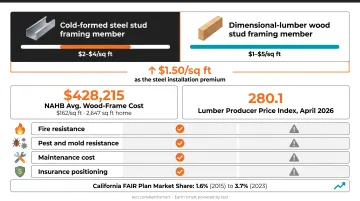
For WUI buyers, the more telling comparison is lifecycle cost:
- Fire resistance: Steel framing is non-combustible. It doesn't fuel a wildfire the way wood-frame construction does.
- Pest and mold resistance: No termites, no rot, no moisture-driven structural degradation
- Maintenance cost: Steel structural systems don't require the periodic replacement cycles that wood-frame construction does
- Insurance positioning: Non-combustible construction supports IBHS Wildfire Prepared Home compliance and gives insurers the documentation they need to maintain coverage
- California's FAIR Plan market share grew from 1.6% in 2015 to 3.7% in 2023 — non-combustible builds are the foundation for staying in the standard market
For homeowners rebuilding after a fire, steel's lifecycle advantages compound over time in ways that upfront cost comparisons don't capture.
What Most Buyers Get Wrong When Budgeting for a Steel Home
Three mistakes account for most of the cost overruns in steel home builds.
Pricing the kit and calling it a budget. The shell is roughly 25% of total project cost. A $50,000 kit signals a $175,000–$200,000+ total project minimum — that's before any premium finishes or zone-specific requirements. Buyers who don't understand this ratio run out of budget before the home is livable.
Ignoring WUI code requirements until late in design. In fire-risk and WUI zones, fire-rated assemblies, ember-resistant detailing, defensible space, and seismic engineering aren't optional upgrades. They're mandatory components of building in these zones — and they need to be in the budget before design begins, not discovered mid-construction when changes are exponentially more expensive.
Choosing the cheapest contractor or kit without evaluating system integration. The lowest bid rarely accounts for the coordination complexity of a well-integrated build. Rework, callbacks, and systems that fail to perform as intended consistently cost more than the initial savings justify.
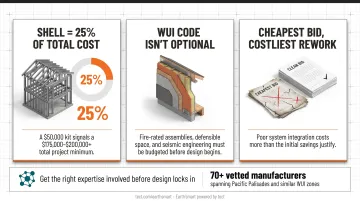
For homeowners rebuilding in Pacific Palisades and similar WUI zones, all three mistakes share a common fix: get the right expertise involved before design locks in. Earth'smart powered by tect's coordinated approach brings manufacturer input and system-level specifications into the project from day one — through its earth'smart powered by tectApp™ community of 70+ vetted manufacturers — so WUI requirements are priced correctly at the start, not discovered mid-construction.
Frequently Asked Questions
How much does it cost to build a steel frame home?
A fully finished steel frame home in the US typically costs between $50 and $275+ per square foot, depending on finish level, size, structural type, and location. That range spans basic shell builds through fully custom, performance-optimized homes with fire-resistive and seismic engineering.
Is a steel frame house cheaper to build than wood frame?
Upfront costs are similar — both materials typically land in the $150–$250/sq ft finished range depending on market and spec. Steel gains ground over time: lower maintenance costs, no rot or pest damage, and non-combustible framing that carries real weight in high-risk insurance markets where wood-frame coverage is increasingly difficult to obtain.
How much does a 2,000 square foot metal house cost?
A fully finished 2,000 sq ft steel home in 2026 ranges from roughly $100,000–$200,000 at the basic end to $350,000–$550,000+ for a premium, fully engineered build in a fire-risk or seismic zone. Finish level and site location are the dominant variables.
What does a steel kit price include versus total build cost?
A steel kit covers the structural shell — frame, wall and roof panels, fasteners — and typically represents about 25% of total project cost. Foundation, labor, interior systems, finishes, and permits make up the remaining 75%.
Do steel homes cost less to insure than wood-frame homes?
Insurers rate non-combustible framing more favorably than wood, particularly in fire-risk zones. Premium differentials vary by carrier, but non-combustible construction is the baseline requirement for IBHS Wildfire Prepared Home certification. In California's tightening insurance market, that documentation is increasingly what determines whether coverage is available at all.
How long does it take to build a steel frame home?
The steel shell goes up in days to weeks. Total build time from permit to move-in averages 9.1 months for single-family homes, per NAHB's 2024 data (1.4 months permit-to-start, 7.6 months construction). Interior finishing and inspections — not the structural erection — drive the overall schedule.