Introduction
For homeowners rebuilding after the Palisades and Eaton fires — or anyone building in California's Wildland-Urban Interface — hiring a custom home builder in 2026 is not a design decision. It's a structural, financial, and generational commitment. The stakes have never been higher.
Most homeowners approach builder selection without a clear framework. They compare portfolios, collect bids, and choose on price or gut feel. Mid-project, they discover their builder can't coordinate systems, doesn't understand current WUI codes, or lacks the subcontractor relationships to keep a complex build on schedule.
This guide walks through 7 critical steps to vet and hire the right custom home builder in 2026 — covering what separates capable builders from costly mistakes, especially in high-risk and WUI zones.
Key Takeaways
- Define performance priorities — resilience, fire resistance, and structural systems — before approaching any builder
- Verify CSLB Class B licensing, insurance, and workers' comp directly through primary sources, not verbal confirmation
- Ask every builder how they coordinate structural, mechanical, and envelope systems together; few can answer it clearly
- Top builders in post-fire rebuild markets carry 12–18 month waitlists; being available now is not a quality signal
- Skipping system integration and skipping credential verification are the two costliest mistakes rebuild homeowners make
What Hiring a Custom Home Builder Actually Involves
According to NAHB, custom builders create homes designed specifically for each owner — often on land the owner already holds — and typically build fewer than 10 homes per year. That owner-specific model puts the builder in charge of coordinating design, engineering, subcontractors, inspections, and regulatory compliance across a timeline that typically spans 12–24 months.
This is structurally different from a production builder, who builds communities on land they own with preselected designs, or a general contractor, who is hired after plans already exist. A custom home builder takes on design-to-delivery accountability as the single point of coordination across all trades.
What California Adds to This Picture
In California, custom home construction involving multiple trades requires a CSLB Class B General Building Contractor license — not a separate "custom builder" designation. That license covers structures requiring at least two unrelated building trades — meaning it applies to virtually every custom home build.
In 2026, the scope has expanded further. Builders in WUI zones must navigate:
- Updated fire resistance standards under the 2025 California Wildland-Urban Interface Code (Title 24, Part 7), which took effect January 1, 2026
- Insurance underwriting criteria that now require documented mitigation measures
- Energy codes and seismic requirements that interact with fire-resistive assembly choices
A builder unfamiliar with these requirements doesn't just create compliance risk — they create a home that may not qualify for insurance coverage at all.
Why Builder Selection Is More Critical in 2026
The post-fire rebuild environment in Southern California has created an unusual market: a surge in demand for resilient custom construction, with both highly qualified builders and underqualified ones competing for the same clients.
CAL FIRE reports that the Palisades Fire destroyed 6,845 structures and the Eaton Fire destroyed 9,419 structures. By early 2026, more than 3,170 rebuild permits had been issued, with LA County reviews typically completing in 31 business days. Faster permitting is real — but it doesn't solve the harder problems downstream.
Those downstream problems come down to the market conditions every rebuild homeowner is now navigating:
What makes selection harder now:
- Skilled-labor shortages reduced 2024 single-family production by approximately 19,000 homes nationally (NAHB, 2025) — post-fire demand adds to the shortage
- Construction costs now represent 64.4% of the average new home price, up from 60.8% in 2022
- Building material input prices rose 4.2% year-over-year as of early 2026
- The 2025 CWUIC replaced prior Chapter 7A experience as the compliance baseline — builders who haven't updated their knowledge are already behind
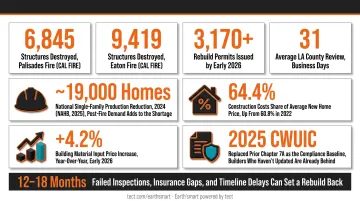
Choose wrong, and the cost isn't just financial: failed inspections, insurance gaps, and timeline delays can set a rebuild back by 12–18 months in a market where qualified crews are already stretched thin.
The 7 Critical Steps to Hiring a Custom Home Builder
Step 1: Define Your Vision, Requirements, and Performance Priorities
Before approaching any builder, document what you're actually building toward. This means more than square footage and aesthetic preferences.
Define:
- Site constraints and zoning requirements
- Lifestyle priorities and long-term use
- Performance requirements specific to your location: fire resistance ratings, flood elevation, seismic design category
- Budget range and flexibility
Buyers who enter builder conversations without defined priorities are more likely to be sold on finishes while being underspecified on structure, envelope, and systems. In WUI zones, this gap has real consequences. You may end up with a beautiful home that doesn't qualify for insurance.
Step 2: Research and Shortlist Builders in Your Area
Source candidates through:
- NAHB affiliate local home builder associations
- Referrals from licensed architects or real estate professionals
- Post-disaster rebuild communities, where builder reputations surface quickly (networks like Builders Alliance LA have emerged specifically for Palisades and Eaton recovery)
- Online platforms and contractor directories
The key filter: narrow your list to builders with demonstrated experience in your specific build type — not just builders who have constructed homes in your county. A track record in WUI, post-fire rebuild, or high-performance residential construction tells you something about capability. A general residential portfolio does not.
NAHB credentials like Certified Green Professional or Graduate Master Builder signal training and ethics commitments, but they don't substitute for verifying actual WUI execution experience directly.
Step 3: Verify Credentials, Licensing, and Insurance
Don't rely on verbal confirmation. Request and verify:
- Current CSLB Class B license — check status, classification, and bond through CSLB's online license verification system
- General liability insurance — confirm coverage is active and sufficient for your project scope
- Workers' compensation certificate — must be written by a California Department of Insurance-licensed insurer, with CSLB listed as certificate holder
- Specialty subcontractor licenses for fire protection, electrical, and any other specialty trades
Also check for NAHB membership or specialty certifications relevant to resilient construction — these memberships typically require adherence to ethical and quality standards.
California law requires a written contract for all home improvement projects over $500, and all changes must also be in writing (Business and Professions Code §7159). A builder who resists putting things in writing is already a red flag.
Step 4: Assess Resilience Expertise and System Integration Capability
Most homeowners skip this step entirely. It's also where homes fail.
Ask every builder directly: How do you coordinate structural, mechanical, envelope, and system decisions — in sequence, or integrated from the start?
In high-risk environments, a builder who sequences these decisions late rather than integrating them early produces homes that underperform under fire, flood, or seismic stress. Many also fail to meet insurance underwriting criteria.
What to ask:
- How do you handle WUI material compliance — specifically OSFM-listed products and Chapter 7A requirements?
- At what phase do you bring in mechanical and envelope system decisions?
- Who coordinates fire suppression design — and when?
- How do you document resilience measures for insurance purposes?
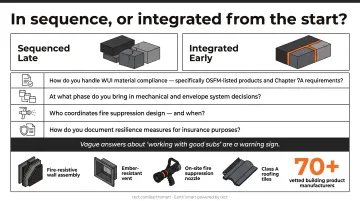
A builder who can answer these questions specifically, with named systems and coordination processes, is demonstrating real capability. Vague answers about "working with good subs" are a warning sign.
Earth'smart powered by tect's Earth'smart™ model is built around this principle. By connecting clients with the earth'smart powered by tectApp™ community of 70+ vetted building product manufacturers, decisions about fire-resistive assemblies, ember-resistant venting, on-site fire suppression, and Class A roofing are integrated from concept design forward — not introduced late in construction, when changing course is expensive.
Step 5: Evaluate Communication and Project Management
Poor communication is the most common cause of cost overruns and missed timelines in custom builds. How a builder answers "how will you keep me informed?" tells you whether their process is designed or improvised.
Ask every candidate:
- How often will I receive project updates, and through what channel?
- Do you use a project management platform (Buildertrend, CoConstruct, or similar)?
- Who is my primary point of contact — and are they involved from design or only during construction?
- How do you coordinate between design, office, and field teams?
- How do you sequence trades, and who manages subcontractor scheduling?
NAHB data shows contractor-built homes average 12 months from authorization to completion; homes over 5,000 sq ft average 14–16 months. That timeline only holds when coordination is tight. In post-fire rebuild markets with compressed labor supply, disorganized project management compounds delays significantly.
For complex WUI builds, also ask how the project manager coordinates inspections and tracks compliance at each phase. This is where schedule slippage typically starts.
Step 6: Review the Contract, Pricing Structure, and Payment Schedule
A qualified builder provides a detailed written contract before any work begins. That contract should include:
- Full scope of work and material specifications
- Allowances for major selections, with clear overage procedures
- Payment schedule tied to project milestones (not calendar dates)
- Change order procedures in writing
- Project timeline commitments
- Warranty terms and lien waiver provisions
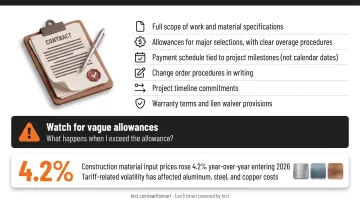
Watch for vague allowances: Builders who give generic budget figures for cabinetry, mechanical systems, or exterior materials without explaining how overages are handled are setting up a budget surprise. Ask explicitly: what happens when I exceed the allowance?
Also ask how the builder handles material cost shifts. Construction material input prices rose 4.2% year-over-year entering 2026, and tariff-related volatility has affected aluminum, steel, and copper costs. Ask whether the contract includes fixed-cost or guaranteed-maximum-price provisions — and if not, what escalation protections exist.
Step 7: Contact References and Review Completed Projects
Request 3–5 references from completed projects similar to yours in scope, location, or complexity. Then actually call them. Don't just ask whether they were happy — ask:
- Did the home perform as promised (not just look good)?
- Did the builder stay within budget?
- Were timelines met? If not, how were delays handled?
- How were problems resolved when they came up?
- Would you hire them again — and would you recommend them for a WUI or high-performance build specifically?
If possible, visit a completed home or active job site. Photos don't reveal workmanship quality, site organization, or material execution details. Walking a finished project tells you far more than a portfolio.
Key Factors That Affect Your Final Decision
Three variables drive most final builder decisions — and each one narrows the field in a different way.
| Factor | What to Evaluate |
|---|---|
| Budget | Determines whether fully custom, semi-custom, or design-build is appropriate; low bids often signal deferred scope decisions |
| Site and risk profile | Builders with WUI or coastal seismic experience anticipate code, insurance, and material requirements that generalists miss |
| Timeline and capacity | In post-fire rebuild markets, qualified builders may have 12–18 month waitlists; availability soonest isn't a quality indicator |
Common Mistakes Homeowners Make
Most hiring decisions go wrong before the contract is signed. Watch for these three:
- The lowest bid rarely reflects genuine savings — it typically signals missing scope, under-specified materials, or labor quality issues that surface mid-build.
- Most homeowners ask about finishes but never ask how their builder coordinates structural, mechanical, and envelope systems. In resilient or high-performance builds, that gap is where cost overruns and system conflicts surface.
- A strong portfolio says nothing about coordination capability, communication standards, or the ability to manage permit complexity and schedule pressure. Find out how they build, not just what they've built.
Frequently Asked Questions
How do you compare custom home builders?
Go beyond price and portfolio. Evaluate communication approach, contract transparency, resilience expertise relevant to your location, subcontractor relationships, and references from comparable completed projects. For WUI builds, ask specifically how each builder handles Chapter 7A compliance and system integration.
What does a project manager do for a custom home builder?
A project manager oversees the full build timeline, coordinates trade sequencing, manages inspections, and communicates progress to the homeowner. Involvement from the design phase, not just construction, indicates the builder thinks in systems rather than sequences.
What questions should I ask a custom home builder before hiring?
Ask these before signing anything:
- How do you handle system integration across structure, envelope, and mechanical?
- Who is my day-to-day point of contact throughout the build?
- How do you manage cost changes mid-project?
- Can I see references from similar builds?
- What does your contract cover, including allowances and change order procedures?
What is the difference between a custom home builder and a general contractor?
A custom home builder typically takes on full design-to-delivery coordination, including design partners, material selections, and trade management from concept through occupancy. A general contractor is usually hired after plans exist and focuses primarily on construction execution within a defined scope.
What should be in a custom home builder contract?
A solid contract covers scope of work, material specifications and allowances, a milestone-tied payment schedule, change order procedures, project timeline, warranty terms, and lien waiver provisions. In California, written contracts are legally required for any home improvement project over $500.