In California's Wildland-Urban Interface (WUI), building codes now require enclosed eave assemblies to meet specific fire-resistance standards — but many homeowners and builders don't fully understand what those standards require, which materials qualify, or how to achieve compliance in a retrofit situation.
This guide covers what a 1-hour fire-rated eave assembly is, why it matters, what California's CBC Section 707A.6 requires, which materials and systems qualify, and how to approach both new construction and retrofits.
This guide is for: homeowners rebuilding in fire-prone areas, those hardening existing homes in WUI zones, and anyone making eave design decisions during construction or renovation.
Key Takeaways
- CBC Section 707A.6 governs enclosed eave assemblies in California's high fire hazard zones, offering eight distinct compliance pathways
- A "rated assembly" is a tested, documented system — not just a material choice
- Fiber cement, exterior-rated FRTW, 5/8-inch Type X gypsum, and tested assemblies are the most common qualifying options
- FEMA explicitly recommends flat, horizontal soffits over sloped designs for better wildfire performance
- Ember-resistant vents and fire-rated soffit panels have separate compliance requirements
What Is a 1-Hour Fire-Rated Eave Assembly?
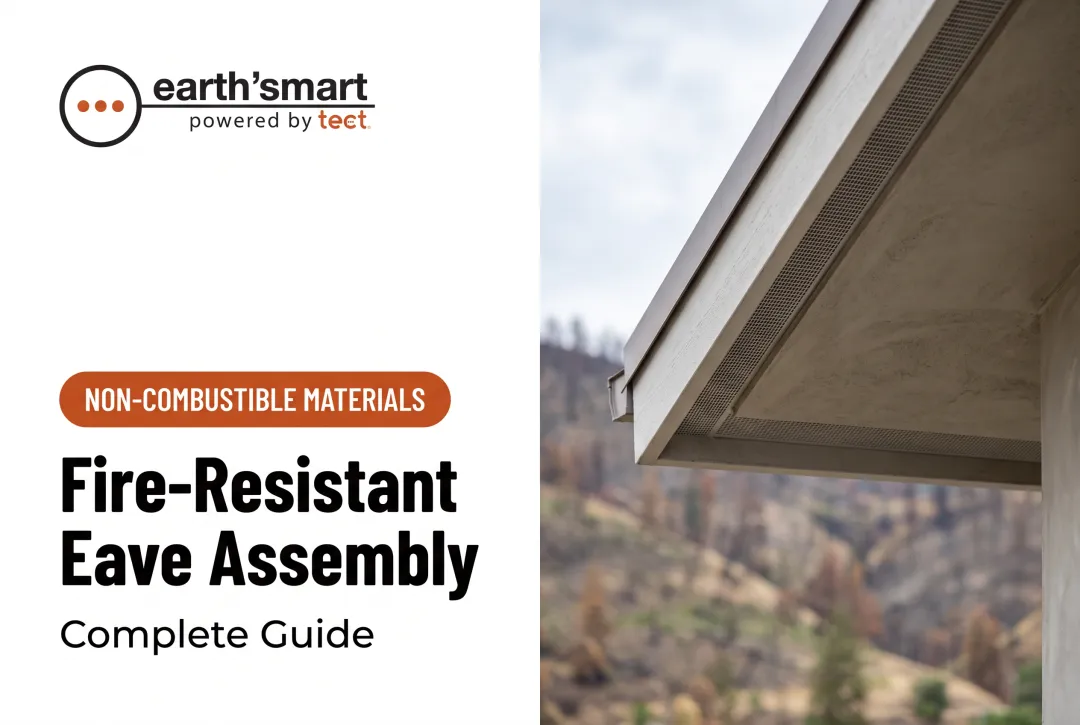
An eave assembly is the system of components at the lower edge of a sloped roof where the roof overhangs the exterior wall. The main components:
- Rafter tails or truss ends: the structural framing that extends past the wall
- Soffit: the panel that closes off the underside of the eave
- Fascia: the vertical trim board at the outer edge
- Venting: openings that allow airflow into the attic
A "fire-rated" assembly means the entire system resists fire passage for a defined period under standardized conditions — in this case, 60 minutes.
What "1-Hour Fire Resistance" Actually Means
The assembly must be tested to ASTM E119 or UL 263 standards, which measure how assemblies perform under controlled fire and heat exposure. To pass, the assembly must prevent structural failure and flame penetration for at least 60 minutes.
A rated assembly is a tested, documented system with a UL design number or listed reference — not simply a combination of fire-resistant materials. Substituting components from one tested assembly into another voids the rating.
Open vs. Enclosed Eaves
- Open eave: exposed rafter tails and roof decking with no soffit panel — highly vulnerable to ember ignition and heat intrusion
- Enclosed eave: a soffit panel boxes in the underside — when built with qualifying materials, significantly reduces ignition risk
CBC Section 707A.6 applies specifically to enclosed roof eaves and roof eave soffits. Open eaves face separate but related requirements.
The code covers two enclosed configurations:
- Boxed-in soffits with a horizontal underside
- Sloping rafter tails with an exterior covering applied to the underside
Note that fascia and architectural trim boards are explicitly excluded from the protection requirement.
Why Eaves Are a Critical Wildfire Vulnerability
Three distinct fire threats converge at the eave:
- Windborne embers that travel ahead of the fire front and lodge in or near the eave opening
- Convective heat — rising columns of hot gas that concentrate under overhangs
- Radiant heat from nearby flames that can ignite combustible soffit materials from a distance
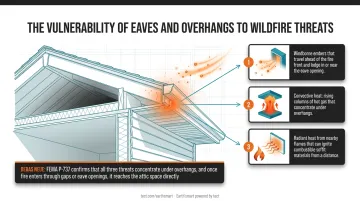
FEMA P-737 confirms that all three threats concentrate under overhangs — and once fire enters through gaps or eave openings, it reaches the attic space directly.
The Fire Propagation Sequence
Once an eave or soffit ignites, the damage doesn't stop there. Fire can:
- Spread directly onto the roof surface
- Penetrate into the attic space
- Travel down into the exterior wall assembly
That progression — eave to roof to attic to wall — is how a localized ignition becomes a total loss.
Why Common Materials Fail
Standard construction materials provide little meaningful resistance:
- Untreated wood soffits ignite readily under ember exposure
- Vinyl soffits melt and fall away, exposing structural members underneath
- Unprotected metal panels warp under heat and leave gaps that allow ember intrusion
The Sloped Soffit Problem
When soffits follow the angle of the rafter tails instead of running horizontally, they create a channel that traps embers and concentrates hot gases. FEMA P-737 explicitly recommends flat, horizontal soffits over sloped configurations because flat soffits reduce heat and ember entrapment.
California Code Requirements: Section 707A.6 and Beyond
California Building Code Chapter 7A (SFM — State Fire Marshal) governs construction in State Responsibility Areas and Very High Fire Hazard Severity Zones (VHFHSZ). It applies to new buildings with permit applications submitted on or after July 1, 2008, in these zones.
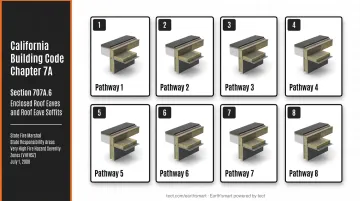
Section 707A.6 specifically addresses "Enclosed Roof Eaves and Roof Eave Soffits" and lists eight approved compliance pathways:
| # | Pathway |
|---|---|
| 1 | Noncombustible material |
| 2 | Ignition-resistant material labeled for exterior use (Section 704A.2) |
| 3 | Fire-retardant-treated wood (FRTW) labeled for exterior use (Section 2303.2) |
| 4 | Materials tested for ≥1-hour fire resistance per ASTM E119 or UL 263 |
| 5 | One layer of 5/8-inch Type X gypsum sheathing behind exterior cladding |
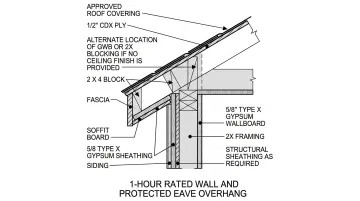
| 6 | Exterior portion of a 1-hour fire-resistive wall assembly, including GA Fire Resistance Design Manual assemblies |
| 7 | Boxed-in horizontal soffit assemblies tested per ASTM E2957 |
| 8 | Boxed-in horizontal soffit assemblies meeting SFM Standard 12-7A-3 |
Local Requirements Can Exceed State Minimums
In VHFHSZ, local authorities — including CAL FIRE and county building departments — may require more than the state baseline. Common examples of enhanced requirements include:
- Adding exterior 5/8-inch fire-resistant gypsum between existing and new soffit layers during retrofits
- More restrictive ignition-resistant material standards for specific micro-climates or terrain
- Additional ember-resistance requirements for vents and enclosed soffit cavities
Cities and counties can adopt ordinances with more restrictive standards when local climatic, geological, or topographical conditions warrant it. Always verify requirements with your local AHJ before proceeding — what satisfies the state baseline may not satisfy your county or city inspector.
Approved Materials and Compliance Pathways
Noncombustible Materials
The most straightforward compliance path. Qualifying options include:
- Fiber cement board (most commonly specified for residential soffits — workable, paintable, widely available)
- Portland cement plaster (stucco)
- Metal (non-distorting type, properly installed)
Fiber cement products like James Hardie soffit panels are specifically designed for this application and meet applicable building code requirements. Confirm the product is labeled for exterior use before specifying.
Fire-Retardant-Treated Wood (FRTW)
FRTW is pressure-impregnated lumber or plywood tested to ASTM E84 or UL 723 with a flame spread index of 25 or less. Two requirements apply:
- Exterior-rated FRTW is required. Interior-rated FRT degrades under moisture cycling and does not satisfy eave exposure requirements
- Painting over FRTW does not void the rating, but sealing with non-breathable coatings may compromise performance
5/8-Inch Type X Gypsum Sheathing
One layer of 5/8-inch Type X gypsum applied behind the exterior cladding on the underside of rafter tails or soffit framing satisfies CBC 707A.6, item 5. This is cost-effective and widely used in new construction.
Standard 1/2-inch drywall does not qualify. The board must specifically be Type X.
Tested Assembly Pathways
Rather than specifying individual materials, a complete system of framing, sheathing, and cladding can be tested and listed as a unit. References include:
- UL design numbers (referenced via UL Product iQ)
- Gypsum Association Fire Resistance Design Manual (GA-600-2024 contains over 750 fire- and sound-rated systems)
- ASTM E2957 — a test method developed specifically for eave and soffit performance under direct wildfire flame exposure
- SFM Standard 12-7A-3 — California's own test standard, using 300 kW direct flame exposure for 10 minutes
A listed assembly must be built exactly as specified. Mixing components from different tested assemblies voids the rating.
Choosing the Right Pathway
| Condition | Recommended Pathway |
|---|---|
| Standard residential, straightforward geometry | Fiber cement (noncombustible) |
| Wood aesthetic desired | Exterior-rated FRTW |
| New construction with proper detailing | Type X gypsum behind cladding |
| Complex geometry or jurisdiction requires listed system | Tested assembly (UL/GA/ASTM E2957) |
Flat vs. Sloped Soffits and Vent Integration
Soffit Geometry
A horizontal soffit runs level from the wall to the fascia regardless of roof pitch. A sloped soffit follows the rafter angle.
Horizontal soffits are the standard choice in WUI construction. They deflect rising embers and hot gases outward rather than channeling them toward the wall. FEMA P-737 makes this recommendation explicitly — sloped soffits create geometry that traps embers and concentrates heat.
Vent Integration
Soffit geometry determines how well your assembly deflects embers — but what goes into that soffit matters just as much. Standard perforated soffit vents are not ember-resistant. In WUI zones:
- All soffit vents must meet ember-resistance requirements, typically tested under ASTM E2886 or California SFM standards
- Ember-resistant vents address ember intrusion — they do not satisfy the surrounding soffit assembly requirement
- The vent and the soffit assembly must each independently comply with their respective code requirements
Some designs eliminate soffit vents entirely and use ridge-only or other ventilation strategies, which can simplify 707A.6 compliance. However, attic ventilation minimums under IRC R806.2 (minimum 1/150 of ventilated space net free area) still apply. Getting both right means the fire code and the building performance code are reviewed together from the start — not reconciled after the fact during plan check.
Retrofitting Existing Eaves to the 1-Hour Standard
Existing eaves cannot be painted or coated to achieve a fire-resistance rating. Compliance requires substantive assembly work.
Common Retrofit Approaches
Enclosing open eaves is the most impactful upgrade. Add a horizontal soffit using fiber cement or Type X gypsum-backed panels to box in exposed rafter tails. CAL FIRE specifically recommends this approach for preventing ember entry.
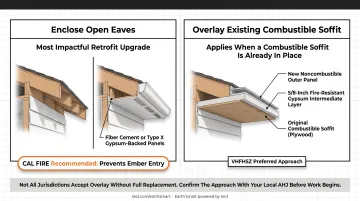
Overlaying existing combustible soffits is possible when plywood or another combustible soffit is already in place. It can be overlaid with a qualifying noncombustible material. In VHFHSZ, the preferred approach adds 5/8-inch fire-resistant gypsum as an intermediate layer between the original soffit and the new outer panel.
Not all jurisdictions accept overlay without full replacement. Confirm the approach with your local AHJ before work begins.
Why Coordination Matters in Retrofit Work
Retrofit eave decisions don't exist in isolation. They intersect with:
- Roofing — eave geometry affects how roof edge details terminate
- Ventilation — soffit changes directly affect attic airflow balance
- Insulation — reduced eave venting shifts moisture dynamics inside the assembly
- Enclosing rafter tails often requires framing additions you'll want to plan for early
Getting these decisions right means understanding how each system interacts. For homeowners rebuilding in Pacific Palisades, the East Bay Hills, Sonoma wine country, or other high-risk WUI zones, earth'smart powered by tect's Earth'smart™ approach integrates non-combustible eaves and soffits from the concept phase.
Structure, envelope, and systems are coordinated through earth'smart powered by tect's network of 70+ vetted building product manufacturers — so the right decisions get made early, not patched together late in construction.
Frequently Asked Questions
Is a 1-hour fire-rated eave assembly required in California?
Yes. CBC Section 707A.6 requires enclosed roof eaves in State Responsibility Areas and VHFHSZ to be protected using one of eight approved methods — most of which effectively meet or exceed 1-hour fire-resistance performance. Local jurisdictions may impose additional requirements beyond the state baseline.
What is the difference between an open eave and an enclosed eave in a wildfire context?
An open eave has exposed rafter tails and roof decking with no soffit, making it highly vulnerable to ember ignition and hot gas intrusion. An enclosed eave uses a soffit to box in the underside — when built with qualifying fire-resistant materials, it significantly reduces ignition risk and satisfies Section 707A.6 requirements.
Does 5/8-inch Type X gypsum sheathing satisfy the 1-hour eave assembly requirement?
Yes. Under CBC Section 707A.6, item 5, one layer of 5/8-inch Type X gypsum sheathing applied behind the exterior cladding qualifies as an approved protection method. Standard 1/2-inch drywall does not meet this requirement — the board must be Type X.
Can I retrofit my existing eaves to meet the 1-hour fire-resistance standard?
Yes. Common approaches include enclosing open eaves with fiber cement soffits, overlaying combustible soffits with noncombustible materials, or adding 5/8-inch Type X gypsum as an intermediate layer in VHFHSZ. Confirm the specific method with your local AHJ before starting work.
What is SFM Standard 12-7A-3 and how does it apply to eave assemblies?
SFM Standard 12-7A-3 is a California State Fire Marshal test standard for under-eave and soffit assemblies, using 300 kW direct flame exposure for 10 minutes. Assemblies that pass satisfy CBC Section 707A.6 without requiring a full ASTM E119 wall assembly rating.
Do ember-resistant soffit vents satisfy both ventilation and fire-resistance requirements?
No. Ember-resistant vents tested per ASTM E2886 or SFM standards address ember intrusion through the vent opening only. They do not satisfy the 1-hour eave assembly rating for the surrounding soffit material. Both the vent and the soffit assembly must independently comply with their respective requirements.