Introduction
When the Palisades Fire tore through Pacific Palisades in January 2025, it destroyed 6,845 structures across 23,448 acres, according to CAL FIRE's incident records. A few homes stood. The question worth asking isn't why those homes were lucky — it's whether they were built differently.
The wall assembly is one of the most consequential systems in any fire-resilient home. It's the boundary between the fire outside and the structure within. A wall that ignites, burns through, or allows ember intrusion will undermine every other fire-safety feature in the building. It doesn't matter how good the roof is or how wide the defensible space extends.
This guide covers what a non-combustible wall assembly actually is, how each layer functions, what materials qualify, and how building codes classify fire performance. The goal isn't a checklist of individual products — it's understanding why system integration is what separates a home that survives from one that doesn't.
Key Takeaways
- A non-combustible wall assembly uses materials that won't ignite or fuel a fire across every layer — framing, sheathing, insulation, cladding, and interior lining
- These three terms have distinct code meanings: "non-combustible," "fire-resistance-rated," and "fire-retardant-treated" are not interchangeable
- Swap one layer without re-evaluating the others and you can void the entire assembly's fire rating
- IBC and NFPA Type I and II construction classifications define non-combustible building requirements
- In WUI zones, ember intrusion at drainage gaps and vent openings is as dangerous as the fire itself
What Is a Non-Combustible Wall Assembly?
A non-combustible wall assembly is a wall system where the primary components — framing, sheathing, insulation, and cladding — are made from materials that do not ignite, burn, or release flammable vapors when exposed to fire or heat. The critical clarification: non-combustible doesn't mean indestructible. It means the assembly doesn't contribute fuel to a fire.
Three Terms Builders and Homeowners Confuse
These are distinct classifications with specific code definitions:
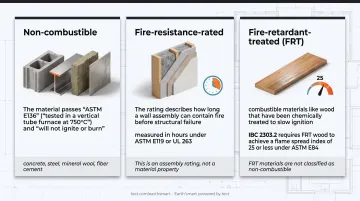
- Non-combustible — material passes ASTM E136 (tested in a vertical tube furnace at 750°C) and will not ignite or burn. Examples: concrete, steel, mineral wool, fiber cement
- Fire-resistance-rated — describes how long a wall assembly can contain fire before structural failure, measured in hours under ASTM E119 or UL 263. This is an assembly rating, not a material property
- Fire-retardant-treated (FRT) — combustible materials like wood that have been chemically treated to slow ignition. IBC 2303.2 requires FRT wood to achieve a flame spread index of 25 or less under ASTM E84. FRT materials are not classified as non-combustible
Flame Spread Classifications
The flame spread index (FSI) measures how quickly fire travels across a material's surface:
| Class | FSI Range | Common Materials |
|---|---|---|
| Class A | 0–25 | Concrete, steel, fiber cement, mineral wool |
| Class B | 26–75 | Some treated wood products |
| Class C | 76–200 | Standard OSB (FSI: 100–110) |
Most non-combustible materials carry a Class A rating. Standard OSB, by comparison, falls in Class C — a meaningful distinction when specifying sheathing for fire-prone areas.
One Common Misconception
"Non-combustible construction" doesn't mean a building contains zero combustible materials. IBC Section 603 explicitly permits specific combustible elements — flooring, millwork, door frames, FRT wood in select applications — within Type I and II construction, because their limited presence doesn't materially increase overall fire risk.
Exterior walls hold a specific position in this calculus: they intercept radiant heat and airborne embers before either reaches interior framing, insulation, or occupied space. In WUI conditions, that barrier is where fire resistance either holds or fails first.
Layer-by-Layer Breakdown of a Non-Combustible Wall Assembly
A non-combustible wall assembly isn't a single product — it's a sequence of interdependent layers, each controlling a different aspect of fire, moisture, air, and thermal performance. Understanding how each layer works — and how they interact — is what separates a code-minimum wall from one built to perform under real wildfire conditions.
Structural Framing
The framing material sets the fire-resistance baseline for everything built on top of it. Two primary options for fire-resilient framing:
- Cold-formed steel (CFS) — inherently non-combustible; building codes recognize CFS as eligible for Type I construction, per the Steel Framing Industry Association
- FRT wood framing — combustible but code-permitted in many Type I/II applications; achieves FSI ≤ 25 under extended ASTM E84 testing
For high-risk WUI rebuilds, poured concrete, concrete masonry units (CMU), and masonry brick are also used as structural alternatives. Earth'smart powered by tect's Earth'smart™ approach for Pacific Palisades rebuilds specifies pre-insulated concrete masonry as a primary fire-resistive wall strategy — a system that addresses framing and insulation simultaneously.
Sheathing
Sheathing serves as the structural backbone and the first substrate for moisture and fire control. For fire-resilient assemblies:
- Glass mat (non-paper-faced) exterior gypsum board — fire-resistant; recommended for WUI assemblies
- FRT plywood — combustible but code-permitted when treated to required FSI thresholds
- Standard OSB — Class C flame spread (FSI 100–110); not appropriate as a fire-control layer in exposed assemblies
Continuous Insulation and Water-Resistive Barrier
The continuous insulation (CI) layer sits outside the framing to eliminate thermal bridging. In a non-combustible assembly, the insulation choice has direct fire implications:
- Mineral wool CI — non-combustible; can withstand temperatures exceeding 2,000°F per ROCKWOOL's product documentation
- Unfaced fiberglass boards — non-combustible option
- Foam-based CI (EPS, XPS, polyiso) — combustible; requires additional protective layers and may trigger NFPA 285 testing requirements
The water-resistive barrier (WRB) is often overlooked in fire discussions, but fluid-applied and membrane-type WRBs are typically combustible. Because the WRB sits within the assembly rather than being independently tested, its fire performance must be evaluated as part of the full wall system — not in isolation.
Exterior Cladding
Non-combustible cladding options that carry a Class A flame spread rating:
- Fiber cement siding and panels
- Brick or stone veneer
- Traditional three-coat stucco
- Metal siding and panels
- Reinforced cement board
In WUI settings, drainage gaps behind cladding can become pathways for ember intrusion and flame spread — a detail the next section covers directly.
Interior Lining
The interior gypsum board layer — typically 5/8" Type X gypsum — does two things at once: it acts as the fire-rated barrier protecting occupants, and it provides the thermal barrier code requires when combustible materials are present behind it. Type X gypsum is classified as a non-combustible interior lining.
Non-Combustible Materials: What to Use and Why
Material Comparison by Layer
| Layer | Non-Combustible Options | Combustible (Code-Permitted) | WUI Suitability |
|---|---|---|---|
| Framing | Cold-formed steel, CMU, concrete | FRT wood | Steel/CMU preferred |
| Sheathing | Glass mat gypsum board | FRT plywood | Glass mat preferred |
| CI | Mineral wool, unfaced fiberglass | EPS, XPS, polyiso foam | Mineral wool strongly preferred |
| Cladding | Fiber cement, brick, stucco, metal | — | All listed options suitable |
| Interior lining | 5/8" Type X gypsum | — | Standard requirement |
Why Mineral Wool Stands Out
Mineral wool is manufactured by melting rock or slag at extreme temperatures, giving it inherent fire resistance without chemical flame retardants. That gives it some practical advantages:
- Withstands temperatures exceeding 2,000°F (1,093°C)
- Non-combustible classification under ASTM E136
- When used as the CI layer, it can reduce the likelihood of triggering NFPA 285 testing requirements — though if the assembly includes other combustible components (combustible WRBs, foam air barriers), testing may still apply
Building Science Corporation's BSI-068 "Rocks Don't Burn" specifically supports mineral wool and gypsum-based exterior assemblies as the most fire-appropriate non-combustible insulation and cladding substrate approach.
Drainage Gaps and Rainscreen Fire Risk
Ventilated rainscreen cavities are standard practice for moisture management — but in WUI zones, the air gap behind cladding can act as a channel for burning embers.
Per Building Science Corporation's BSI-129 "Wildfire":
- Gaps of ¾ inch or less present minimal fire risk due to oxygen starvation in the cavity
- Larger gaps require both the cladding and CI layer to be non-combustible — fiber cement over mineral wool with metal hat channel furring is a documented approach
Gap size, though, isn't the only vulnerability — how those gaps are terminated at the base of the wall matters just as much.
Ember Entry at Wall Openings
Even a fully non-combustible cladding system can fail if weep holes, drainage gap openings, or vent gaps allow ember intrusion. Research cited by IBHS indicates ember exposure accounts for up to 90% of building ignitions in wildfire events.
The IBHS Wildfire Prepared Home standard requires vents to be covered with non-combustible, corrosion-resistant mesh with openings not exceeding 1/8 inch. Any drainage gap opening at the base of a WUI wall assembly warrants equivalent protection.
Building Code Classifications for Non-Combustible Construction
Three systems govern how buildings are classified for fire performance:
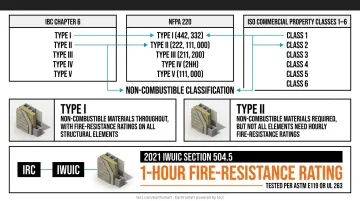
- IBC Chapter 6 — classifies construction into Types I through V based on combustibility and fire resistance of structural elements
- NFPA 220 — a separate but equivalent classification using the same Type I/II non-combustible framework
- ISO Commercial Property Classes 1–6 — used by insurers to rate buildings; Classes 1 and 2 align with non-combustible construction
Type I and Type II are the non-combustible categories under both systems. The distinction:
- Type I — non-combustible materials throughout, with fire-resistance ratings on all structural elements
- Type II — non-combustible materials required, but not all elements need hourly fire-resistance ratings
Those commercial-code categories establish the baseline vocabulary. For residential WUI rebuilds, the governing framework shifts to the IRC layered with the IWUIC. Under 2021 IWUIC Section 504.5, Class 1 ignition-resistant construction requires exterior walls to meet a 1-hour fire-resistance rating from the exterior side as one compliance path — tested per ASTM E119 or UL 263.
Key Fire Test Standards
| Standard | What It Tests |
|---|---|
| ASTM E136 | Combustibility of individual materials at 750°C |
| ASTM E119 / UL 263 | Fire resistance of full assemblies (1-hour, 2-hour ratings) |
| NFPA 285 | Fire propagation of exterior wall assemblies containing combustible components |
| NFPA 268 | Ignitability of exterior wall assemblies exposed to radiant heat |
Passing ASTM E136 confirms a material is non-combustible — it says nothing about whether a wall assembly built with that material will achieve an ASTM E119 fire-resistance rating. Material compliance and assembly performance are separate tests, and both matter.
WUI and Wildfire Zone Considerations
The Wildland-Urban Interface presents threats that standard IBC non-combustible construction wasn't designed to address: ember cast from fire fronts traveling well ahead of flames, radiant heat from burning vegetation, and direct flame contact at the building perimeter.
Ember exposure is the critical threat. Up to 90% of building ignitions are attributed to ember contact rather than direct flames. That means a wall system must defend against firebrands landing in drainage gaps, weep holes, and unscreened vent openings — not just the flame front visible from the street.
The IWUIC Whole-Assembly Requirement
The IWUIC's approach differs from standard IBC in one important way: it evaluates the entire wall system together, not individual material properties in isolation. The 1-hour exterior fire-resistance rating requirement means an assembly must be tested and listed as a system — cladding, CI, sheathing, framing, and interior lining evaluated in sequence.
Two compliance points follow from this:
- Combustible foam CI in IWUIC-governed assemblies requires review under IBC Chapter 26 and NFPA 285 to confirm the full assembly remains compliant.
- Non-combustible mineral wool CI satisfies the same requirement without the additional compliance analysis.
What Surviving Homes Had in Common
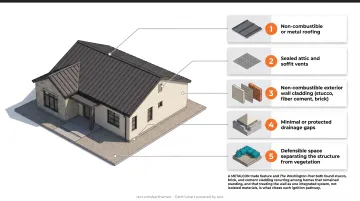
Homes documented as surviving the 2025 LA fires — including a Pacific Palisades residence profiled in a METALCON trade article on non-combustible construction — shared consistent design features:
- Non-combustible or metal roofing
- Sealed attic and soffit vents
- Non-combustible exterior wall cladding (stucco, fiber cement, brick)
- Minimal or protected drainage gaps
- Defensible space separating the structure from vegetation
The Washington Post's reporting on surviving LA homes similarly noted that stucco, brick, and cement cladding appeared repeatedly among structures that remained standing. The pattern holds because each of these features addresses a specific ignition pathway. Treating the wall as an integrated system — not a collection of individual materials — is what closes those pathways.
Why the Whole System Matters — Not Just Individual Materials
A non-combustible cladding installed over combustible foam CI, with an unscreened drainage gap, fails as a system — even if the cladding itself is Class A. The performance of a wall assembly depends on how each layer connects to the ones adjacent to it, and whether the combined result meets the required fire rating.
This is where most specification errors happen. The choice of framing affects what sheathing can be used. The CI choice determines whether a drainage gap is safe. The cladding selection depends on what's behind it. Change one material mid-design and you may need to re-evaluate every other decision downstream.
Getting this right requires the right people at the table before materials are ordered — not after. Through earth'smart powered by tectApp, earth'smart powered by tect connects homeowners rebuilding in Pacific Palisades and other high-risk areas with licensed architects and a community of 70+ building product manufacturers.
Wall assembly decisions — framing type, sheathing, CI, cladding, interior lining — are made collaboratively and early, when changes cost time rather than money. That's the only point in the process where a system error can be caught before it's built into the wall.
Frequently Asked Questions
What is a non-combustible wall?
A non-combustible wall is a wall assembly built primarily from materials — such as concrete, steel, fiber cement, or mineral wool — that do not ignite or burn when exposed to fire or heat. The assembly does not contribute fuel to a fire, though it may still sustain structural damage at high temperatures.
What is a fire-rated wall assembly?
A fire-rated wall assembly has been tested and certified to contain a fire for a specified time period — typically 1 or 2 hours — before structural failure occurs. The rating is determined by testing the full assembly under ASTM E119 or UL 263, not individual materials within it.
What is the difference between non-combustible and fire-retardant materials?
Non-combustible materials (concrete, steel, mineral wool) will not ignite or burn. Fire-retardant-treated materials are combustible materials like wood that have been chemically treated to slow ignition and reduce flame spread. FRT materials are not classified as non-combustible under building codes.
What cladding materials qualify as non-combustible?
Primary non-combustible cladding options include:
- Fiber cement siding and panels
- Brick and stone veneer
- Traditional three-coat stucco
- Metal siding and panels
- Reinforced cement board
All carry a Class A flame spread rating.
Does building a non-combustible wall assembly affect homeowners insurance?
California's Safer from Wildfires program confirms that qualifying home-hardening actions can reduce insurance premiums. Non-combustible materials and fire-resistant assemblies lower a home's risk profile, which insurers weigh directly when setting premiums. This matters especially in high-risk fire zones, where some carriers have already withdrawn from the market.