The answer is almost never a simple yes or no. Getting it wrong carries real consequences — structural failure, code violations, insurance complications, and a home that may need to come down again. This article explains what fire actually does to concrete, how engineers evaluate the damage, when reuse is viable, and when replacement is the smarter path forward.
Key Takeaways
- Concrete is not fireproof — heat above 300°C begins reducing compressive strength, and losses become severe by 600°C
- In most wildfire scenarios, foundation replacement is safer and often more cost-effective than reuse
- Reuse requires a licensed structural engineer's evaluation using core sampling and ultrasonic testing — visual inspection alone isn't enough
- Older foundations frequently fail to meet current California seismic and WUI codes regardless of physical condition
- Foundation replacement also opens the door to current seismic detailing, WUI compliance, and slab configurations your original build never had
What Fire Actually Does to a Foundation
Concrete looks permanent. It survives centuries in the right conditions. But sustained heat is a different problem entirely, and wildfires — especially when a structure burns on top of a slab — create exactly the kind of prolonged, ground-level exposure that concrete handles poorly.
How Heat Degrades Concrete Strength
NIST research on high-strength concrete shows normal-strength concrete loses 10–20% of compressive strength at 300°C and 60–75% at 600°C. ORNL's elevated-temperature review adds that at 800°C, high-strength concrete can fall to roughly 30% of its original strength. That's structural failure territory, not a marginal reduction.
The chemistry behind this matters. Around 535°C, the portlandite in cement paste begins dehydrating. By 600–700°C, the calcium silicate hydrate (C-S-H) — the binding compound that gives concrete its strength — starts breaking down. The concrete may look intact on the surface while its internal chemistry has fundamentally changed.
Spalling, Microcracking, and Rebar Damage
Three failure modes compound that strength loss:
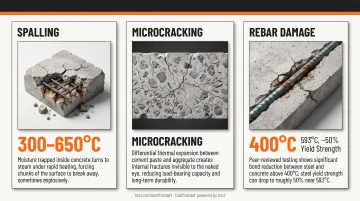
- Spalling — Moisture trapped inside concrete turns to steam under rapid heating, forcing chunks of the surface to break away — sometimes explosively. NIST documents this in the 300–650°C range. Beyond surface damage, spalling exposes the rebar below and accelerates further deterioration.
- Microcracking — Differential thermal expansion between cement paste and aggregate creates internal fractures invisible to the naked eye. These reduce both load-bearing capacity and long-term durability. A fast-moving brush fire may only heat the surface — but a house burning on top of a slab, fueled by plastics, insulation, and stored materials, drives far greater heat intensity at ground level.
- Rebar damage — Peer-reviewed testing shows significant bond reduction between steel and concrete above 400°C. ORNL reports steel yield strength can drop to roughly 50% near 593°C. When the bond weakens and the steel loses tensile strength, the entire system is compromised — regardless of what the surface looks like.
Chemical Contamination
Concrete is porous — and that creates a contamination risk many homeowners miss. LA County has warned that ash and soot from burned WUI properties can contain heavy metals, asbestos, and toxic residues from burned plastics, pipes, and building materials. These compounds can absorb into the slab surface and outgas over time — a genuine indoor air quality concern if the slab is enclosed and reused without remediation.
Signs Your Foundation Is Too Damaged to Reuse
Before any engineer arrives, certain visible indicators can tell you — and your engineer — where to focus the evaluation. None of these alone determines whether a foundation can be reused, but each one flags a condition that warrants professional assessment.
Color Changes in the Concrete
Fire-exposed concrete changes color based on temperature reached:
| Concrete Color | Approximate Temperature | Implication |
|---|---|---|
| Pink or red | 300°C – 600°C | Meaningful strength loss; evaluate thoroughly |
| Whitish gray | 600°C – 900°C | Severe damage likely; replacement probable |
| Buff/tan | 900°C – 1,000°C | Assume replacement is required |
These colors don't replace testing — they tell engineers where to focus core sampling and petrographic analysis.
Other Physical Warning Signs
- Surface spalling and chunk loss — Even moderate spalling often signals deeper internal damage — the heat that fractures the surface penetrates well into the slab
- Cracking through the slab or at the perimeter — Fire-induced cracks often follow irregular patterns and may widen as the concrete cools; they differ from the typical straight-line settling cracks in undamaged concrete
- Exposed or discolored rebar — Any visible rebar warrants immediate professional evaluation
- Destroyed anchorage hardware — Anchor bolts, moisture barriers, and embedded conduit are almost always compromised in significant fires, leaving the foundation functionally incomplete even when the concrete itself survives
- Code non-compliance — Foundations built before modern seismic and WUI requirements may not meet current California standards regardless of physical condition
For Pacific Palisades homeowners, the LADBS wildfire rebuilding page and LA County's recovery rebuilding portal are the authoritative sources for current permit and code requirements.
How Engineers Assess a Fire-Damaged Foundation
Visual inspection is a starting point, not a conclusion. The ASCE practical guide for fire-damaged concrete assessment frames this as a structured engineering process — not a visual-only decision. A licensed structural engineer must conduct formal testing before any rebuild decision is made.
The Two Primary Testing Methods
Engineers typically use two methods — sometimes a third when results are unclear:
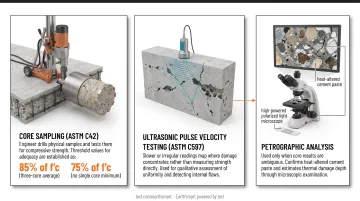
- Core sampling (ASTM C42): The engineer drills physical samples from the slab and tests them for compressive strength. ACI 318 sets the adequacy threshold at a three-core average of at least 85% of design strength (f'c), with no single core below 75% of f'c. Cores falling short signal replacement.
- Ultrasonic pulse velocity testing (ASTM C597): The test transmits sound waves through the concrete; slower or irregular readings point to internal voids, cracks, or delamination that core samples alone might miss. UPV maps where damage has concentrated rather than measuring strength directly.
- Petrographic analysis: When core results are ambiguous, engineers examine thin concrete sections under a microscope to confirm heat-altered cement paste and estimate the depth of thermal damage.
What the Engineering Report Must Include
A complete structural engineering report should document:
- Burn exposure narrative and heat indicator observations (color, spalling pattern, crack map)
- Core test results with locations mapped on a site plan
- UPV or other non-destructive testing results
- Rebar and anchorage condition assessment
- Code compliance evaluation against current California and local requirements
- A clear stamped recommendation: reuse (with defined limits), repair (with scope), or replace
This report is required by most insurers and permitting authorities before construction can begin. Keep every piece of documentation — test results, photos, permits, and inspection sign-offs — for future buyers, lenders, and insurance carriers.
When Can You Actually Rebuild on a Fire-Damaged Foundation?
Reuse is technically possible, but it's the exception rather than the rule in wildfire scenarios.
Conditions Where Reuse May Be Viable
All of the following must be true simultaneously:
- Core tests meet the ACI 318 adequacy screen (3-core average ≥85% f'c, no core <75% f'c)
- UPV and petrography don't indicate widespread internal voiding or delamination
- Rebar and embedded anchorages remain structurally adequate
- The foundation already meets current California seismic and WUI code requirements — or can be brought into compliance without major intervention
- No contamination requiring significant slab removal or surface remediation
This combination is rare in homes lost to wildfire, where sustained structural burning (not just a passing vegetation front) creates the most damaging conditions.
The Resale and Insurance Reality
Passing the engineering tests doesn't end the conversation. Future buyers, lenders, and insurers will ask for documentation — and the expectation is thorough, not partial. There's no reliable data showing automatic resale penalties, but the burden is real.
Preserve everything:
- Engineer's report and test results
- All repair records
- Permit approvals
- Final inspection certificates
The Decision in Plain Terms
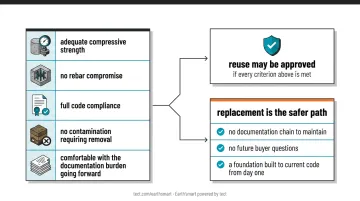
If the engineering report confirms adequate compressive strength, no rebar compromise, full code compliance, and no contamination requiring removal — and you're comfortable with the documentation burden going forward — reuse may be approved. In all other cases, replacement is the safer path. For most Pacific Palisades homeowners, replacement is also the more straightforward one: no documentation chain to maintain, no future buyer questions, and a foundation built to current code from day one.
If You're Rebuilding, Build Forward — Not Just Back
A foundation replacement isn't only a loss to recover from. It's the first decision in a sequence that determines whether the next home lasts 20 years or well past 100.
Decisions made at the foundation and framing stage lock in (or foreclose) performance options for everything above. These systems must be coordinated before a single wall goes up:
- Non-combustible exterior wall systems using pre-insulated concrete masonry
- Integrated fire suppression infrastructure
- Fresh-air and environmental control systems
- Long-life structural assemblies tied to seismic and fire performance
California's 2025 Energy Code applies to permit applications filed on or after January 1, 2026, and WUI ignition-resistance requirements for structure, envelope, and attached spaces affect every rebuilding project in fire-prone Southern California. The moment to get these decisions right is before design is finalized — not after framing begins.
Earth'smart powered by tect works with homeowners rebuilding in Pacific Palisades and surrounding high-risk WUI areas through two service paths: a fully integrated turnkey delivery that coordinates architecture, engineering, construction, and permit strategy from concept through completion; and an advisory role that works alongside existing teams to strengthen critical early decisions. Both paths connect homeowners to the earth'smart powered by tectApp™ community of 70+ building product manufacturers — so system decisions are understood, integrated, and delivered correctly from day one.
A new foundation, designed and coordinated correctly, is the beginning of a home that performs better than what stood before. That's the standard worth building to.
Frequently Asked Questions
Can you rebuild on a foundation after a fire?
Sometimes — but it requires a full structural engineering evaluation using core sampling and ultrasonic testing. In most wildfire scenarios where a structure burned on the slab, replacement is the safer and more practical outcome — concrete that looks intact can still be structurally compromised.
How soon can you rebuild after a fire?
Debris removal from the 2025 LA fires was substantially complete around six months after ignition. Engineering evaluation, insurance documentation, and permitting can begin before cleanup is fully finished — LA County confirms rebuild plans can be submitted while debris removal is still underway. Resolve foundation questions early, as uncertainty there is the most common source of schedule delays.
What things are salvageable after a fire?
In-ground utilities (if undamaged), some masonry elements, and select site infrastructure may survive. Framing, insulation, embedded systems, moisture barriers, and anchor hardware are almost always compromised. The slab itself requires professional evaluation — it cannot be assumed salvageable by appearance alone.
What tests determine if a fire-damaged foundation is safe?
Core sampling (ASTM C42) and ultrasonic pulse velocity testing (ASTM C597) are the two primary methods. Petrographic analysis is sometimes added for ambiguous cases. Only a licensed structural engineer can interpret results and issue a stamped report authorizing reuse or specifying replacement.
Does insurance cover foundation replacement after a fire?
Most standard HO-3 homeowner policies cover foundation replacement as part of a covered fire loss, subject to policy limits, exclusions, and code-upgrade provisions. Document everything — dated photos, the engineer's report, contractor estimates, and insurer communications — and review your specific policy before assuming coverage.
Will rebuilding on a fire-damaged foundation affect my home's resale value?
Even a structurally certified reused foundation may prompt questions from future buyers and lenders — similar to the scrutiny a salvage-title vehicle receives. A new foundation, paired with complete documentation of current-code compliance, generally supports stronger long-term market value and easier insurability than a certified-but-damaged original.