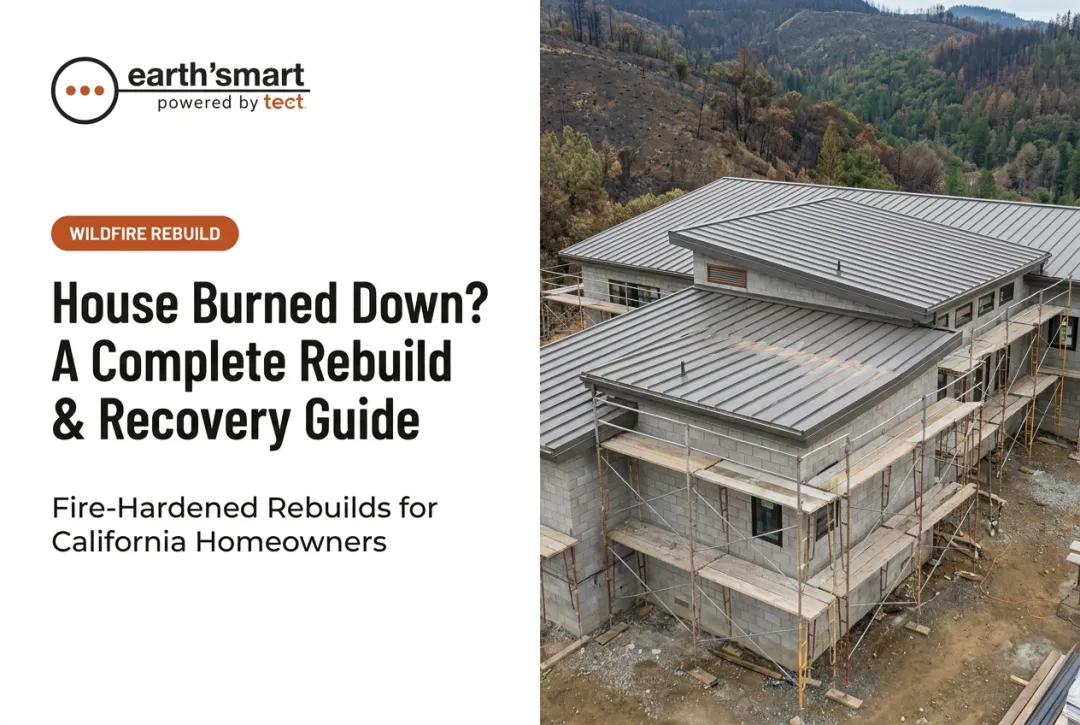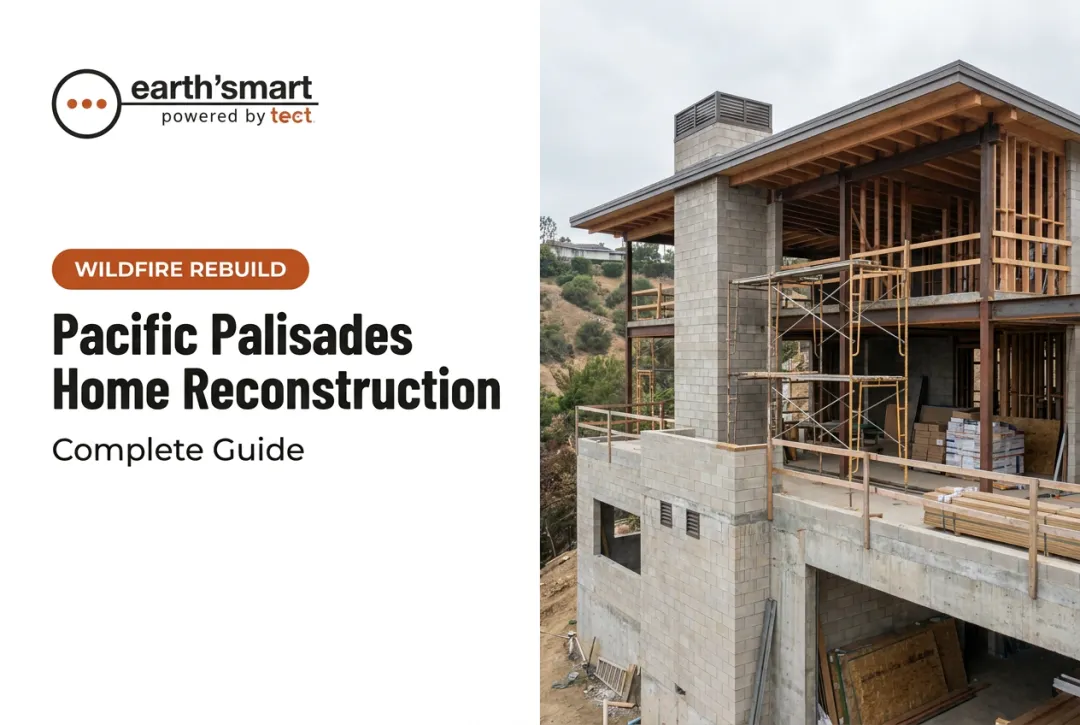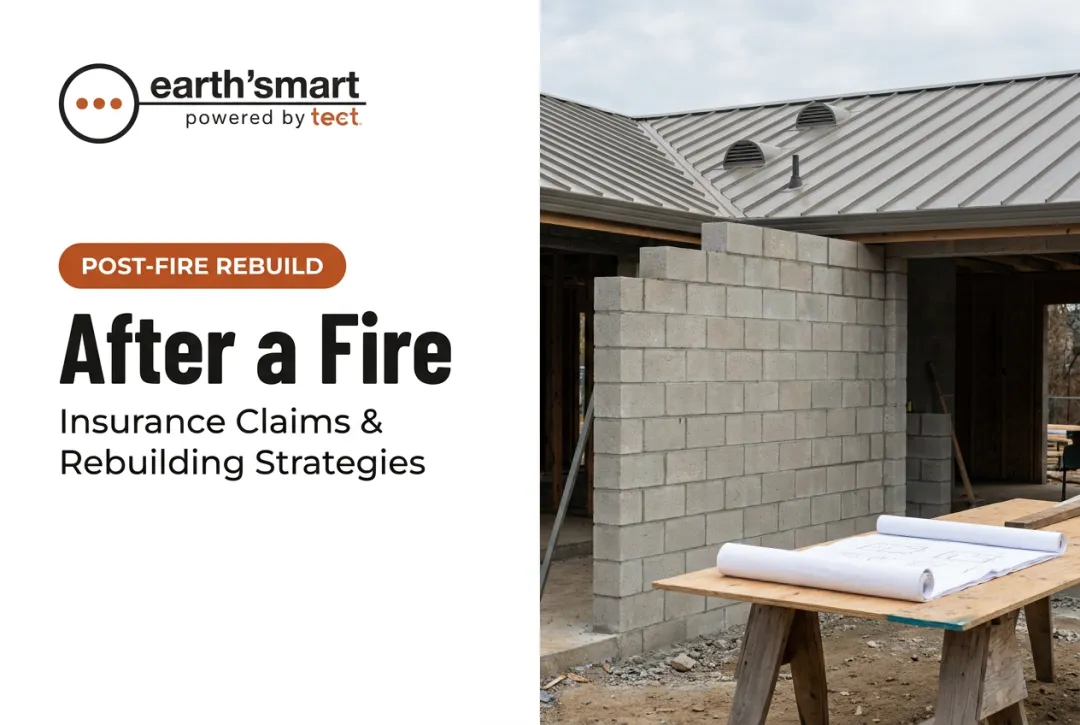
Topanga's winding roads, WUI designation, and older housing stock make this rebuild more consequential than a standard construction project. The decisions made now — on materials, systems, and who leads the work — will determine whether the next home performs better than the one that burned, or simply repeats its vulnerabilities.
This guide walks Topanga homeowners through every phase of the rebuild, from clearing the lot to making fire-resilient design choices that meet today's code and survive tomorrow's fire season.
Key Takeaways
- The Palisades Fire (Jan. 7, 2025) destroyed 33+ Topanga-area homes, plus 30+ structures at Topanga State Park and Will Rogers State Historic Park
- Rebuilding follows five distinct phases: debris clearance → insurance settlement → permitting → design → construction
- All Topanga rebuilds must comply with CBC Chapter 7A fire-resistant construction standards — no exceptions, even for pre-2008 homes
- Assemble your architect and contractor team before the lot is cleared — qualified professionals are in short supply right now
What the Palisades Fire Destroyed in Topanga Canyon
The Palisades Fire ignited on January 7, 2025 at 10:30 a.m., driven by wind gusts up to 80 mph. By the time it was contained, CAL FIRE recorded 23,448 acres burned, 6,845 structures destroyed, and 12 civilian fatalities across the broader fire zone.
In Topanga specifically, California State Parks reported more than 30 structural losses at Topanga State Park and Will Rogers State Historic Park — including the historic Topanga Ranch Motel, concessions buildings, and State Park employee residences. The fire then burned into residential areas.
The Kanji Family and the Human Reality
Topanga New Times reported in July 2025 that 33 families in the Topanga area lost their homes. Among them: Azmina and Sasha Kanji, who lost the Buddha House on Saddle Peak. Their experience — navigating under-insurance, a complex process, and an uncertain timeline — reflects what most Topanga families are facing.
Structural losses came with a second problem: road access. Topanga Canyon Boulevard (SR-27) sustained damage severe enough to require at least $38.5 million in emergency repairs. Key repair scope included:
- Removal of 35,000 cubic tons of debris
- Replacement of a 36-inch drainage pipe with an 84-inch reinforced concrete pipe
- Full structural evaluation and phased restoration
Caltrans restored daytime travel on March 4, 2026, with structural work expected to continue through summer 2026.
For a rebuild, that timeline matters directly. Restricted access affects materials delivery schedules, subcontractor availability, and overall project duration — in ways that teams without canyon experience routinely underestimate.
The Topanga Canyon Home Rebuild Timeline: Phase by Phase
Phase 1: Debris Clearance and Site Assessment
No permit application can proceed until the lot is cleared. The state ran a two-phase program:
- Phase 1 — Household hazardous waste removal by the U.S. EPA, completed February 27, 2025
- Phase 2 — Structural debris removal by the U.S. Army Corps of Engineers, covering fire debris, foundations, contaminated soil, destroyed vehicles, and hazardous trees
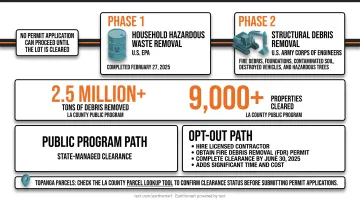
LA County removed over 2.5 million tons of debris from more than 9,000 properties through the public program. Homeowners who opted out were required to hire licensed contractors, obtain a Fire Debris Removal (FDR) permit, and complete clearance by June 30, 2025 — a path that added significant time and cost.
For Topanga parcels specifically, check the LA County parcel lookup tool to confirm clearance status before submitting permit applications.
Phase 2: Insurance Claim and Loss Documentation
Document everything before debris removal begins. Photographs, written records of finishes, appliances, structural details, and personal property all feed into your claim. Two issues trip up many homeowners:
Public adjusters vs. insurance company adjusters. The insurer's adjuster works for the insurer. A licensed public adjuster works for you. For complex losses with significant code upgrade costs — which describes most Topanga rebuilds — hiring a public adjuster is often recovered many times over in a better settlement.
"Ordinance or law" coverage. Most older Topanga homes predate California's 2008 WUI building codes. Rebuilding to current 2025 California Building Code (CBC) and Chapter 7A standards costs more than replacing the original structure.
The California Department of Insurance's Bulletin 2025-2 addressed situations where policyholders were told they wouldn't receive building-code upgrade costs because those costs hadn't yet been incurred. Review your declarations page for ordinance or law coverage and contact the CDI if your settlement doesn't reflect those costs.
Work with a licensed architect to produce a detailed scope of work before accepting any settlement — those numbers are what you negotiate from.
With insurance documentation in hand, permitting becomes your next major hurdle.
Phase 3: Permitting and Regulatory Approvals
Governor Newsom issued Executive Order N-4-25 in January 2025, directing state agencies to support faster rebuilding.
A subsequent EO (N-29-25, July 2025) created targeted streamlining: exemptions from solar panel and battery storage requirements for substantially damaged or destroyed homes, and exemptions from upcoming residential code changes.
Critical caveat: Fire-safety standards — including CBC Chapter 7A — are explicitly excluded from these exemptions. WUI compliance is not waived.
LA County's expedited review targets 10 business days for first review and 5 business days for subsequent reviews, submitted through the EPIC-LA portal. One-Stop Permit Centers are available, including Calabasas support for affected residents.
Expedited review does not eliminate standard submittals. Plans still require full permit applications and agency review — the timeline is compressed, not the requirements.
For like-for-like rebuilds (not increasing floor area, height, or footprint by more than 10%), LA County provides additional zoning-code relief. Projects that expand beyond those parameters face standard zoning review.
Insurance Claims, Permits, and Financial Recovery
When your home is gone, financial recovery starts with knowing exactly what's available — and moving fast before application windows close.
Financial Assistance Sources
| Program | What It Covers | Contact |
|---|---|---|
| FEMA Individual Assistance | Basic needs and recovery expenses (not a full insurance replacement) | 800-621-3362 or disasterassistance.gov |
| SBA Disaster Loans | Low-interest loans for homeowners to repair or replace property | 800-659-2955 or sba.gov/disaster |
| California/LA County programs | Recovery resources, debris program, permit support | recovery.lacounty.gov or 844-347-3332 |
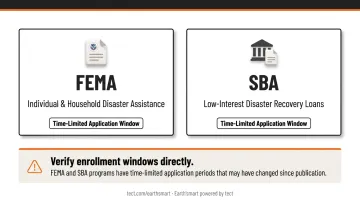
Verify enrollment windows directly — FEMA and SBA programs have time-limited application periods that may have changed since publication.
Additional Living Expense (ALE) Coverage
ALE covers temporary housing, meals, and related costs while your home is being rebuilt. Most policies cover 12–24 months, but LA County's rebuild timeline for WUI projects routinely extends beyond that window — so plan for the gap now. Track every expense (hotel receipts, rental payments, restaurant costs), because undocumented costs are routinely denied during claim review.
Contractor Fraud
After a disaster, unlicensed contractors and inflated bids flood the area. Protect yourself:
- Get at least three detailed, itemized bids
- Verify every contractor's license at CSLB's Disaster Help Center
- Never pay large upfront sums before work begins — California law limits deposits
California's Department of Consumer Affairs issued a consumer alert in January 2025 warning homeowners to confirm license numbers on CSLB after the Southern California wildfires.
Designing a Fire-Resilient Home for Topanga's WUI Conditions
The rebuild is not just a replacement. It's the only opportunity many Topanga homeowners will ever have to build a home engineered for the fire conditions the canyon actually faces — not the conditions of fifty years ago.
All new construction in Topanga's Very High Fire Hazard Severity Zone must comply with CBC Chapter 7A, which applies to permits submitted on or after July 1, 2008. Since Topanga's housing stock largely predates those standards, most families are rebuilding to code requirements their original homes never had to meet.
Key Fire-Hardening Requirements
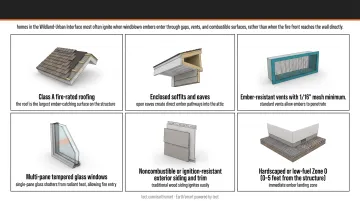
Chapter 7A addresses the primary ignition pathway: embers, not direct flame contact. WUI homes typically ignite when embers enter through gaps, vents, or combustible surfaces — not when the fire front reaches the wall. The code-required and fire-safety-recommended assemblies include:
- Class A fire-rated roofing — the roof is the largest ember-catching surface on the structure
- Enclosed soffits and eaves — open eaves create direct ember pathways into the attic
- Ember-resistant vents with 1/16" mesh minimum
- Multi-pane tempered glass windows — single-pane glass shatters from radiant heat, allowing fire entry
- Noncombustible or ignition-resistant exterior siding and trim
- Hardscaped or low-fuel Zone 0 (0–5 feet from the structure) — immediate ember landing zone
Defensible Space Requirements
California law under Public Resources Code Section 4291 requires 100 feet of defensible space around structures in fire-prone areas. The two zones:
- Zone 1 (0–30 feet): Clear combustible vegetation. No dead plant material, no wood piles against the structure, no combustible fencing attached to the home.
- Zone 2 (30–100 feet): Reduce fuel load. Thin trees, trim low branches, space shrubs to slow fire spread.
In Topanga, fuel density means this work needs active scheduling alongside — not after — the rebuild.
Building for 100+ Years, Not Code Minimum
The structural and systems decisions that separate a lasting home from a code-minimum replacement need to be made at the design stage. For Topanga, where fire, seismic, and flood exposure all apply simultaneously, that means:
- Structural systems engineered across all three hazard types, not optimized for one
- Mechanical systems and exterior envelope continuity that eliminate the penetrations where embers typically enter
- Material choices made with long-term performance in mind, not lowest initial cost
Getting these decisions right requires the full team — architect, engineer, and builder — aligned before design is locked. Retrofitting fire-resilient systems after framing is complete is expensive and structurally impossible or cost-prohibitive.
Earth'smart powered by tect, led by licensed architect Bob Habian AIA, works with Topanga homeowners through two paths: full turnkey delivery (architecture, engineering, construction, and permit strategy under one aligned team) or advisory services alongside an existing team. Both paths give homeowners direct access to the earth'smart powered by tectApp™ community of 70+ building product manufacturers, so material and system decisions are made early — with input from the experts behind those products, not under deadline pressure at the end of construction.
Reach Bob directly at (310) 913-5000 or bob@tect.com.
Choosing Your Rebuild Partner in a High-Demand Market
Demand for licensed architects, engineers, and contractors across the LA fire rebuild zone far exceeds supply. Topanga homeowners who wait to assemble their team — until the lot is cleared, or until insurance settles — face longer queues and fewer qualified options. Start interviewing while documentation is still underway.
What to Look for in a WUI Rebuild Team
Not every contractor who can build a house can build the right house in a WUI canyon. Evaluate candidates on:
- Chapter 7A experience — have they designed and permitted WUI-compliant construction in LA County, not just standard residential?
- Fire rebuild permitting familiarity — do they know the EPIC-LA portal, LA County's expedited process, and like-for-like criteria?
- Cross-discipline coordination — can they integrate structural, mechanical, and envelope decisions without each discipline working in isolation?
- Canyon logistics experience — have they priced and scheduled projects with limited road access, restricted delivery windows, and remote subcontractor availability?
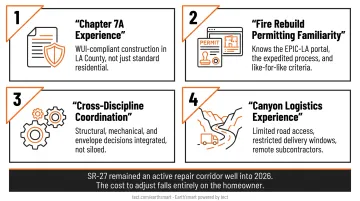
That last point matters more in Topanga than almost anywhere else in the rebuild zone. SR-27 remained an active repair corridor well into 2026.
A team without canyon experience will discover those access constraints only after committing to a schedule and budget — at which point the cost to adjust falls entirely on the homeowner. Experienced WUI canyon teams price and plan for them from day one.
The Cost of Choosing on Price Alone
In complex WUI builds, the coordination failures that come from misaligned teams often cost more to fix than they saved upfront. A lower bid from a team unfamiliar with Chapter 7A, the permit process, or canyon logistics will generate change orders, schedule overruns, and compliance gaps that a more experienced team would have caught before breaking ground.
Get at least three detailed bids — and compare scope, assumptions, and exclusions. The number that matters isn't the bottom line; it's what each team has actually priced in.
Frequently Asked Questions
Have homes burned in Topanga Canyon?
Yes. The January 2025 Palisades Fire destroyed dozens of residential structures in the Topanga Canyon area, along with more than 30 structures at Topanga State Park and Will Rogers State Historic Park. Topanga New Times reported approximately 33 Topanga-area families lost their homes in the disaster.
Are homes being rebuilt after the LA fires?
Rebuilding is underway across the LA fire zones. By late 2025, the first rebuilt home in the Palisades was complete, and construction was underway at multiple sites. Topanga and Malibu plans were being prepared and vetted as of mid-2025, with timelines varying by insurance status and design readiness.
What building codes apply to rebuilding in Topanga Canyon after a fire?
All new construction must comply with the current California Building Code, including CBC Chapter 7A fire-resistant construction standards, because Topanga is designated a Very High Fire Hazard Severity Zone. These requirements apply even to homes replacing structures that predate the 2008 WUI code — there is no grandfather exemption for rebuilds.
How long does it take to rebuild a home after a wildfire in California?
Timelines vary widely, but debris clearance, insurance settlement, design, permitting, and construction typically take 2–4 years in complex WUI areas. Homeowners who start design and team assembly early — rather than waiting for each phase to close — consistently reach completion faster.
Can I rebuild my Topanga Canyon home to be more fire-resistant than the original?
Yes, and current code requires it. The rebuild is an opportunity to engineer a home that can withstand ember storms and direct fire exposure, with assemblies and systems the original structure never had.
What financial assistance is available for Topanga Canyon wildfire victims?
Potential sources include FEMA Individual Assistance, SBA disaster loans, California and LA County recovery programs, and insurance "ordinance or law" coverage for code upgrade costs. Verify availability directly — application windows are time-limited and change frequently.