This guide breaks down realistic cost ranges by tier and location, the major cost factors unique to California, a phase-by-phase budget breakdown, and the mistakes that blow custom home budgets before a single wall goes up.
Key Takeaways
- Custom home construction in California ranges from roughly $300–$400/sq ft in lower-cost inland markets to $600–$1,000+/sq ft for coastal, luxury, or WUI fire-zone compliant builds (land and site prep not included)
- Location, design complexity, labor markets, and California-specific compliance requirements (seismic, solar, fire) are the primary cost drivers
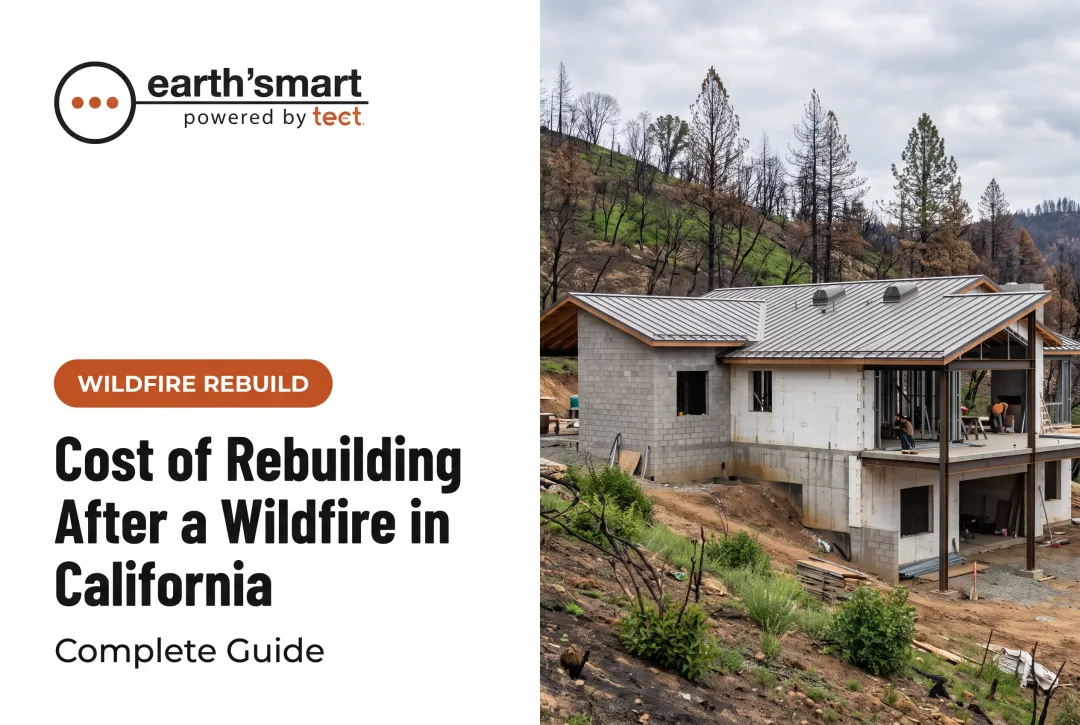
- Post-fire rebuild costs are running higher: 2025 owner estimates hit $800/sq ft in Pacific Palisades and $570/sq ft in the Altadena/Eaton fire areas
- Fragmented team assembly and late material decisions inflate final costs; integrated delivery from concept through construction is the most reliable way to control both
How Much Does It Cost to Build a Custom Home in California?
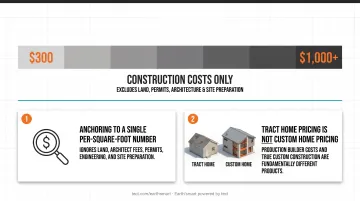
Custom home costs in California don't follow a single number. They vary based on location, size, design complexity, finish quality, and site conditions. Statewide, construction costs alone (excluding land, permits, architecture, and site work) typically range from $300 to over $1,000 per square foot depending on the tier.
Two budgeting mistakes are responsible for most of the sticker shock homeowners experience:
- Anchoring to a single per-square-foot figure without accounting for land, architect fees, permits, engineering, and site preparation
- Confusing tract home or production builder pricing with true custom home costs — these are fundamentally different products
Here's a quick reference before the full breakdown:
| Tier | Typical Markets | Cost per Sq Ft | 2,000 Sq Ft Hard Cost |
|---|---|---|---|
| Entry-Level | Sacramento, Riverside, Central Valley | $300–$400 | $600K–$800K |
| Mid-Range | LA suburbs, San Diego, Orange County | $450–$650 | $900K–$1.6M |
| High-End / WUI | Bay Area, coastal, fire zones | $700–$1,000+ | $1.4M–$2M+ |
Entry-Level Custom Build
Inland California markets — Sacramento, Riverside, the Central Valley — represent the most accessible custom build tier. Standard architectural plans, mid-grade finishes, and conventional wood framing typically put construction costs at $300–$400/sq ft. For a 2,000 sq ft home, that's $600,000–$800,000 in hard construction costs before land, permits, or fees.
This tier suits homeowners with defined budgets who prioritize function and livability over luxury finishes or architectural complexity.
Mid-Range Custom Build
Suburban markets — LA suburbs, San Diego, Orange County — drive construction costs up through higher labor rates, stricter municipal requirements, and greater design expectations. Custom architectural plans, upgraded finishes, modern systems, and full California Solar Mandate compliance push costs to $450–$650/sq ft. A 2,000–2,500 sq ft home typically runs $900,000–$1.6M in hard costs.
This is the sweet spot for families building a personalized primary residence with meaningful customization, without crossing into ultra-luxury territory.
High-End, Luxury, or WUI-Compliant Custom Build
Bay Area, coastal regions, and Wildland-Urban Interface (WUI) fire zones carry the highest construction costs — driven by premium or fire-resistant materials, complex site conditions, seismic engineering, and high-performance building systems. Luxury coastal builds generally land in the $700–$1,000+/sq ft range.
WUI rebuilds add another layer of cost. 2025 owner estimates reported in the LA Times placed rebuild costs at $800/sq ft in Pacific Palisades and $570/sq ft in the Eaton fire area — figures that reflect non-combustible materials, fire suppression systems, and hardened envelopes now considered standard in these zones.
This tier covers homeowners building in high-value or high-risk markets, those rebuilding after wildfire, and anyone prioritizing a home engineered for the next 100 years rather than the next 20.
Key Factors That Affect Custom Home Building Costs in California
California custom home costs run higher than nearly any other state — not for one reason, but for several that compound on each other: high labor rates, strict regulatory requirements, seismic engineering, and energy mandates that together add tens of thousands before a single wall goes up.
Location and Regional Labor Markets
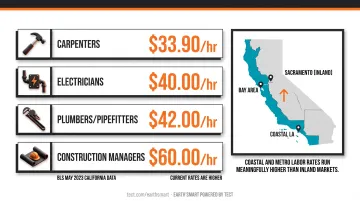
Coastal and metro areas carry significantly higher labor rates than inland markets. Skilled trades in California are among the highest-compensated in the country. BLS May 2023 data for California shows:
- Carpenters: $33.90/hr
- Electricians: $40.00/hr
- Plumbers/Pipefitters: $42.00/hr
- Construction managers: $60.00/hr
These are 2023 figures — current rates are higher. A Bay Area or coastal LA build will run meaningfully more than an inland Sacramento project, reflecting both labor market premiums and land costs that compound across every trade.
Home Size, Design Complexity, and Floor Plan Efficiency
Larger homes don't automatically cost less per square foot. What drives cost up is design complexity:
- Multi-story structures require more complex engineering
- Open spans and cantilevers demand additional structural steel
- Complex rooflines increase both framing labor and material waste
- California's seismic requirements add cost to open-concept designs through required shear walls or moment frames
A simple, efficient single-story footprint often costs less per square foot than a smaller home with architectural complexity — something many first-time custom home builders don't expect.
California-Specific Regulatory Requirements
California's regulatory environment adds costs that don't exist in most other states:
- California Solar Mandate — New single-family homes must include solar PV systems; battery-energy-storage-ready (BESS-ready) requirements apply where full battery systems aren't installed. The 2025 Energy Code applies to permit applications on or after January 1, 2026.
- Title 24 energy compliance — Requires energy modeling and documentation at permit submission
- Seismic structural engineering — Required for all new construction; adds cost particularly in open-concept or multi-story designs
- WUI/coastal fire regulations — Chapter 7A-compliant materials, setbacks, defensible space requirements, and specialized inspections
Permit fees vary widely. San Francisco's 2025 fee schedule shows plan review fees of $3,286 for the first $200,000 of project valuation, plus additional per-thousand charges — and that's before impact fees, utility connection fees, or inspection costs. Budget permit and fee costs as a distinct line item, not an afterthought.
Custom Home Cost Breakdown: Where the Money Actually Goes
The per-square-foot figure is a starting point, not a complete picture. Total project cost includes several distinct categories beyond construction.
Land Acquisition and Site Preparation
Land cost varies enormously across California — from low six figures per acre in rural inland areas to multiple millions for a coastal or view lot. Site preparation costs depend heavily on topography and prior site condition:
- Grading and excavation on sloped sites adds substantial cost over flat lots
- Utility trenching in areas without existing infrastructure
- Soil reports, geotechnical testing (required in seismic zones)
- Previously disturbed or contaminated sites carry remediation costs
Many homeowners underestimate site prep as a cost category. On a challenging lot, it can rival the cost of the foundation itself.
Architecture, Engineering, and Permitting
Expect architect fees in the range of 8–15% of construction budget for custom homes. Structural engineering for a new California custom home runs approximately $8,750–$44,000 depending on complexity. Additional line items include:
- Civil engineering
- Title 24 energy modeling
- Permit fees (which vary significantly by jurisdiction)
One decision that consistently affects both cost and timeline: whether the architecture, engineering, and permitting team is assembled as an integrated unit or hired sequentially. In fragmented projects, structural engineers inherit architectural decisions that conflict with seismic or energy code requirements — triggering expensive revisions late in the process.
Earth'smart powered by tect's Earth'smart™ approach addresses this directly, bringing licensed architect leadership, structural engineering, and manufacturer input together from concept design forward. Critical system decisions get made once, with full coordination, rather than revisited after construction documents are complete.
Construction: Structure, Systems, and Envelope
Major hard-cost categories for a California custom home:
| Category | Notes |
|---|---|
| Foundation | Type varies with site and seismic zone; slab vs. raised foundation affects cost significantly |
| Framing | Wood frame standard; steel moment frames or shear walls add cost in seismic/open-concept designs |
| Roofing | Class A required in WUI zones; metal, tile, and composite systems vary in cost and longevity |
| Exterior envelope | Siding, windows, and insulation; non-combustible assemblies required in WUI areas |
| MEP (mechanical, electrical, plumbing) | California's all-electric push and solar mandate affect system design and cost |
| Insulation and drywall | Tied to Title 24 compliance; higher-performance assemblies cost more upfront, less over time |
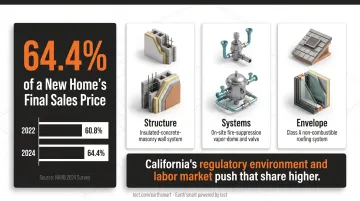
Per NAHB's 2024 survey, construction costs nationally represent 64.4% of a new home's final sales price, up from 60.8% in 2022. California's regulatory environment and labor market push that share higher.
Interior Finishes and Fixtures
Interior finishes are the most variable cost category in any custom home. A realistic range for mid-grade versus high-end finish packages:
- Mid-grade interior finish package (standard cabinetry, engineered wood floors, quartz countertops, builder-grade fixtures): $80,000–$150,000 for a 2,500 sq ft home
- High-end interior finish package (custom cabinetry, natural stone, luxury tile, designer fixtures, smart home integration): $250,000–$500,000+
Interior finishes can represent 20–30% of total construction cost, and they're also the category where costs most often creep beyond the original budget during construction.
Contingency Budget
Set aside 10–15% of total project cost as contingency. In California's construction market — with long permit timelines, seismic engineering complexity, and material price volatility — this isn't optional. Projects that skip contingency routinely hit financial trouble before the certificate of occupancy.
What Drives Costs Higher: Building in Fire Zones and High-Risk Areas
Homeowners rebuilding in WUI fire zones face cost premiums beyond standard custom home pricing. California's Chapter 7A requirements mandate specific assemblies for any new construction in designated WUI areas, including:
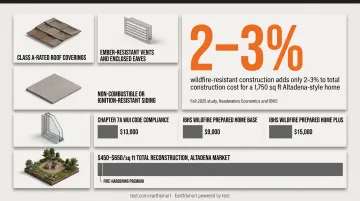
- Class A-rated roof coverings
- Ember-resistant vents and enclosed eaves
- Non-combustible or ignition-resistant siding
- Double-pane windows
- Defensible space and vegetation management
A Fall 2025 study by Headwaters Economics and IBHS found that wildfire-resistant construction adds only 2–3% to total construction cost for a 1,750 sq ft Altadena-style home. The materials premiums on an assumed $500,000 base break down as:
- Chapter 7A WUI code compliance: ~$13,000 over standard construction
- IBHS Wildfire Prepared Home Base: ~$9,000
- IBHS Wildfire Prepared Home Plus: ~$15,000
These are incremental costs, not the full rebuild figure. The same study placed total reconstruction at $450–$650/sq ft in the Altadena market.
The fire-hardening premium, in other words, is a relatively small line item. The larger cost driver is the base cost of rebuilding in high-demand WUI markets with labor shortages and complex site conditions — and that's before insurance enters the picture.
The Insurance Equation
The long-term financial case for fire-resilient construction goes beyond upfront cost. California's insurance crisis is real and worsening: a 2024 survey cited by the SF Chronicle found that 31% of California Realtors reported their most recent buyers had difficulty obtaining home insurance, and approximately 13% had a transaction fall out of escrow because a buyer couldn't find coverage at all.
Homes built to IBHS Wildfire Prepared Home and CAL FIRE Chapter 7A standards are better positioned for insurance availability and pricing. California's Department of Insurance confirms that every Safer from Wildfires action qualifies for a discount — the exact discount depends on the insurer and coverage tier.
For homeowners rebuilding in the Palisades, Malibu, East Bay Hills, or North Bay, the stakes are higher than for a standard custom build. Earth'smart powered by tect's Earth'smart™ model is designed specifically for these markets, delivering 100+ year homes built to perform across structure, systems, and envelope.
The approach integrates fire-resistive assemblies (pre-insulated concrete masonry, ICF, AAC), Class A non-combustible roofing, ember-resistant venting, vapor dome fire suppression, and dedicated on-site fire water supply from concept design forward. Full documentation packages aligned with IBHS and Chapter 7A standards support insurance placement from day one.
How to Budget Accurately (and What Most Homeowners Get Wrong)
The most common budgeting error: treating per-square-foot construction cost as the total project cost. Land, site prep, architecture, engineering, permits, and carrying costs (interest, rent during construction) routinely add 40–60% or more on top of hard construction.
Illustrative example — 2,500 sq ft mid-range custom home in suburban California:
| Cost Category | Estimated Range |
|---|---|
| Land (suburban lot) | $400,000 – $800,000 |
| Site prep and grading | $50,000 – $150,000 |
| Architecture and engineering | $100,000 – $175,000 |
| Permits and fees | $30,000 – $80,000 |
| Construction (at $500/sq ft) | $1,250,000 – $1,375,000 |
| Interior finishes | $150,000 – $300,000 |
| Contingency (12%) | $150,000 – $220,000 |
| Total estimated project cost | $2.1M – $3.0M+ |
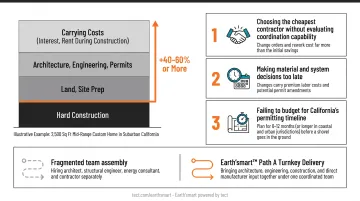
Three additional mistakes that consistently inflate final costs:
- Choosing the cheapest contractor without evaluating coordination capability — change orders and rework cost far more than the initial savings
- Making material and system decisions too late — after permits are pulled and construction has begun, changes carry premium labor costs and potential permit amendments
- Failing to budget for California's permitting timeline — plan for 6–12 months (or longer in coastal and urban jurisdictions) before a shovel goes in the ground, and budget the carrying costs accordingly
Avoiding these mistakes is half the battle. The other half is stress-testing your budget against the right variables before you commit. When evaluating your budget, consider:
- Intended location and its cost tier
- Design complexity versus floor plan efficiency
- Finish level relative to resale expectations
- Long-term operating costs (energy efficiency, material durability)
- Whether your building team is integrated from concept through construction or assembled piecemeal
That last point carries more weight than most homeowners expect. Fragmented team assembly — hiring architect, structural engineer, energy consultant, and contractor separately at different project phases — consistently produces higher final costs. Disciplines that build the home never weigh in on decisions that directly affect their work. Earth'smart powered by tect's Earth'smart™ Path A Turnkey Delivery addresses this by bringing architecture, engineering, construction, and direct manufacturer input together under one coordinated team from the start of design.
Frequently Asked Questions
What is the total cost to build a custom home in California start to finish?
All-in costs — land, site prep, architecture, engineering, permits, construction, finishes, and contingency — typically range from $1.5M to $3.5M+ for a mid-size custom home in suburban California. High-demand coastal, Bay Area, or WUI fire-zone locations push totals significantly higher, with WUI rebuilds in the Palisades area running $800/sq ft in construction alone.
Is $500,000 enough to build a house in California?
$500,000 is feasible only for a modest basic build in lower-cost inland markets (Central Valley, Inland Empire), and only if land is already owned. It will not stretch to cover land, site prep, and construction in coastal, Bay Area, or WUI fire-zone markets. Realistically, $500,000 supports roughly 1,200–1,500 sq ft of basic construction in the most favorable California markets.
How much is a 2,500 sq ft house in California?
Construction cost alone for a 2,500 sq ft custom home ranges from approximately $750,000–$1,000,000 in inland markets, $1.1M–$1.6M in suburban coastal markets, and $1.5M–$2.5M+ in luxury coastal or WUI fire zones. These figures exclude land.
How long does it take to build a custom home in California?
Total timeline from design start to move-in typically runs 18–24+ months. Permitting alone can consume 6–12 months in urban and coastal jurisdictions, with design and engineering adding several months before permit submission. Build time after permits are in hand is typically 10–14 months for a mid-size custom home.
Is it cheaper to buy or build a custom home in California?
Buying an existing home is almost always less expensive upfront. Building custom makes sense when adequate inventory doesn't exist, when specific layout or systems performance is required, or when building in a WUI zone where resilient construction standards are non-negotiable — and it gives you direct control over long-term operating costs through energy efficiency and material durability choices.
How much more does building in a fire zone or WUI area cost in California?
The materials premium for WUI-compliant fire-resistant construction is modest — roughly $13,000–$15,000 above standard construction for a 1,750 sq ft home, per the Headwaters/IBHS study. The larger cost factor is base construction cost in high-demand WUI markets, where labor shortages and site complexity drive rates to $570–$800+/sq ft. Fire-resilient homes also qualify for insurance discounts and face lower rebuild risk, a tangible financial advantage in markets where coverage is increasingly difficult to obtain.